Climate change
Receding glacier causes immense Canadian river to vanish in four days
First ever observed case of ‘river piracy’ saw the Slims river disappear as intense glacier melt suddenly diverted its flow into another watercourse
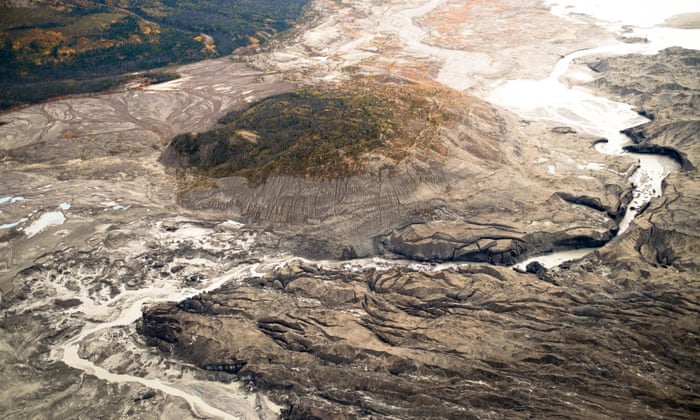
An aerial view of the ice canyon that now carries meltwater from the Kaskawulsh Glacier, seen here on the right, away from the Slims River and toward the Kaskawulsh River. Photograph: Dan Shugar/University of Washington Tacoma
Hannah Devlin Science correspondent
@hannahdev
Monday 17 April 2017 16.00 BST Last modified on Monday 17 April 2017 16.28 BST
An immense river that flowed from one of Canada’s largest glaciers vanished over the course of four days last year, scientists have reported, in an unsettling illustration of how global warming dramatically changes the world’s geography.
The abrupt and unexpected disappearance of the Slims river, which spanned up to 150 metres at its widest points, is the first observed case of “river piracy”, in which the flow of one river is suddenly diverted into another.
For hundreds of years, the Slims carried meltwater northwards from the vast Kaskawulsh glacier in Canada’s Yukon territory into the Kluane river, then into the Yukon river towards the Bering Sea. But in spring 2016, a period of intense melting of the glacier meant the drainage gradient was tipped in favour of a second river, redirecting the meltwater to the Gulf of Alaska, thousands of miles from its original destination.
The continental-scale rearrangement was documented by a team of scientists who had been monitoring the incremental retreat of the glacier for years. But on a 2016 fieldwork expedition they were confronted with a landscape that had been radically transformed.....
The rest of the story:
theguardian.com |



