Flashback 1978: Scientist Predicts 10°C Warming, 5 Meter Sea Level Rise, 660 ppm CO2…By 2028!
By Kenneth Richard on 11. May 2017
AGW ‘Disaster’ Predictions Recycled1978: 5 Meter Sea Level Rise By 2028 2015: 10 Feet Sea Level Rise By 2065 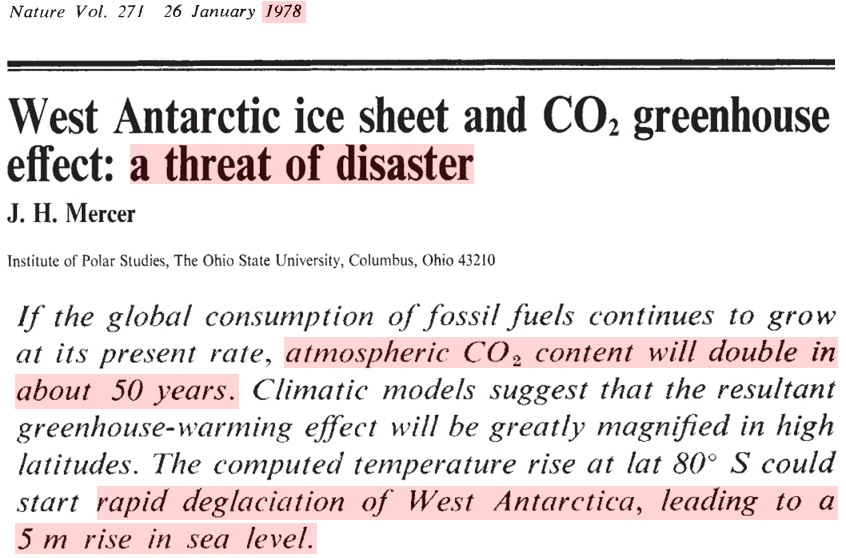
Forecasting human-caused climate disaster is anything but new.
Nearly 40 years ago, a landmark paper was published in the prestigious scientific journal Nature providing a dapper rubric for the modern human-caused climate disaster papers to follow.
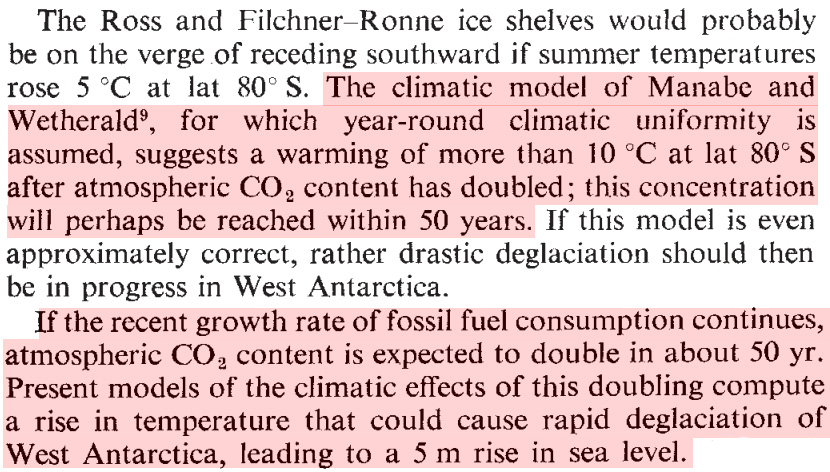
The Mercer (1978) “… a threat of disaster” paper introduced above was fraught with presumptions, guesswork, and spectacularly wrong predictions about the connections between fossil fuel consumption by humans and future carbon dioxide (CO2) parts per million (ppm) concentrations, the melting of polar ice sheets, and an impeding sea level rise disaster.
Specifically, Mercer claimed that atmospheric CO2 concentrations would double from ~330 parts per million (late 1970s) to ~660 ppm within 50 years, or by 2028 — due to a continuance of the rapid growth in fossil fuel consumption. Indeed, global-scale fossil fuel or CO2 emissions rates have increased by approximately 100% since the late 1970s, or from about 5 gigatons of carbon (GtC) per year (late 1970s) to about 10 GtC/year by 2014. And yet, despite the explosive increase in CO2 emissions, the atmospheric CO2 concentration is nowhere close to reaching 660 ppm. Instead, it currently hovers around 400 to 405 ppm. It would appear highly implausible to claim that CO2 concentrations will rise by more than 250 ppm in the next 11 years.
The Mercer paper also states that the expected temperature increase due to the doubling of CO2 concentrations would, according to climate models, yield a temperature change of +10°C for the region. This sweltering warmth could, according to advocates of human-caused climate alarm, cause a “rapid deglaciation” of the West Antarctica ice sheet that would, in turn, lead to sea level rise by about 5 meters within 50 years (2028).
As will be illustrated below, the temperatures for Antarctica as a whole have not risen since 1979. Instead, they have been flat to slightly cooling. And, of course, without the “rapid deglaciation” of the West Antarctic ice sheet, sea levels would need to rise by about 4.95 meters in the next 11 years to satisfy the “disaster” forecasts outlined by Mercer in 1978.
Today, Scientists Predict 1400 ppm CO2, 16- 30°C Warming By 2130
Dr. James Hansen, the leading climate scientist at NASA for decades and often characterized as the father of climate change awareness, has long been alarming the public with forecasts of climate doom.
Like Mercer (1978), Hansen has written that CO2 concentrations will quintuple to reach 1400 ppm just 118 years from now (2013), or by the year 2130. Humans, he writes, will burn through 10,000 GtC of fossil fuels by then. This atmospheric CO2 concentration (1400 ppm) is said to yield a warming of 16°C globally, 20°C over land, and 30°C at the poles by 2130. It is also claimed that this human-caused climate disaster will eliminate agricultural production for most of the world and otherwise make “most of the planet uninhabitable by humans”.
Hansen et al., 2013“If we assume that fossil fuel emissions increase by 3% per year, typical of the past decade and of the entire period since 1950, cumulative fossil fuel emissions will reach 10?000?Gt C in 118 years [~2130]. Are there sufficient fossil fuel reserves to yield 5000–10?000?Gt?C? Recent updates of potential reserves, including unconventional fossil fuels (such as tar sands, tar shale and hydrofracking-derived shale gas) in addition to conventional oil, gas and coal, suggest that 5×CO2 (1400?ppm) is indeed feasible.”“Our calculated global warming in this case [1400 ppm] is 16°C, with warming at the poles approximately 30°C. Calculated warming over land areas averages approximately 20°C. Such temperatures would eliminate grain production in almost all agricultural regions in the world. Increased stratospheric water vapour would diminish the stratospheric ozone layer. More ominously, global warming of that magnitude would make most of the planet uninhabitable by humans.”Modern Alarmist Forecast: Now 10 Feet Of Sea Level Rise By 2065
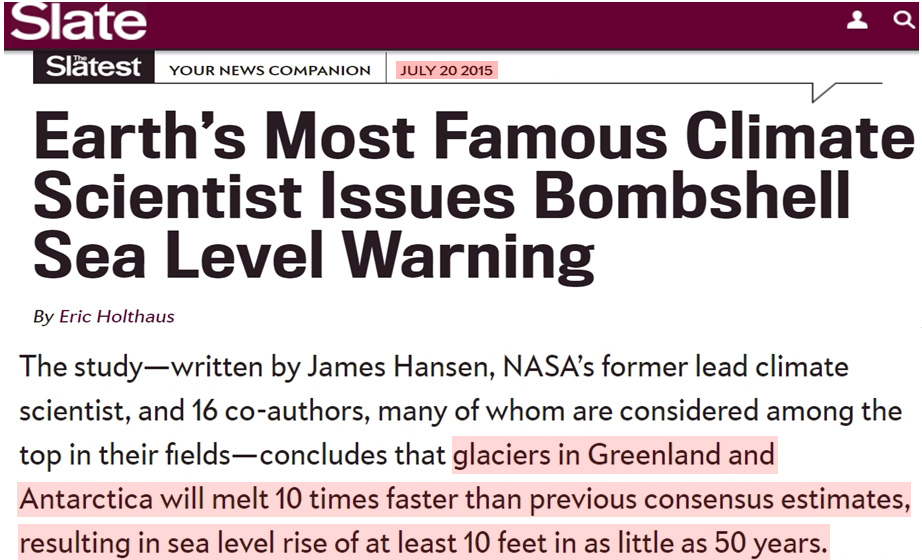
It is obvious the 660 ppm CO2 concentration, wholesale melting of West Antarctica, and 5 meters of sea level rise forecast by Mercer in 1978 has not materialized. No matter. When observations contradict projections found in climate models, modern climate scientists don’t question or modify their CO2-caused-climate-disaster assumptions. They just change the dates.
The current forecast from climate scientists is that both the Greenland and Antarctica ice sheets will melt 10 times faster than what they have been in recent decades, and this will lead to 10 feet (~3 meters) of sea level rise by about 2065.
Observations Of Negligible Mass Losses For Antarctica In Recent Decades
According to the most highly-cited analyses of polar ice sheet melt and contribution to sea level rise, the Antarctic ice sheet as a whole changed in mass by -71 gigatonnes (GT) per year between 1992 and 2011. This modest mass loss contributed just 0.2 mm/year to sea level rise over that 20 year period.
Shepherd et al., 2012“Between 1992 and 2011, the ice sheets of Greenland, East Antarctica, West Antarctica, and the Antarctic Peninsula changed in mass by –142 ± 49, +14 ± 43, –65 ± 26, and –20 ± 14 gigatonnes year-1, respectively. Since 1992, the polar ice sheets have contributed, on average, 0.59 ± 0.20 millimeter year-1 to the rate of global sea-level rise.”
To put that 0.2 mm/year sea level rise contribution from Antarctica (1992-2011) into perspective, at that pace it would take 100 years for the Antarctic ice sheet as a whole contribute 2 centimeters to sea level rise.
And more recent estimates of the Antarctic mass balance contribution to sea level rise has the East Antarctica ice sheet gaining mass at a more accelerated pace for 2003-2013 than the mere +14 Gt per year identified by Shepherd et al. (2012) for 1992-2011. For example, Martín-Español et al. (2017) find that the total mass trend for the East Antarctic Ice Sheet was a gain of +57 Gt per year during 2003-2013, which is 4 times the rate of gain assessed for 1992-2011. Effectively, this would reduce the Antarctic contribution to sea level rise to close to zero for recent decades.
Martín-Español et al., 2017“We investigate the mass balance of East Antarctica for 2003–2013 using a Bayesian statistical framework. … We apportion mass trends to SMB and ice dynamics for the EAIS, based on two different assumptions, different remote sensing data and two RCMs. In the first experiment, the model apportions about a third of the mass trend to ice dynamics, +17 Gt/yr, and two thirds, +40 Gt yr-1 to SMB, resulting in a total mass trend for the EAIS [East Antarctic Ice Sheet] of +57 ± 20 Gt yr-1.”Observations Reveal No Recent Warming In Antarctica
Antarctica has not been cooperating with the forecasts of human-caused climate disaster narrative. Within the last year, scientists have been reporting that essentially the only place on the Antarctic ice sheet where there was pronounced warming in recent decades — the West Antarctic Peninsula — has reversed course since the 21st century began. It is now cooling…rapidly. There has even been “a shift to surface mass gains” for glaciers in that region.
Turner et al., 2016“Here we use a stacked temperature record to show an absence of regional warming since the late 1990s. The annual mean temperature has decreased at a statistically significant rate, with the most rapid cooling during the Austral summer.”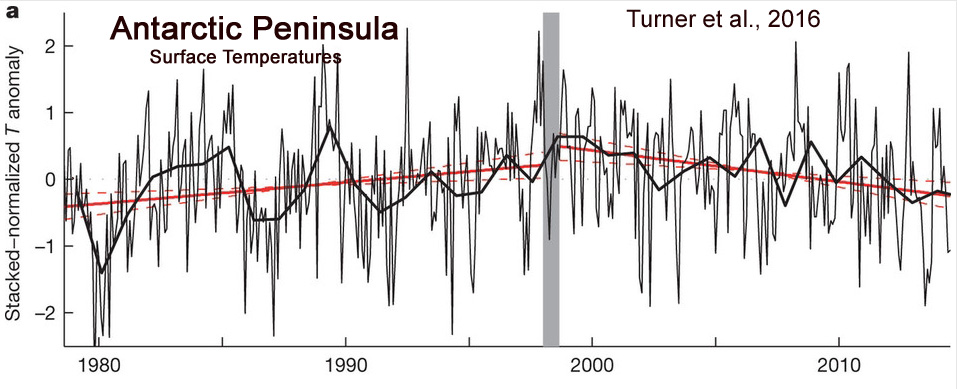
Oliva et al., 2017“However, a recent analysis (Turner et al., 2016) has shown that the regionally stacked temperature record for the last three decades has shifted from a warming trend of 0.32 °C/decade during 1979–1997 to a cooling trend of - 0.47 °C/decade during 1999–2014. … This recent cooling has already impacted the cryosphere in the northern AP [Antarctic Peninsula], including slow-down of glacier recession, a shift to surface mass gains of the peripheral glacier and a thinning of the active layer of permafrost in northern AP islands.”Another recent analysis reveals that West Antarctica — the region that Mercer maintained would rapidly melt and contribute 5 meters to sea level rise — has undergone the “strongest” long-term cooling trend of any region in the Antarctic. Furthermore, Stenni et al. (2017) conclude there has been “no continental-scale warming of Antarctic temperature” evident in the last century.
Stenni et al., 2017“A recent effort to characterize Antarctic and sub-Antarctic climate variability during the last 200 years also concluded that most of the trends observed since satellite climate monitoring began in 1979 CE cannot yet be distinguished from natural (unforced) climate variability (Jones et al., 2016), and are of the opposite sign [cooling, not warming] to those produced by most forced climate model simulations over the same post-1979 CE interval.(1) Temperatures over the Antarctic continent show an overall cooling trend during the period from 0 to 1900 CE, which appears strongest in West Antarctica, and (2) no continent-scale warming of Antarctic temperature is evident in the last century.”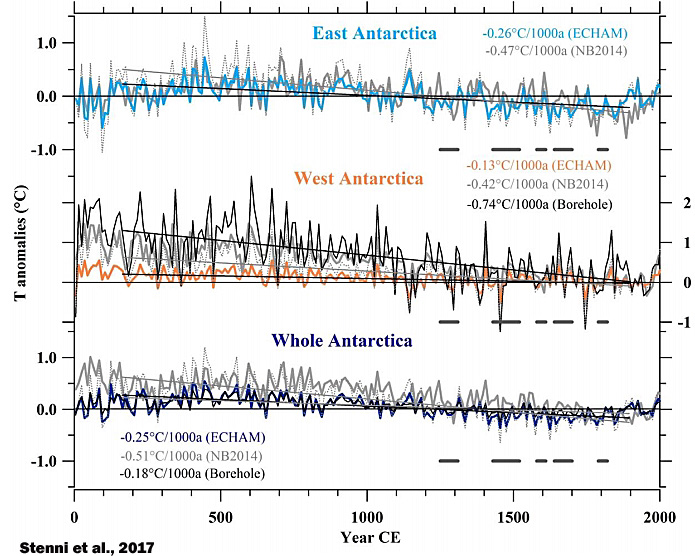
Extending the temperature record back even further, modern temperatures in West Antarctica are still some of the coldest of the last 8,000 years.
Fudge et al., 2016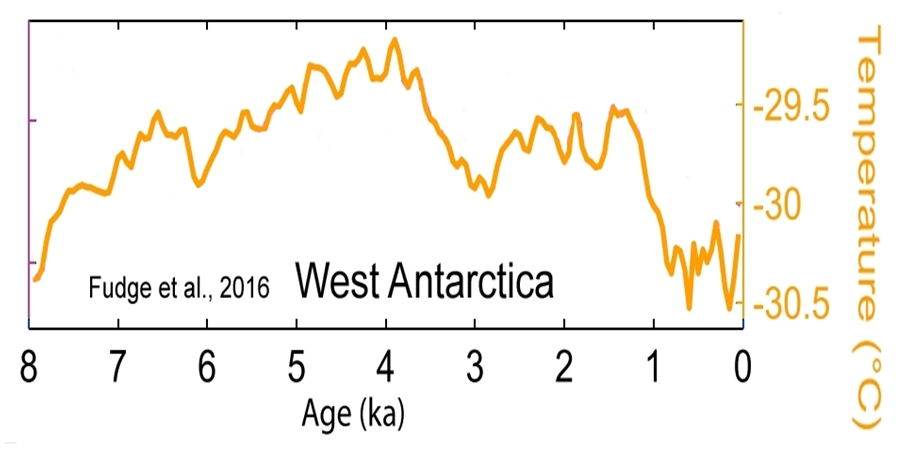
Forecasts Of Human-Caused Climate Disaster Are Non-Scientific
In science, when a hypothesis is advanced and tested using empirical evidence, and the results of the testing do not support the hypothesis, the hypothesis is then discarded.
In climate science, a hypothesis has been advanced that says a rise in human CO2 emissions will cause polar ice sheets to dramatically recede and contribute meters to sea level rise within a span of decades. This hypothesis is not supported by the observational evidence.
But instead of discarding this hypothesis and conceding that our knowledge of the factors contributing to polar ice sheet melt and sea level rise are still not fully developed, climate scientists continue to embrace their favored hypotheses anyway.
So instead of human-caused climate disaster occurring in 2028, it will now occur in 2065. Or perhaps 2100. Or 2130. Or…someday.
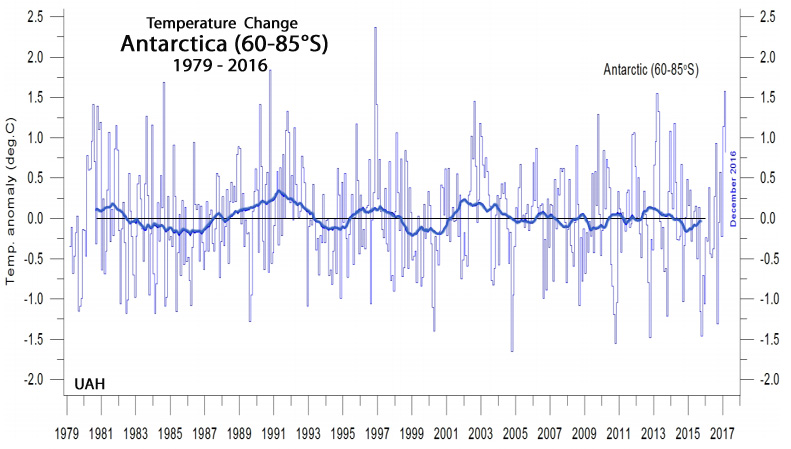
Image Source: State of the Climate, 2016
- See more at: notrickszone.com
|
|



