Hi TJ,
The Euro is hanging tough and not giving up much ground...... The USD continues on it's weakening way
the Yuan is appreciating as the PBOC is activately gunning currency speculators by really Jacking up the overnight borrowing cost of the currency.....
and Silver is displaying weak technical price and Chaikin Money Flow and Aroon patterns.
The Euro is hanging tough both on the 60 minute chart.. with the price staying above supporting Fib
price projection levels and the Chaikin Money flow and Aroon are both in bull mode on the 60
.

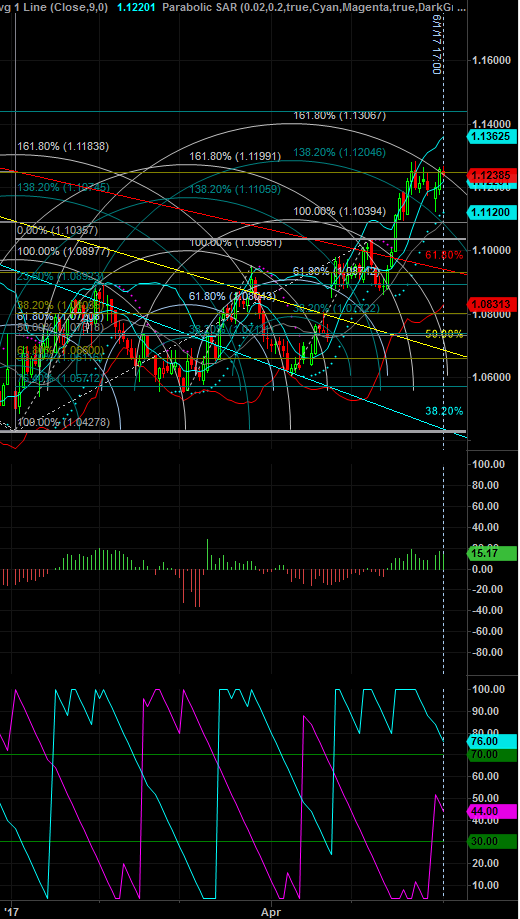
The Daily EUR has the EUR staying above an important Fibonacci price level and
staying north of the Fib Arc as you can see. The Aroon and the CMF is also in a
moderate to moderate Plus bull mode. ---- it would be equivalent to getting a
grade of B.
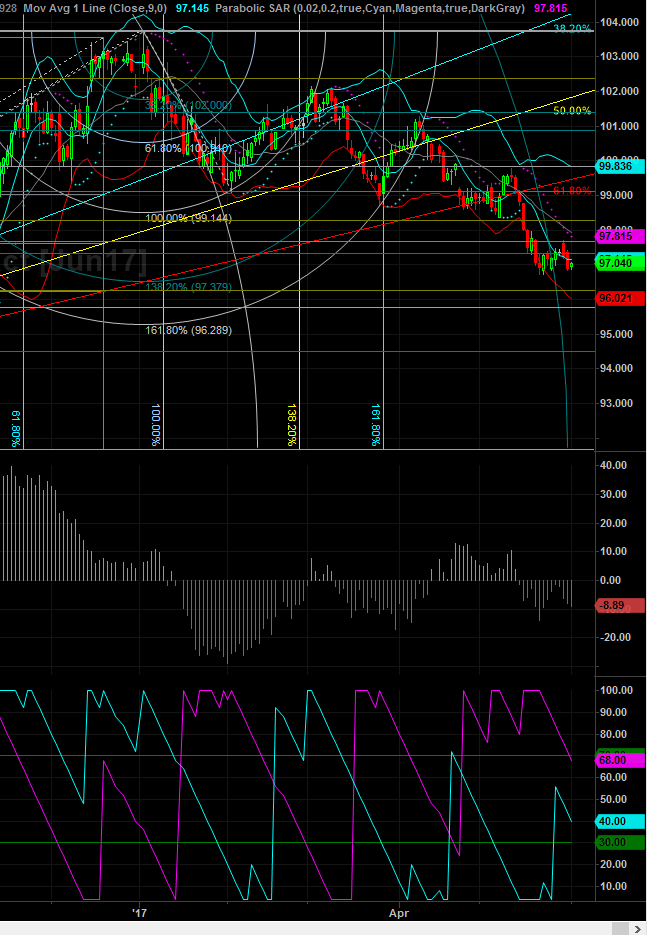
As contrasted by the Daily USD Index--- The USD has been unable to mount an kind of
serious rally and the CMF and Aroon are in Sell mode.
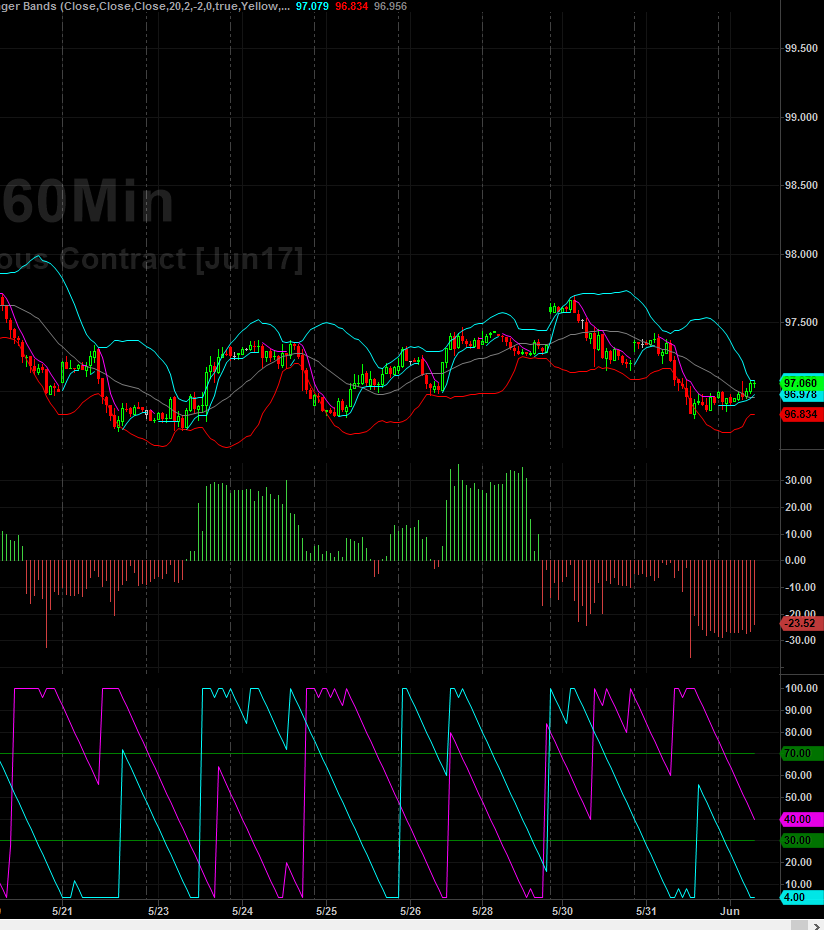
The 60 minute USD chart , confirms the daily chart
The USD had a bottom on May 23rd and embarked on a weakish sideways to upper soft little corrective series of waves... The Chaikin Money Flow index forecast the upward price more nicely and flipped back to the sell side about 9 hours prior to the price high in the USD at 3 AM ET on May 30th. and the CMT , Aroon, and the USD hitting it's upper bollinger band indicate, the probability of further weakness near term
The Chinese Yuan has strengthened significantly in the past couple of days as the increase in the Yuan has stretched the standard deviation band to 3.3 as reported on Bloomberg this morning.
-------------------------------------
Yuan Rally Doesn’t Have Far to Run
China’s central bank looks to stop resurgent capital outflows—and bets against the yuan—before they get out of hand
By
Nathaniel Taplin
Updated June 1, 2017 5:43 a.m. ET
After a sleepy start to 2017, China’s yuan is in the news again—and for the opposite reason from last year. Rather than sliding ever lower, the onshore-traded currency has gained about 1% against the U.S. dollar in the last three days, thanks in part to strong market intervention by state banks.
The yuan’s sudden surge has also come after China’s central bank last week made yet another tweak to the way it sets the midpoint for the yuan’s daily trading range—suggesting to some that Beijing may be willing its currency still higher.
In fact, investors shouldn’t expect a new yuan bull market, for which there are few fundamental reasons. Instead, the recent big moves look like warning shots across the bow of speculators considering heavy bets against the yuan, as capital outflows quietly re-emerge and the Federal Reserve strikes an unexpectedly hawkish tone. Adding to concerns about growth, Thursday’s gauge of May factory activity from Caixin also moved into contraction for the first time in nearly a year.
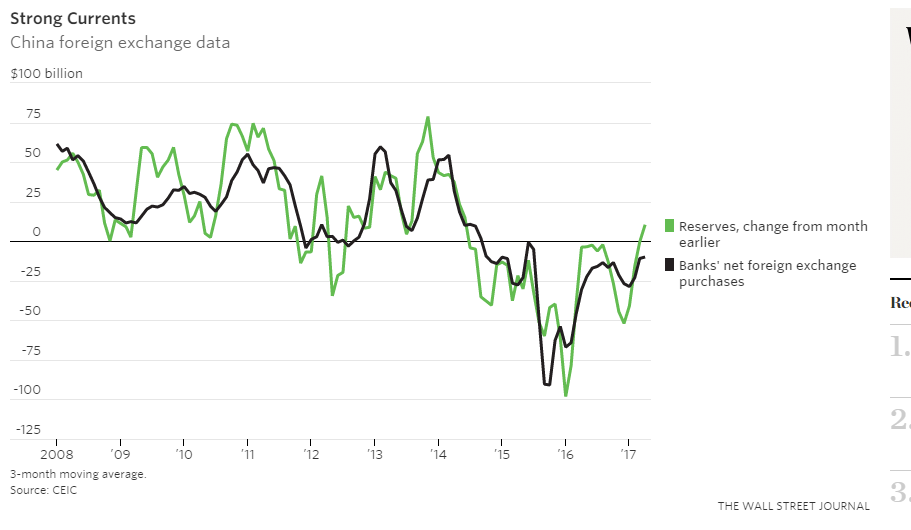
The recent apparent calm in China’s foreign currency markets—until last week the onshore-traded yuan hadn’t moved by more than 0.25 percentage point on any one day since February—masked some worrying signs. First, capital outflows rose to about $25 billion in April, up from $17 billion in March, Capital Economics’ Julian Evans-Pritchard estimates. And despite higher dollar earnings from net exports in April as the trade surplus widened, central bank foreign currency sales barely slowed, implying that overall demand for dollars strengthened. Bets on a weaker yuan have also risen: Investors speculating on the yuan in offshore forward markets started betting on sharper depreciation again in mid-May.
China’s newly fortified capital controls will likely prevent a repeat of last year’s massive capital exodus, unless growth slows far quicker than currently expected.
But with the recent Moody’s downgrade of China’s debt weighing on sentiment, capital outflows re-emerging and regulators pumping more cash into the banking system again following last month’s “war” on financial market leverage, the central bank has clearly concluded it’s better to be safe than sorry.
Sowing a little confusion about its intentions now to avoid shelling out another cool $1 trillion to support the currency must look like a price worth paying.

wsj.com
---------------------------------------------------------
China Crushes Yuan Bears, Snubs Moody's as Currency Takes Off
Bloomberg News
May 31, 2017, 10:33 AM EDT May 31, 2017, 10:27 PM EDT
China is dishing out a tough lesson to currency traders and strategists alike: don’t bet against the yuan.
The currency jumped its highest level in seven months offshore, extending Wednesday’s gain of 1.2 percent, despite analyst forecasts for declines this quarter. Surging interbank rates are squeezing bears by driving up the cost of short positions.
The rally, which broke months of calm against the dollar, comes as a rebuke to Moody’s Investors Service, which downgraded China’s sovereign debt rating last week. The government has made its displeasure clear, calling the move “absolutely groundless.” The central bank had already been tackling pessimistic traders by repeatedly strengthening the daily fixing, while an opaque change to the setting announcedFriday added to the complexity of betting on future movements.

The Moody’s downgrade and a weaker spot rate compared to the fixing could have spurred the authorities to change the fixing mechanism and potentially intervene in the market,” said Jason Daw, Singapore-based head of emerging-market currency strategy at Societe Generale SA.
The onshore yuan gained 0.4 percent to 6.7935 per dollar at 10:18 a.m. in Shanghai, after fluctuating in a narrow band around 6.9 for most of this year. The rate in Hong Kong rose 0.2 percent, taking its gain to 2.2 percent since the Moody’s rating change on May 24. The city’s overnight deposit rate touched 65 percent on Wednesday, while the spread between the offshore and onshore exchange rates reached the widest since March.
Analysts are scrambling to adjust to the shift. Credit Agricole SA scrapped a forecast of 7.25 per dollar that’s been in place since December, replacing it on Tuesday with a year-end level of 7.05. Australia & New Zealand Banking Group Ltd. strengthened their end-2017 target to 6.95 from 7.10. Credit Suisse Group AG, United Overseas Bank Ltd. and UniCredit SpA are mulling adjustments.
State RolePropping up the yuan has been a policy priority this year as Chinese authorities try to stem capital outflows and prevent financial shocks before an important leadership reshuffle in the ruling Communist Party in late 2017. The stakes have increased in recent weeks after a regulatory clampdown on leverage roiled domestic bond and equity markets.
Play Video
Yuan Asia's Best Performer After Moody's Downgrade
While the role of government intervention in the latest squeeze is unclear, people familiar with the matter have said in recent days that Chinese banks were selling dollars both offshore and onshore, while the central bank consistently set stronger reference rates in May than analysts predicted. The surge in interbank rates echoed similar moves in January of both this year and last that burned bears.
The People’s Bank of China didn’t immediately respond to faxed questions about the yuan on Wednesday.
Last Friday, the government said policy makers may add a “counter-cyclical factor” to the yuan’s daily fixing. Analysts said the change would give authorities more control over the fixing and could restrain the influence of "herd" behavior in the market.
U.S. RiskConcern over the currency being “consistently weaker” than the fixing at the end of the Chinese trading day is behind the change to the calculations, said Gao Qi, a currency strategist in Singapore at Scotiabank. He said he expects the difference between the level the yuan reaches at the end of the day and the fixing rate to narrow in future.
The central bank may also be seeking to shore up the currency before a possible interest-rate hike in the U.S, according to Fiona Lim, a senior currency analyst at Malayan Banking Bhd.
“The PBOC is probably trying to introduce more guidance into the yuan now in order to boost market confidence ahead of a prospective dollar rally,” said Lim, whose firm strengthened its year-end forecast by almost 2 percent on Wednesday. “The fixing is now less transparent and the influence of the market has been limited.”
of interest is the weak look of Silver on the Daily chart with a bearish Aroon and Chaikin Money flow
over every time period from daily, to 60 minute.... 30, 15 minute, 5 and 2 minute

the 60 minute July Silver chart
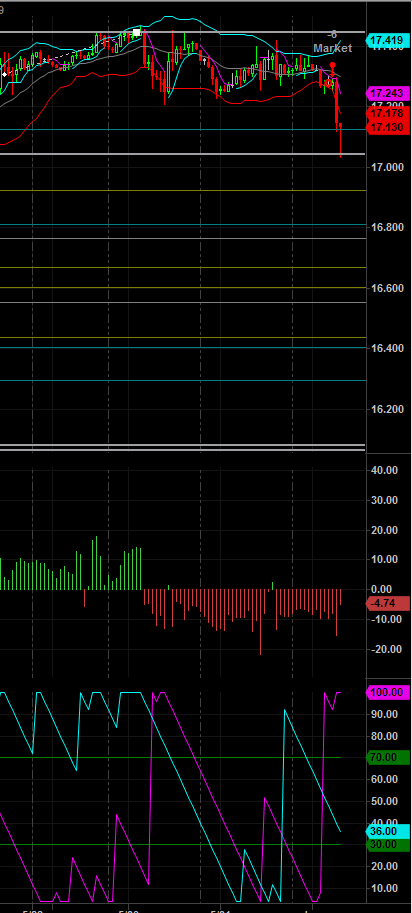
and 15 minute chart.......... the Chaikin money flow and Aroon have been in sync recently....
Gold looks a little better.

John |
| |
|



