"The entire point is that the article predates any significant interest in global warming,"
It didn't; it just pre-dated denial.
| Just at this time, however, planning was underway for an International Geophysical Year. Scientists and governments organized the IGY in response to a combination of altruistic and Cold War motives, ranging from a hope to promote international cooperation to a quest for geophysical data of military value. The project would extract a large if temporary lump of new money from the world's governments. Greenhouse gases like CO2 were too low on the list of IGY concerns to be allocated much support, but with so much money now available, a little might be spared. |
<= International | | A modest plan crystallized in meetings of experts arranged by the U.S. National Committee for the IGY in early 1956. Here two senior scientists, Roger Revelle and Hans Suess, argued the value of measuring CO2 in the ocean and air simultaneously at various points around the globe. The ultimate goal was "a clearer understanding of the probable climatic effects of the predicted great industrial production of carbon-dioxide over the next 50 years." But the immediate aim was to observe how sea water took up the gas, as just one of the many puzzles of geochemistry. The committee granted some small funds for this to Revelle. He had become interested in the question through his own research, which had been amply supported by the U.S. Navy's Office of Naval Research and other federal agencies, whose interest in the oceans was whetted by the competition with the Soviet Union. (6) |
<= Government
<= Revelle's result
<= Revelle's result
| | Revelle already had Keeling in mind for this work, and he now hired the young geochemist to come to the Scripps Institution of Oceanography and conduct the world survey. One of their aims, as Keeling recalled it, would be to "establish a reliable 'baseline' CO2level which could be checked 10 or 20 years later." To actually detect a rise of the CO2 level during the 18-month term of the IGY scarcely seemed possible. (7) Obedient to his sources of funding, Keeling scrupulously measured CO2 variations in the sea and air at various locations. But his heart went into something more fundamental, the atmospheric "baseline" value. | | | Keeling wanted to buy a new type of gas detector (namely, infrared spectrophotometers) that penned a precise and continuous record on a strip chart. Development of these instruments had begun in academia, and in the late 1930s little entrepreneurial firms took up the technology. The firms received a big boost from government orders during the Second World War, but afterward they also developed instruments for monitoring civilian industrial processes. It was wholly fortuitous that they could accurately monitor CO2 not just in a factory but in the atmosphere at large. Most of Keeling's seniors thought that such instruments were more costly than anyone needed to measure something that fluctuated so widely as atmospheric CO2 levels. Yet the IGY money pot was big enough so that when Keeling lobbied key officials, he managed to persuade them to give him funds to buy the spectrophotometers. (8) | 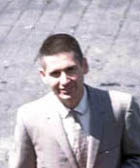 Dave Keeling,1961 Dave Keeling,1961
| | The survey's logistics, like its instruments, depended on things that happened to be available for unrelated purposes. One lynchpin would be a weather observatory built in 1956 atop the volcanic peak Mauna Loa in Hawaii. Rising above the lower atmosphere and surrounded by thousands of miles of clean ocean, it was one of the best sites on Earth to measure undisturbed air. Funding for the Mauna Loa Observatory was split between the U.S. Weather Bureau and the National Bureau of Standards. It was also reported that "The Armed Forces are keenly interested in some of the projects at Mauna Loa" thanks to concerns with high-altitude equipment and monitoring satellites. (9) The military accordingly provided help for road-building and the like. |
history.aip.org |



