The Mystery Behind OPEC's Meeting With Shale Oil Producers
Ellen R. Wald ,
CONTRIBUTOR
In the past, the U.S. has permitted coordination between oil companies for specific causes Some wonder if Barkindo and OPEC representatives are talking to U.S. shale producers to learn more about the shale business
The Secretary General of OPEC, Mohammad Barkindo, said today that the cartel he oversees, “has broken the ice in reaching out to shale producers in the U.S.” The announcement came as a surprise, since many have assumed that OPEC and shale producers are engaged in a prolonged battle in the oil market. Barkindo revealed that he and key shale oil producers met on the sidelines of this year’s World Petroleum Congress in Istanbul, Turkey.
He said the meeting was useful and productive. It is believed that the OPEC and the shale industry began talkingin March at CERAWeek, an annual energy conference in Houston. Reports are that OPEC seeks further, more serious conversations with U.S. shale producers.
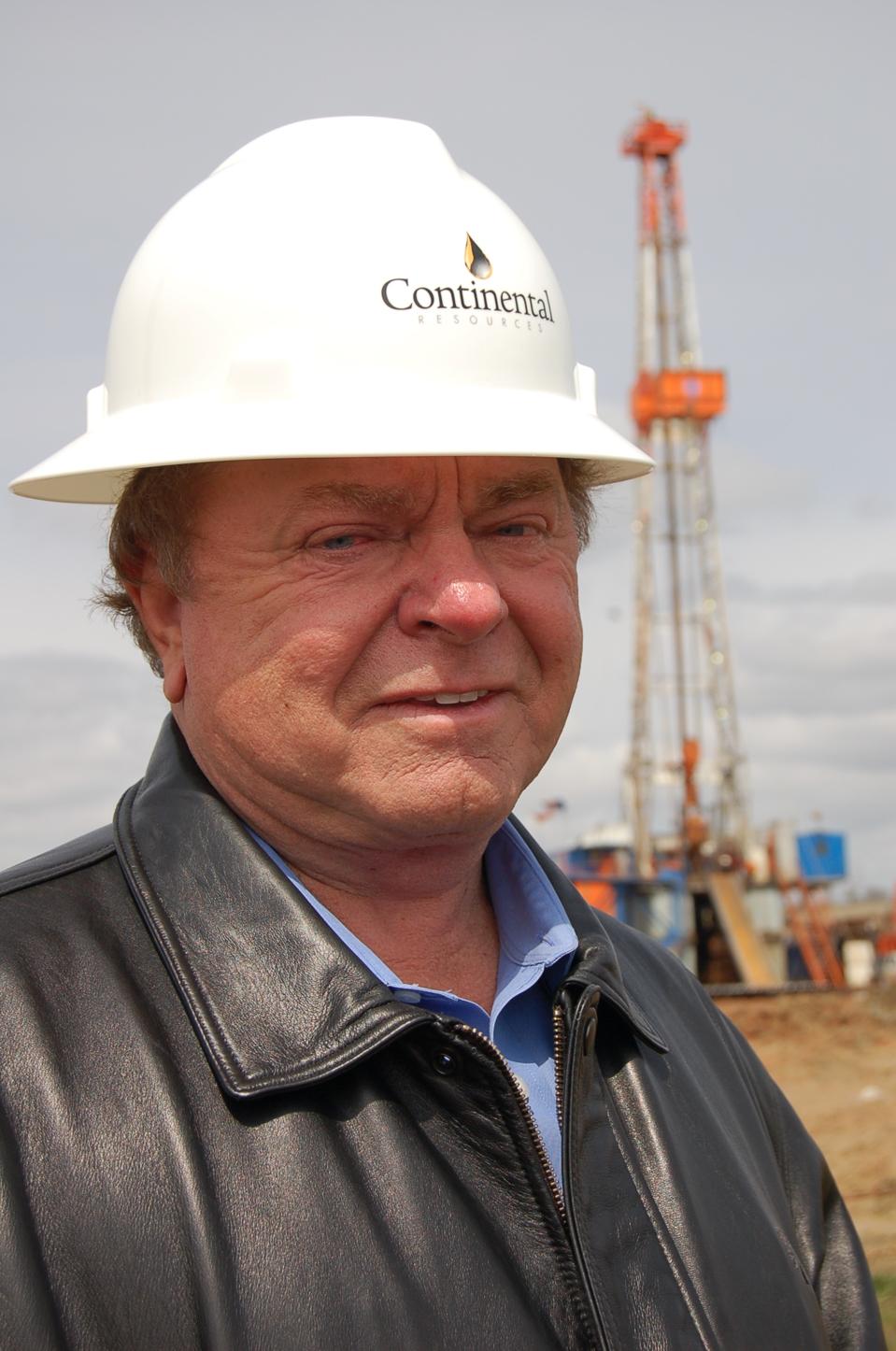
Oilman Harold Hamm poses by an oil rig near Watford City, N.D. (AP Photo/James MacPherson)
[ Howard Hamm of Coyboyistan: forbes.com
......... “I call it Cowboyistan because that's the attitude of those who have made it happen,” says Hamm, whose Continental Resources CLR +2.87%now produces 200,000 barrels of oil (and natural gas equivalents) per day. What differentiates Cowboyistan, he says, is the Three R's: Rigs, Rednecks and property Rights. “We've got more rigs running than in the rest of the world combined. We've got highly trained and reliable rednecks to run them. And unlike anywhere else on the planet, we've got property rights, which enable landowners to lease out their acreage and receive royalties for their trouble. That's what sets us apart.”
.................
If Cowboyistan can succeed in stopping and reversing its oil growth, it has the wherewithal to become the world's oil "swing producer." In a commodity business, a swing producer is an entity with the operational and financial capability to add to supply in times of scarcity and take supply away in times of glut. In the oil business, that mantle has been borne by Saudi Arabia for a generation .......... ]
Barkindo’s statements leave much mystery. First, there is no unified entity of U.S. shale producers. Individual corporations operate shale wells in the U.S. Some are small wildcatters, some are giants like Royal Dutch Shelland some are in between. They generally all belong to trade organizations such as API, but these do not set production policy. Harold Hamm, the most prominent personality in U.S. shale and the CEO of Continental Resources for 40 years, does not and cannot collude with other producers like EOG Resources , ExxonMobil , Pioneer Natural Resources or a tiny wildcatter. He may wish to collude to decrease production, but U.S. antitrust laws forbid this.
In the past, the U.S. has permitted coordination between oil companies for specific causes , such as supplying allied efforts during World War II and negotiating with OPEC over oil prices in 1973. Even if the U.S. government were to grant an exemption today for shale producers to collude along with OPEC and others (Russia, most prominently), cooperation by the large shale firms alone may not be enough control production or raise the price of oil. U.S. shale production is simply too fragmented with too much production by small firms. The small producers, in particular, are too financially precarious to decrease production; they have creditors and anxious investors on Wall Street to face. If the price of oil were to rise, small producers would be even more eager to take advantage of high prices and produce. U.S. shale producers—particularly small ones—face too much debt to abide by any production cut agreement, even if the government permitted it.
Some wonder if Barkindo and OPEC representatives are talking to U.S. shale producers to learn more about the shale business . OPEC, as an organization, wants to understand a prominent competitor. Shale is part of the reason OPEC has not been able to raise prices over the last eight months, despite production cuts. In addition, OPEC nations must be interested in partnerships with experienced shale enterprises as they look more and more and exploiting this aspect of their natural resources.
The real questions raised by Barkindo’s comments are best answered by the unknown U.S. shale producers in these meetings. Which producers are talking to OPEC? What are they discussing? Do they discuss oil production levels? Do they discuss oil prices?
And if there is collusion, they best hope it is not the U.S. Department of Justice asking these questions.
forbes.com |



