Winnie the Pooh blacklisted by China’s online censors
Social media ban for fictional bear follows comparisons with Xi Jinping
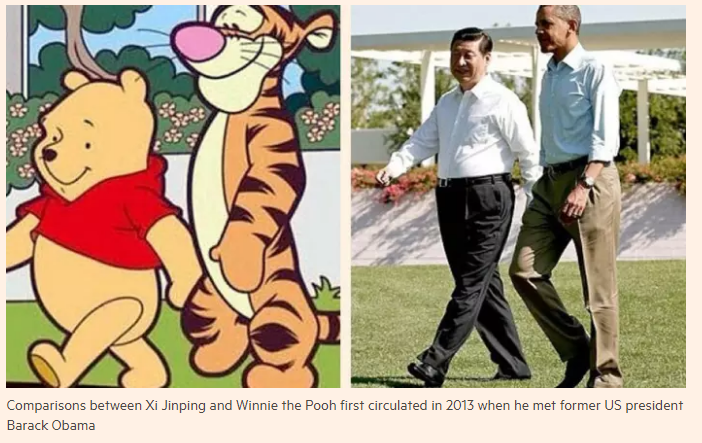
Comparisons between Xi Jinping and Winnie the Pooh first circulated in 2013 when he met former US president Barack Obama
by: Yuan Yang in Shanghai Winnie the Pooh has become too politically sensitive to be mentioned on Chinese social media. Posts including the Chinese name of the fictional bear were censored on Sina Weibo, ChinaTwitter-like platform, over the weekend, while a collection of animated gifs featuring the bear were removed from social messaging app WeChat.
While no official explanation was given, observers suggested the crackdown was related to previous comparisons of President Xi Jinping with the portly bear created by the English author AA Milne that went viral. The ban is the latest escalation of online censorship in the run-up to this autumn’s Communist party congress, where key political appointments will be announced. “Historically, two things have been not allowed: political organising and political action. But this year a third has been added to the list: talking about the president,” said Qiao Mu, assistant professor of media at Beijing Foreign Studies University. Mr Qiao said he knew of online commentators who were detained after posting remarks about the president. He added: “I think the Winnie issue is part of this trend.” Attempts to post the Chinese characters for Winnie’s name on Weibo returned the message “content is illegal”, although some users appeared able to circumvent the block. Banned words are often added to censors’ blacklists during big political events, but these are usually directly related. Recent restrictions on online freedom have alarmed business. Last week multinationals were disconcerted after reports circulated that the government was to fully block the VPN services that make it possible to access Google and other platforms commonly used by foreign companies. The government later refuted the reports. Chinese social media is rich with euphemisms and jokes used to bypass the censors. Comparisons between Mr Xi and Winnie the Pooh first circulated in 2013 during Mr Xi’s visit with then US president Barack Obama. A photo of the taller and thinner Mr Obama walking with Mr Xi was combined with a picture of Winnie the Pooh and his lanky friend Tigger, and the comparison stuck. In 2014, the comparison was extended to Mr Xi’s meeting with Japan’s prime minister Shinzo Abe, who was pictured as Eeyore, the sad donkey, alongside the bear. A photo of Mr Xi standing up through the roof of a parade car, next to a picture of Winnie the Pooh in a toy car, was named the “most censored image of 2015” by political consultancy Global Risk Insights. The humour has been lost on China’s government, which is wary of any discussion of its leadership in the run-up to this autumn’s 19th National Congress of the Communist party. The once-in-five-years event will bring a potentially tricky handover of power at the top of the party. The political tightening this time is more severe than in previous congresses, one retired senior party official told the Financial Times, pointing out that a recent party meeting was convened to “ensure a smooth and stable congress” — a measure the official said had not been seen as necessary before previous congresses. Heavy online censorship has been a feature of the past week, with the letters “RIP” blocked from Weibo following the death of Liu Xiaobo, the Chinese dissident and Nobel Peace Prize winner. Sina Weibo did not respond to a request for comment. |



