With a shrieking death-cackle the Trump administration and Turkey announced tit-for-tat travel restrictions - A sign of a deteriorating alliance
The increasingly strained alliance between Turkey and the United States took a sharp downward turn Sunday when both governments abruptly announced they were canceling most visitor visas between the countries, sowing confusion among travelers and exposing a widening rift between the NATO partners. The crisis began when the U.S. Embassy in Ankara, the Turkish capital, announced it was immediately suspending all nonimmigrant visa services at diplomatic facilities across Turkey. The move appeared to be retaliatory, coming days after the government of President Recep Tayyip Erdogan arrested an employee of the U.S. Consulate in Istanbul.
Turkey's President Recep Tayyip Erdogan in New York firmly grabs Trump's hand, hoping to prevent Trump from squeezing his crotch again
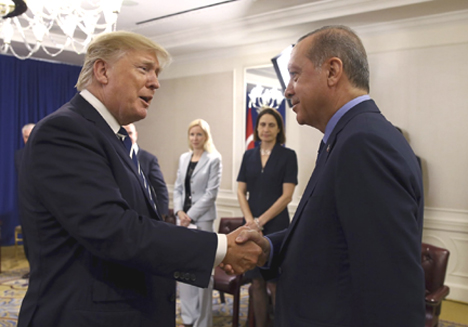 An embassy statement said it was limiting visitors to U.S. missions while it “reassesses” Turkey’s commitment to the security of American personnel — an extraordinary rebuke that underscored a rapidly deteriorating relationship between the longtime allies. Within hours, the Turkish Embassy in Washington released a nearly identical statement announcing its own suspension of nonimmigrant visas for Americans. An embassy statement said it was limiting visitors to U.S. missions while it “reassesses” Turkey’s commitment to the security of American personnel — an extraordinary rebuke that underscored a rapidly deteriorating relationship between the longtime allies. Within hours, the Turkish Embassy in Washington released a nearly identical statement announcing its own suspension of nonimmigrant visas for Americans.
The tit-for-tat moves illustrated how the critical alliance between Turkey and the United States, anchored in military, intelligence and commercial ties, has been battered in recent months by a series of deep disagreements over the war in Syria and the fate of Fethullah Gulen, a Turkish cleric who lives in exile in Pennsylvania and is wanted by the Turkish authorities.
The strains have undermined vows by President Trump to repair U.S. ties to Turkey, which became frayed during the administration of President Barack Obama. The escalating tensions also came despite what are said to be warm personal relations between Erdogan and Trump that stretch back several years.
Turkey, which once enthusiastically pursued membership in the European Union, has also become estranged from European countries, particularly Germany.
After the arrest last week of the U.S. consulate employee, Metin Topuz, strains between the two governments burst into the open.
Turkish authorities accused Topuz of espionage and links to Gulen, the exiled cleric. The U.S. Embassy, in a statement, responded by saying that it was “deeply disturbed” by the arrest and that the charges were “without merit.”
In a meeting with Turkish journalists, John Bass, the outgoing ambassador to Turkey, said the arrest of Topuz, “does not strike me as pursuing justice. It seems to me more a pursuit of vengeance.”
Tensions between the two countries started almost as soon as Trump took office, when his administration, setting aside Turkish objections, elected to partner with a Kurdish-dominated force in the fight against the Islamic State militant group in Syria. The Syrian Kurds are aligned with Turkey’s Kurdistan Workers’ Party, or PKK, which is considered a terrorist group by both Turkey and the United States.
Turkey has also forcefully demanded the extradition of Gulen, whom it accuses of masterminding a failed attempt to topple the Turkish government in July 2016. And Turkish officials have tried to win the release of Reza Zarrab, a Turkish-Iranian gold trader who is facing charges in the United States of evading sanctions on Iran.
Last month, U.S. federal prosecutors indicted a former Turkish minister of the economy for allegedly conspiring with Zarrab to skirt the sanctions. Erdogan called the case “a step against the Turkish Republic.”
And this summer, Erdogan’s bodyguards were accused of beating protesters outside the Turkish ambassador’s residence in Washington.
At home, Turkey has pursued a broad crackdown on suspects in the failed coup, while also arresting scores of academics, journalists, political opponents and ordinary critics of the government. They have included several U.S. citizens, including Andrew Brunson, a pastor from North Carolina who has been detained since last October.
Erdogan referred to Brunson in a recent speech in which he chided the Trump administration and suggested that the detained American was a bargaining chip in Turkey’s dispute with the United States.
“Give us that pastor,” Erdogan said, referring to Gulen, “and we will do what we can in the judiciary to give you this one.”
The halting of visas between the two countries represented an unusually perilous turn in the relationship, analysts said, while affecting untold numbers of travelers, including tourists, business executives, students and others. “I think the whole thing could go off its wheels,” said Soner Cagaptay, the author of “The New Sultan,” a book about Erdogan. “There is a very, very deep trust deficit in bilateral ties, especially as far as Erdogan is concerned.”
Cagaptay cited Turkey’s recent decision to buy a surface-to-air missile defense system from Russia as evidence of Erdogan’s growing suspicion of the United States and of NATO — to the point where Turkey was openly buying weapons to defend itself against the West.
“He does not trust the U.S. at all,” Cagaptay said. |



