The "Russian Influence" Group Mueller Indicted Is Just a Group of Commercial Marketing Scheme Operatives
Yesterday, I wrote:
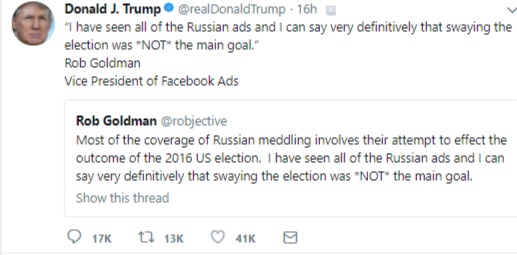
[M]y suspicion is that the indictment is misleading. I suspect this group was in operation for reasons having nothing to do with politics. Politics just happened to be a hot topic when they were operating. Perhaps they were operating website click farms, that is, generating content to get ad clicks. This is just speculation on my part but it appears to fit the facts best. Some great work by Moon of Alabama shows that the Russians indicted were, indeed, nothing but workers at a click bait farm.
Robert Mueller has to know this. His indictment based on "Russian attempts at influencing the election" is a lie.
This proves more than anything that the investigation is simply a Deep State battle between the intelligence community, MSM and parts of the FBI versus the military/Trump wing and that Mueller's side will do anything to win.
I don't mine internal battles between Deep State operatives. This results in less time for them to harass us but know this is what is really going on.
- RW
Here's Moon of Alabama:
Mueller Indictment - The "Russian Influence" Is A Commercial Marketing Scheme
Yesterday the U.S. Justice Department indicted the Russian Internet Research Agency on some dubious legal grounds. It covers thirteen Russian people and three Russian legal entities. The main count of the indictment is an alleged "Conspiracy to Defraud the United States".
The published indictment gives support to our long held believe that there was no "Russian influence" campaign during the U.S. election. What is described and denounced as such was instead a commercial marketing scheme which ran click-bait websites to generate advertisement revenue and created online crowds around virtual persona to promote whatever its commercial customers wanted to promote. The size of the operation was tiny when compared to the hundreds of millions in campaign expenditures. It had no influence on the election outcome.
The indictment is fodder for the public to prove that the Mueller investigation is "doing something". It distracts from further questioning the origin of the Steele dossier. It is full of unproven assertions and assumptions. It is a sham in that
none of the Russian persons or companies indicted will ever come in front of a U.S. court. That is bad because the indictment is build on the theory of a new crime which, unless a court throws it out, can be used to incriminate other people in other cases and might even apply to this blog. The later part of this post will refer to that.
In the early 1990s some dude in St.Petersburg made a good business selling hot dogs. He then opened a colorful restaurant. He invited local celebrities and politicians to gain notoriety while serving cheap food for too high prices. It was a good business. A few years later he moved to Moscow and gained contracts to cater to schools and to the military. The food he served was still substandard.
But catering bad food as school lunches gave him, by chance, the idea for a new business:
Parents were soon up in arms. Their children wouldn’t eat the food, saying it smelled rotten.As the bad publicity mounted, Mr. Prigozhin’s company, Concord Catering, launched a counterattack, a former colleague said. He hired young men and women to overwhelm the internet with comments and blog posts praising the food and dismissing the parents’ protests.
“In five minutes, pages were drowning in comments,” said Andrei Ilin, whose website serves as a discussion board about public schools. “And all the trolls were supporting Concord.”
The trick worked beyond expectations. Prigozhin had found a new business. He hired some IT staff and low paid temps to populate various message boards, social networks and the general internet with whatever his customers asked him for.
You have a bad online reputation? Prigozhin can help. His internet company will fill the net with positive stories and remarks about you. Your old and bad reputation will be drowned by the new and good one. Want to promote a product or service? Prigozhin's online marketeers can address the right crowds.
To achieve those results the few temps who worked on such projects needed to multiply their online personalities. It is better to have fifty people vouch for you online than just five. No one cares if these are real people or just virtual ones. The internet makes it easy to create such sock-puppets. The virtual crowd can then be used to push personalities, products or political opinions. Such schemes are nothing new or special. Every decent "western" public relations and marketing company will offer a similar service and has done so for years.
While it is relatively easy to have sock-puppets swamp the comment threads of such sites as this blog, it is more difficult to have a real effect on social networks. These depend on multiplier effects. To gain many real "likes", "re-tweets" or "followers" an online persona needs a certain history and reputation. Real people need to feel attached to it. It takes some time and effort to build such a multiplier personality, be it real or virtual.
At some point Prigozhin, or whoever by then owned the internet marketing company, decided to expand into the lucrative English speaking market. This would require to build many English language online persona and to give those some history and time to gain crowds of followers and a credible reputation. The company sent a few of its staff to the U.S. to gain some impressions, pictures and experience of the surroundings. They would later use these to impersonate as U.S. locals. It was a medium size, long-term investment of maybe a hundred-thousand bucks over two or three years.
The U.S. election provided an excellent environment to build reputable online persona with large followings of people with discriminable mindsets. The political affinity was not important. The personalities only had to be very engaged and stick to their issue - be it left or right or whatever. The sole point was to gain as many followers as possible who could be segmented along social-political lines and marketed to the companies customers.
Again - there is nothing new to this. It is something hundreds, if not thousands of companies are doing as their daily business. The Russian company hoped to enter the business with a cost advantage. Even its mid-ranking managers were paid as little as $1,200 per month. The students and other temporary workers who would 'work' the virtual personas as puppeteers would earn even less. Any U.S. company in a similar business would have higher costs.
In parallel to building virtual online persona the company also built some click-bait websites and groups and promoted these through mini Facebook advertisements. These were the "Russian influence ads" on Facebook the U.S. media were so enraged about.
Read the rest here. |




