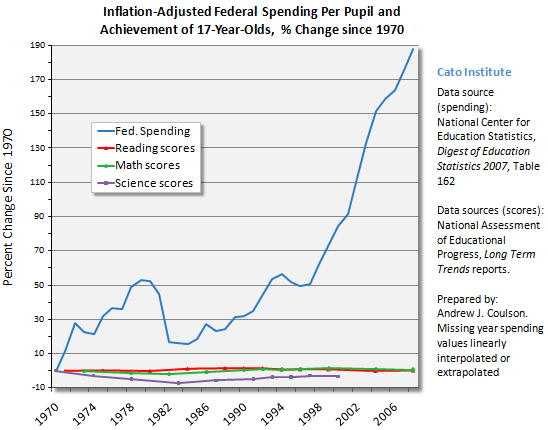
I already shown you the evidence in the past. Its not up to date data, it (the first graph, some of the other data is newer) was posted in 2009 so it says nothing about trends since then, but its not like education spending has fallen off a cliff in those years. Its generally still gone up even if the rate has slowed.
------------
cato.org
Related -
"The US spends the most per student of any nation in the developed world: $15,171 per student in 2011. The average in the Organization for Economic Co-operation and Development was just $9,313."
vox.com
Taxpayers already provide record-setting funding. The Department of Education says last year’s record was $13,237 per-pupil and they say it will jump to $13,647 this year with the first of a two-year phase-in of $293 million more in state aid. The State Board of Education wants another $600 million but the schools’ lawyers want at least $1.4 billion more; on top of additional funding already pledged for FY 2019, their demands would take funding to $15,113 and $16,800 respectively. The final numbers would likely be even higher, as more money spent on personnel would increase KPERS pension funding.
kansaspolicy.org
educationnext.org
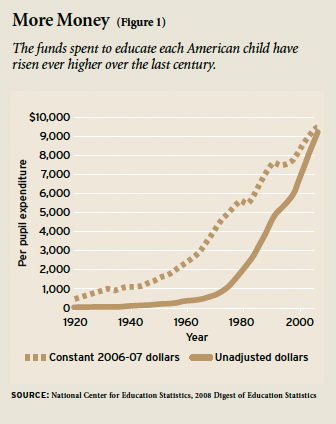
Between 1985 and 2008, for instance, real (after-inflation) per-pupil spending increased by roughly 70 percent, from about $7,000 to nearly $12,000 (all figures are in 2017 dollars). ...
...states continued a two-decade trend of adding adults – especially non-teachers – much more rapidly than they added students. Public schools responded to a 19 percent increase in enrollment between 1992 and 2014 by growing their teaching force by 28 percent – and adding to their non-teaching and administrative ranks at a 45 percent clip – or more than twice the rate at which they added students. California, for instance, responded to a 24 percent enrollment increase by growing non-teaching staff by 48 percent – or twice the rate of enrollment growth. Illinois offers a similar story: An 11 percent increase in students yielded a 20 percent increase in teachers and a 49 percent increase in non-teaching staff.
aei.org
Here are the key findings from an OECD study, as reported by the AP.
The United States spends more than other developed nations on its students’ education each year… Despite the spending, U.S. students still trail their rivals on international tests. …brand-new and experienced teachers alike in the United States out-earn most of their counterparts around the globe.
Now let’s look at some of the grim details.
…the United States spent $15,171 on each young person in the system — more than any other nation covered in the report. That sum inched past some developed countries and far surpassed others. Switzerland’s total spending per student was $14,922… The average OECD nation spent $9,313 per young person. …The United States routinely trails its rival countries in performances on international exams despite being among the heaviest spenders on education. U.S. fourth-graders are 11th in the world in math in the Trends in International Mathematics and Science Study, a separate measure of nations against each other. U.S. eighth-graders ranked ninth in math, according to those 2011 results. The Program for International Student Assessment measurement found the United States ranked 31st in math literacy among 15-year-old students and below the international average. The same 2009 tests found the United States ranked 23rd in science among the same students, but posting an average score. …The average first-year high school teacher in the United States earns about $38,000. OECD nations pay their comparable educators just more than $31,000. …The average high school teacher in the United States earns about $53,000, well above the average of $45,500 among all OECD nations.
Here’s the chart from the OECD study showing per-student spending.

So we spend more, pay more to our bureaucrats, yet we get worse results. Not exactly a ringing endorsement of the education monopoly.
danieljmitchell.wordpress.com
D.C. Public Schools Spend Almost $30,000 Per Student
blog.heritage.org |




