Climate Science Denial Explained: The Denial Personality
Posted on 24 April 2018 by DPiepgrass
Continued from Part 2
When it comes to pseudo-skeptic behavior and motives, I'm no expert, but I'd like to share my sense of the kinds of behavior they use based on my debates with them. I'm sure frequent readers of SkS have their own impressions and I'd be interested in hearing about them.
They come in many flavors, but they tend to have some attributes in common. The core characteristic I noticed in debates was this: they will not engage with facts they don’t like.
If you make a weak argument (or if they misunderstand your argument), they will attack it relentlessly. But if you make a clear case that their reasoning is fallacious, or give them data they can't explain away, they will not engage. They simply ignore it, as though you had said nothing at all. Instead they will change the subject. I suppose how it works is, their brains contain a mental model in the form of a network of interconnected facts, myths and fallacies. They can let go of one or two fallacies temporarily, because the network has many more myths ready to compensate for the loss of one or two. But if you get too close to demolishing their core belief, they must ignore you to protect it, ?like a Doctor Who perception filter.
Perhaps the key is that learning takes energy and deliberate effort, while ignoring is easy. If they make an effort to understand what you're saying, they risk overturning their own beliefs. Why should they bother? Their goal is to convince you, not to let you convince them. So they ignore you and push their narrative. If you do debate a pseudo-skeptic (and you shouldn’t until you spend some time studying the science and the myths), you’ll have to watch closely for the key arguments they have ignored, call them out on those, and spend little or no effort on the other points. It’s probably a bad habit that I tend to spend a lot of time doing research and write long responses; the longer it is, the easier it becomes to ignore you. Don’t waste your time. (Peter Hadfield suggests an easier approach, have a look.)
Here are some other characteristics I noticed:
They probably know more about climate science than you do, having learned from denial books or web sites. But they typically know less than I do, and far less than any climate scientist. Perhaps their greater knowledge?—?compared to random strangers on the internet?—?convinces them they know better than the experts.They virtually never admit that they got anything wrong, not even little things. (If you spot someone admitting they were wrong about something, congrats! You may have stumbled upon a real skeptic!)They tend to have a poor mental model of how the climate system works. After all, they are taught “models can’t be trusted,” even though all science is built on models of some sort. Instead they learn a list of stories, ideas and myths, and they debate mainly by repeating items on their list.All political stripes can believe climate science, but vocal pseudo-skeptics are usually conservatives.They think they are “scientific”. Some of them have an remarkable ability to sound sciencey.They lack self-awareness. You’ll never hear them say “Okay, I know this might sound crazy, but those thousands of climate scientists are all wrong. I can’t blame you for agreeing with a supermajority, but if you’ll just hear me out, I will explain how I, a non-scientist, can be certain the contrarians are right. Just let me know if I’ve made some mistake in my reasoning here...” Schoolyard irony may be an important defense mechanism. They take accusations often used against them, and toss them at detractors. They’ll say you’re in a “cult” or “religion” for believing humans cause warming, that you lie, fudge data, are “closed-minded”, etc. One guy called me a “denier” (in denial that it’s all a hoax) even though I had not called him a denier. In general you can expect attacks on your character even if you were careful not to attack them, yet these attacks will seem like plausible descriptions of the attacker. Similarly, they may dismiss talk of the scientific literature or consensus as “appeals to authority”, apparently oblivious to the authorities (Rush Limbaugh, Roy Spencer, and many others) upon which their own opinion is based. Last but not least, they’ll complain of “politicizing the science” while politicizing the science.Lack of knowledge seems to satisfy them as a knowledge substitute?—?e.g. “I’ve not seen evidence for X, so I can safely assume X is false” or “I’ve not seen evidence against X, so I can safely assume X is true.” Like Lonnie against his doctor, missing knowledge somehow provides not merely hope, but great confidence that the experts are wrong.While they avoid peddlers of fact such as SkepticalScience or NASA/NOAA, they can and do read such sites, or even IPCC reports, by raising protective shields in their brains. They’re only looking for flaws, and not really trying to understand the arguments presented.They are not introspective: they’re not thinking about how they think. So they haven’t thought about the Dunning-Kruger effect, and confirmation bias is something that happens to other people. “ Motivated reasoning? Not me! So what if I do? Everybody does it…”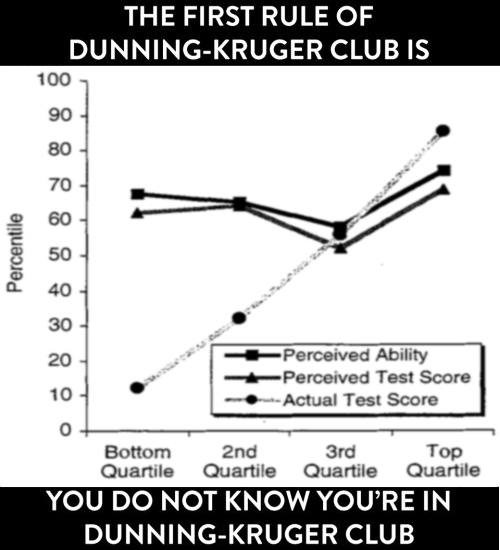
“ Unskilled and Unaware of it”
They reject conventional risk management practices, i.e. “an ounce of prevention is worth a pound of cure”. But they are specifically taught to reject the “ precautionary principle” (PP), which can be stated loosely as “don’t do anything that could cause global financial ruin, or world war 3, or a mass extinction, even if there’s only a small chance that this will happen”. The PP is justified based on widely accepted concepts such as expected value, but pseudo-skeptics are taught that environmental regulations have been bad, and that these regulations are motivated by the PP, so therefore the PP should always be ignored.History & Anchoring
Climate scientists know that the greenhouse effect, warming from CO2, and positive feedbacks were predicted in the 19th century based on fundamental physics, by prominent scientists like Joseph Fourier and Svante Arrhenius. Scientists considered the topic more closely in the 60s and 70s, predicting the earth would start to warm despite a slight cooling trend from 1945–1975. Early non-computer models ( Manabe & Wetherald 1967, Sawyer 1972) accurately predicted how much warming a 25% increase in CO2 would cause; later computer models gave similar results. Evidence from paleoclimatology provided indications of how strong the greenhouse effect might be, and this evidence from ancient history is used to help constrain the parameters of modern climate simulations and to check their accuracy.
The chains of reasoning that say humans cause warming were developed before much global warming actually happened, before the first computer models, before politicians got involved, before I was born, and long before the IPCC was formed in 1988. It explains a lot of things and has a lot of successful predictions.
So why do pseudo-skeptics think that one scientific-looking paper by a crank, or the difficulty of proving the tropospheric hot spot, demolishes decades of discoveries?
My guess is that it's a matter of the order in which they received the information. Humans tend to place more weight on information received earlier ( anchoring plus confirmation bias). Climate change is not taught in most American schools, and pseudo-skeptics are usually unaware of the history of climate science, hearing instead myths and mythological histories where the IPCC came first and “corrupted” climate science. By the time they finally stumble upon the actual history and facts, it’s such a challenge to their worldview that they seek out excuses to ignore it.
For the same reason, young scientists who hear the correct history and information first, then hear the myths later, would find the latter ridiculous.
Why conservatives?I don't have an entirely satisfactory answer, but here are some things to consider.
Upton Sinclair said, “It is difficult to get a man to understand something, when his salary depends upon his not understanding it!” Similarly, it is difficult to get a man to understand something if his political ideology depends on not understanding it.
Libertarian and free-market ideology has traditionally had difficulty dealing with negative externalities, as detailed in the non-libertarian FAQ; denial allows a person to simply ignore the limitations of their ideology. American conservatives in particular tend to distrust government, dislike regulations and hate taxes, so that any problem whose solution is a tax or a regulation naturally attracts distrust.
In the U.S. two-party system, the $1.7 trillion oil industry has been aligned with Republicans for decades, perhaps because environmentalists aligned with Democrats. Even so, Republicans used to be more likely to believe climate science. What changed? Was it that Democrats supported action against climate change, so Republicans had to oppose it?
Finally, letting go of denial could have major implications: losing faith in conservatives who told you it’s a “scam”, letting go of your pride, and losing connections to grassroots movements built upon denial. This might explain why denial continues even after the evidence became overwhelming.
Can their minds be changed?A Quartz article offers one perspective:
There’s one particular personality trait that underpins most of these other correlations: social dominance orientation […]: a measure of an individual’s acceptance of hierarchical power structures and inequality between social groups. Those who score high in surveys measuring social dominance orientation tend to see the world as an ongoing competition between social groups, and think it’s normal that some groups are at the bottom and others are at the top. [….]The takeaway from all this, Jylha says, is that appealing to a sense of empathy towards victims of climate change?—?whether that’s other people, animals, or plants?—?is not an effective tactic with deniers. Instead, research shows, they are more likely to respond to arguments of how society at large can benefit from climate change mitigation efforts.A comprehensive study published in 2015 in Nature surveyed 6,000 people across 24 countries and found that emphasizing the shared benefits of climate change was an effective way of motivating people to take action?—?even if they initially identified as deniers. For example, people were more likely to take steps to mitigate climate change if they believe that it will produce economic and scientific development. Most importantly, these results were true across political ideology, age, and gender.In order to appeal to those who deny climate change, discussions should focus on convincing people to take on behaviors that would help protect the environment?—?without trying to convince them to become environmentalists. The renewable energy economy is a great example. Arguing that innovation in alternate energy sources would lead to the creation of jobs does not necessarily require convincing someone of the harmful impact of climate change.If you’re talking in an internet forum, you almost certainly can’t persuade vocal pseudo-skeptics who roam the internet repeating myths everywhere they go. So your key audience is not the guy you’re responding to, but fence-sitters who may be listening in. There are more silent doubters than vocal deniers; always remember that.
Another important issue is who delivers the information. Typically, conservatives won’t listen to people that they perceive as liberals. Thus, the libertarian Niskanen Center and the Republican climate change plan are more likely to sway them than you, if you resemble a liberal. To have any chance, you have be credible to your audience.
George Marshall makes a wise but challenging suggestion: establish common ground first.
Stress the benefits of solving climate change. Manufacturing clean energy technology creates jobs. It saves lives too: via air pollution, fossil fuels kill dramatically more peoplethan hydro-electric, nuclear power, wind or solar—including thousands of Americans. In the long run, clean energy will cost less: in equatorial deserts, unsubsidized solar is already cheaper than coal, and I've researched Molten Salt Reactors for a long time and am convinced they will undercut coal as well. Energy efficiency, whether in cars or electricity, saves money in the long run. All these benefits apply even if AGW were a big hoax, and since we will eventually run out of fossil fuels anyway, why not pursue these changes early just in case it's real?
When it comes to debunking myths, the Debunking Handbook notes that you should put the facts front and center. A myth must not be the headline or the focus of the discussion. State the fact first, then explain the myth and identify convincingly why the myth is wrong. Explain the fact in a memorable way that makes sense to the reader.
Where did this all come from?I thank Denial101x for teaching me about the specific ideas that help denial to flourish, but it doesn’t explore how various facts and myths are able to interlock into a complete whole that intellectually satisfies the person who believes them, and it doesn’t explain the psychological process of “indoctrination”.
There's probably a lot of research yet to be done on how misinformation flourishes. How do millions of people get indoctrinated with it? How did that massive web of “think tanks”, denial blogs and articles develop? What is the history of this network? How much of it was it built by oil companies, and how much by conservative groups?
It's easy to blame oil companies, and certainly oil companies (notably ExxonMobil) have funded misleading advertisements, denialist groups, and research by contrarian scientists. But these are scientists who already refused to accept the findings of their field. In other cases, misinformation spreads with no commercial interest behind it at all: consider the anti-vaxxers, and the people who are convinced that MSG is a poison. What explains this?
Conspiratorial thinking usually plays a clear role (see for example the paper " NASA Faked the Moon Landing—Therefore, (Climate) Science Is a Hoax"), though I'm not convinced that all pseudo-skeptics rely on conspiracy theories. On the whole, I still don't think I fully understand these rascals.
If you’d like to see a video series about climate science, there are two excellent ones: Peter Hadfield’s fantastic series, and of course Denial101x (also available on YouTube). Both of these give extensive references to scientific journals. This series was based on a giant article I wrote after taking Denial101x.
|



