Of course, I don't. Dems caused the mortgage problem in the first place.
They let people like this run the mortgage GSE's:
.... Though she had no training or experience in finance, Gorelick was appointed the Vice Chairman of Fannie Mae and served in the role from 1997 to 2003. During that six-year period, she earned over $26 million.
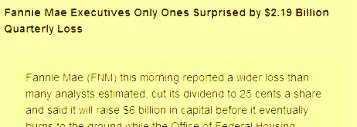 During Gorelick's tenure, FNMA suffered a $10 billion accounting scandal, an ominous harbinger of the firm's looming troubles. One of the falsified transactions helped FNMA hit earnings targets for 1998, which triggered bonuses for top executives including nearly $800,000 to Gorelick. During Gorelick's tenure, FNMA suffered a $10 billion accounting scandal, an ominous harbinger of the firm's looming troubles. One of the falsified transactions helped FNMA hit earnings targets for 1998, which triggered bonuses for top executives including nearly $800,000 to Gorelick.
........
Message 28071642
"When Mr RAINES himself was challenged by the Republican Christopher Shays, to the effect that his ratio of capital to assets (that is, mortgages) of 3 per cent was dangerously low, the Fannie Mae boss retorted that “our assets are so riskless, we could have a capital ratio of under 2 per cent”.
...........
Message 26273173
Andrew CUOMO and Fannie and Freddie
How the youngest Housing and Urban Development secretary in history gave birth to the mortgage crisis
....
villagevoice.com
Democrats also prevented effective regulation:
hotair.com
-----------------------------------------
From the Village Voice feature story:
"In 2000, CUOMO required a quantum leap in the number of affordable, low-to-moderate-income loans that the two mortgage banks—known collectively as Government Sponsored Enterprises—would have to buy. The GSEs don't actually sell mortgages to borrowers. They buy them from banks and mortgage companies, allowing lenders to replenish their capital and make more loans. They also purchase mortgage-backed securities, which are pools of mortgages regularly acquired by the GSEs from investment firms. The government chartered these banks to pump money into the mortgage market and, while they did it, to make a strong enough profit to attract shareholders. That created a tug-of-war between their efforts to maximize shareholder value, which drove them toward high-end mortgages, and their congressionally mandated obligation to finance loans for those who needed help. The 1992 law required HUD's secretary to make sure housing goals were being met and, every four years, set new goals for Fannie and Freddie.
Cuomo's predecessor, Henry Cisneros, did that for the first time in December 1995, taking a cautious approach and moving the GSEs toward a requirement that 42 percent of their mortgages serve low- and moderate-income families. CUOMO raised that number to 50 percent and dramatically hiked GSE mandates to buy mortgages in underserved neighborhoods and for the "very-low-income." Part of the pitch was racial, with CUOMO contending that Fannie and Freddie weren't granting mortgages to minorities at the same rate as the private market. William Apgar, Cuomo's top aide, told The Washington Post: "We believe that there are a lot of loans to black Americans that could be safely purchased by Fannie Mae and Freddie Mac if these companies were more flexible."
While many saw this demand for increasingly "flexible" loan terms and standards as a positive step for low-income and minority families, others warned that they could have potentially dangerous consequences. Franklin Raines, the Fannie chairman and first black CEO of a Fortune 500 company, warned that Cuomo's rules were moving Fannie into risky territory: "We have not been a major presence in the subprime market," he said, "but you can bet that under these goals, we will be." Fannie's chief financial officer, Timothy Howard, said that "making loans to people with less-than-perfect credit" is "something we should do." CUOMO wasn't shy about embracing subprime mortgages as a possible consequence of his goals. "GSE presence in the subprime market could be of significant benefit to lower-income families, minorities, and families living in underserved areas," his report on the new goals noted.
.....
The HUD secretary is also required to produce voluminous rules that govern how the GSEs meet those goals, and the 187-page rules CUOMO issued opened the door to abuse.
The rules explicitly rejected the idea of imposing any new reporting requirements on the GSEs. In other words, HUD wanted Fannie and Freddie to buy risky loans, but the department didn't want to hear just how risky they were.
....
Message 25043226
"For an accounting fraud of $567 million, Enron's executives went to jail, and its head guy died there. For an accounting fraud ten times that size, the two Democrat hacks who headed Fannie Mae and Freddie Mac, Franklin Raines and Jamie Gorelick, walked away with a combined taxpayer-funded payout of $116.4 million. Fannie and Freddie are two of the largest businesses in America, but they're exempt from SEC disclosure rules and Sarbanes-Oxley "corporate governance" burdens, and so in 2008, unlike Enron, WorldCom or any of the other reviled private-sector bogeymen, they came close to taking down the entire global economy."
Message 27455479
.... ongressman [Barney] Frank, of course, blamed the financial crisis on the failure adequately to regulate the banks. In this, he is following the traditional Washington practice of blaming others for his own mistakes. For most of his career, Barney Frank was the principal advocate in Congress for using the government’s authority to force lower underwriting standards in the business of housing finance. Although he claims to have tried to reverse course as early as 2003, that was the year he made the oft-quoted remark, “I want to roll the dice a little bit more in this situation toward subsidized housing.” Rather than reversing course, he was pressing on when others were beginning to have doubts.
“It is government’s fault for offering a housing finance program without making an effort to maintain underwriting standards.”–Peter J. Wallison
His most successful effort was to impose what were called “affordable housing” requirements on Fannie Mae and Freddie Mac in 1992. Before that time, these two government sponsored enterprises (GSEs) had been required to buy only mortgages that institutional investors would buy–in other words, prime mortgages–but Frank and others thought these standards made it too difficult for low income borrowers to buy homes. The affordable housing law required Fannie and Freddie to meet government quotas when they bought loans from banks and other mortgage originators.
This was the beginning of the bubble and ended with the collapse.
At first, this quota was 30%; that is, of all the loans they bought, 30% had to be made to people at or below the median income in their communities. HUD, however, was given authority to administer these quotas, and between 1992 and 2007, the quotas were raised from 30% to 50% under Clinton in 2000 and to 55% under Bush in 2007. Despite Frank’s effort to make this seem like a partisan issue, it isn’t. The Bush administration was just as guilty of this error as the Clinton administration. And Frank is right to say that he eventually saw his error and corrected it when he got the power to do so in 2007, but by then it was too late.
There are you tube videos of Bush officials being berated by Democrats as they try to press for better standards for mortgage loans. Paul Gigot identified some of the villains.
Angelo Mozilo was in one of his Napoleonic moods. It was October 2003, and the CEO of Countrywide Financial was berating me for The Wall Street Journal’s editorials raising doubts about the accounting of Fannie Mae. I had just been introduced to him by Franklin Raines, then the CEO of Fannie, whom I had run into by chance at a reception hosted by the Business Council, the CEO group that had invited me to moderate a couple of panels.
Mr. Mozilo loudly declared that I didn’t know what I was talking about, that I didn’t understand accounting or the mortgage markets, and that I was in the pocket of Fannie’s competitors, among other insults. Mr. Raines, always smoother than Mr. Mozilo, politely intervened to avoid an extended argument, and Countrywide’s bantam rooster strutted off.
Notice that the executives of Fannie Mae are all Democrats and left with hundreds of millions. Mr Gigot goes on:
I recount all this now because it illustrates the perverse nature of Fannie and Freddie that has made them such a relentless and untouchable political force. Their unique clout derives from a combination of liberal ideology and private profit. Fannie has been able to purchase political immunity for decades by disguising its vast profit-making machine in the cloak of “affordable housing.” To be more precise, Fan and Fred have been protected by an alliance of Capitol Hill and Wall Street, of Barney Frank and Angelo Mozilo.
.............
chicagoboyz.net
Franklin Raines, Fannie Mae's CEO through 2005, who helped plunge the government-sponsored mortgage giant into the subprime abyss, while cooking Fannie's books to score fatter bonuses for himself and other Clinton Democrats on its board. Despite holding 20 hearings and 700 interviews, Pelosi's commission never found room for Raines on the witness list. One of the prime suspects in the crisis got off scot-free.
Henry Cisneros, Clinton's housing chief who strong-armed Countrywide Financial into signing "fair lending" contracts that exposed it to billions in risky subprime loans. Cisneros later joined Countrywide's board. (Pelosi's son also worked for Countrywide.)
Rahm Emanuel, who served on Freddie Mac's board, where he pocketed $320,000 before making millions working for an investment banker in Chicago that brokered high-cost subprime loans to minorities.
Barney Frank, who was one of Fannie's and Freddie's biggest protectors — and beneficiaries of their political donations — on Capitol Hill. Frank landed a plum Fannie job for his gay partner, Herb Moses, whose work involved relaxing Fannie's restrictions on home loans. Frank previously led the House committee charged with oversight of Fannie, which also gave at least $25,000 to Frank's mother's charity in Boston. His glaring conflicts of interest were never investigated.
Chris Dodd, the ex-Democratic senator who scored not one, but two sweetheart Countrywide mortgages, while protecting Fannie as head of the Senate committee charged with oversight of Fannie. Countrywide was Fannie's biggest customer.
Dodd and Frank did more than any other lawmakers to cover up the risks Fannie and Freddie took meeting government-imposed affordable lending quotas. Yet they got to write the law to supposedly stop the next financial crisis — one that doesn't even lay a glove on Fannie and Freddie, who together held or guaranteed almost half the subprime and other bad loans in the system when it crashed in 2008.
Maxine Waters, senior Democratic member of the House banking committee who defended Raines by arguing that reining him in would only hurt lending to lower-income and minority households.
After the subprime crisis, Waters allegedly swung $12 million in federal bailout money to her husband's ailing minority bank. Regulators cited OneUnited Bank for poor lending practices and excessive executive pay and perks — including providing its CEO a $6 million mansion and a Porsche SUV. The Waters at the time owned more than $350,000 in OneUnited stock.
It wasn't the first time Waters used her power to advance the interests of the bank. In 2002, when her husband first became a shareholder in OneUnited, the bank (then known as Boston Bank of Commerce) tried to purchase Family Savings, another minority-owned bank in Los Angeles. But when the thrift turned instead to a suitor in Illinois, Waters tried to block the merger by contacting FDIC regulators. Her efforts paid off. The thrift ended up merging with her husband's bank.
Waters remains one of Washington's most outspoken critics of "greedy" Wall Street bankers — whom she says conspired with Republicans to create the crisis.
But Democrats ought to look in the mirror. Their colleague Jon Corzine wasn't just tied to Wall Street bankers. He was one — and one of the worst.
As a Democratic senator and governor of New Jersey, Corzine decried income inequality and Wall Street pay. Then he joined MF Global Holdings and bagged a $14 million compensation package — including $2 million in guaranteed bonuses, regardless of performance.
It took Corzine just 18 months to run the Wall Street brokerage into the ground with risky bets on euro zone debt. Just hours before filing for bankruptcy, Corzine continued paying out executive bonuses, mimicking the actions of Wall Street CEOs he had criticized during the crisis.
The list of financial "greed" and sleaze on the left is long. What a bunch of hypocrites.
news.investors.com
In his early activist days, Barack Obama the community organizer sued banks to ease lending practices.

State Sen. Barack Obama and Fr. Michael Pfleger led a protest against the payday loan industry demanding the State of Illinois to regulate loan businesses in January 2000. During his time as a community organizer Barack Obama led several protests against banks to make loans to high risk individuals. ( NBC 5 Week of January 3, 2000)
Here’s something that won’t get any play in the liberal media…
A new study by the respected National Bureau of Economic Research found that Democrats are to blame for the subprime mortgage crisis.
Investor’s Business Daily reported:
Democrats and the media insist the Community Reinvestment Act, the anti-redlining law beefed up by President Clinton, had nothing to do with the subprime mortgage crisis and recession.
But a new study by the respected National Bureau of Economic Research finds, “Yes, it did. We find that adherence to that act led to riskier lending by banks.”
Added NBER: “There is a clear pattern of increased defaults for loans made by these banks in quarters around the (CRA) exam. Moreover, the effects are larger for loans made within CRA tracts,” or predominantly low-income and minority areas.
To satisfy CRA examiners, “flexible” lending by large banks rose an average 5% and those loans defaulted about 15% more often, the 43-page study found.
The strongest link between CRA lending and defaults took place in the runup to the crisis — 2004 to 2006 — when banks rapidly sold CRA mortgages for securitization by Fannie Mae and Freddie Mac and Wall Street.
CRA regulations are at the core of Fannie’s and Freddie’s so-called affordable housing mission. In the early 1990s, a Democrat Congress gave HUD the authority to set and enforce (through fines) CRA-grade loan quotas at Fannie and Freddie.
It passed a law requiring the government-backed agencies to “assist insured depository institutions to meet their obligations under the (CRA).” The goal was to help banks meet lending quotas by buying their CRA loans.
But they had to loosen underwriting standards to do it. And that’s what they did.
Republicans warned Democrats of the impending doom in 2004.
But Democrats wouldn’t budge.
Message 28624107
New Study Finds CRA 'Clearly' Did Lead To Risky LendingFri, Dec 21 2012 00:00:00 E A01_A1 By Paul Sperry, Investor's Business Daily
Posted 12/20/2012 06:56 PM
 View Enlarged Image View Enlarged Image
Democrats and the media insist the Community Reinvestment Act, the anti-redlining law beefed up by President Clinton, had nothing to do with the subprime mortgage crisis and recession.
But a new study by the respected National Bureau of Economic Research finds, "Yes, it did. We find that adherence to that act led to riskier lending by banks."
Added NBER: "There is a clear pattern of increased defaults for loans made by these banks in quarters around the (CRA) exam. Moreover, the effects are larger for loans made within CRA tracts," or predominantly low-income and minority areas.
To satisfy CRA examiners, "flexible" lending by large banks rose an average 5% and those loans defaulted about 15% more often, the 43-page study found.
The strongest link between CRA lending and defaults took place in the runup to the crisis — 2004 to 2006 — when banks rapidly sold CRA mortgages for securitization by Fannie Mae and Freddie Mac and Wall Street.
CRA regulations are at the core of Fannie's and Freddie's so-called affordable housing mission. In the early 1990s, a Democrat Congress gave HUD the authority to set and enforce (through fines) CRA-grade loan quotas at Fannie and Freddie.
It passed a law requiring the government-backed agencies to "assist insured depository institutions to meet their obligations under the (CRA)." The goal was to help banks meet lending quotas by buying their CRA loans.
But they had to loosen underwriting standards to do it. And that's what they did.
"We want your CRA loans because they help us meet our housing goals," Fannie Vice Chair Jamie Gorelick beseeched lenders gathered at a banking conference in 2000, just after HUD hiked the mortgage giant's affordable housing quotas to 50% and pressed it to buy more CRA-eligible loans to help meet those new targets. "We will buy them from your portfolios or package them into securities."
She described "CRA-friendly products" as mortgages with less than "3% down" and "flexible underwriting."
From 2001-2007, Fannie and Freddie bought roughly half of all CRA home loans, most carrying subprime features.
Lenders not subject to the CRA, such as subprime giant Countrywide Financial, still fell under its spell. Regulated by HUD, Countrywide and other lenders agreed to sign contracts with the government supporting such lending under threat of being brought under CRA rules.
"Countrywide can potentially help you meet your CRA goals by offering both whole loan and mortgage-backed securities that are eligible for CRA credit," the lender advertised to banks.
Housing analysts say the CRA is the central thread running through the subprime scandal — from banks and subprime lenders to Fannie and Freddie to even Wall Street firms that took most of the heat for the crisis.
Obama officials, who are cracking the CRA whip anew against banks, insist the law played no role in the mortgage meltdown.
"CRA loans performed substantially better than subprime loans, and the CRA has been around for decades," argued senior Justice Department official Thomas Perez.
While the 1977 law was passed 30 years before the crisis, it underwent a major overhaul just 10 years earlier. Starting in 1995, banks were measured on their use of innovative and flexible" lending standards, which included reduced down payments and credit requirements.
Banks that didn't meet Clinton's tough new numerical lending targets were denied merger plans, among other penalties. CRA shakedown groups like Acorn held hostage the merger plans of banks like Citibank and Washington Mutual until they pledged more loans to credit-poor minorities (see chart).
WaMu CEO Kerry Killinger has blamed the CRA for his bank's overexposure to risky loans. He said he wanted to tighten lending requirements, but "such measures would have presented other issues such as the company's CRA rating and its commitment to serving its (low-income and minority) customers and communities."
Other large banks have reported serious delinquency rates on CRA home loans. Bank of America's 2009 10-K states: "Our CRA portfolio comprised 6% of the total residential mortgage balances, but 17% of nonperforming residential mortgage loans."
Under Clinton's revised CRA, moreover, banks for the first time earned CRA credit for purchasing subprime securities.
A wave of these securitizations began in 1997, which also happens to mark the start of the housing bubble.
Read More At IBD: http://news.investors.com/ibd-editorials-perspective/122012-637924-faults-community-reinvestment-act-cra-mortgage-defaults.htm#ixzz2FzZpvxFU
How the youngest Housing and Urban Development secretary in history gave birth to the mortgage crisis
Comments (0) By Wayne Barrett Tuesday, Aug 5 2008
Cuomo's predecessor, Henry Cisneros, did that for the first time in December 1995, taking a cautious approach and moving the GSEs toward a requirement that 42 percent of their mortgages serve low- and moderate-income families. Cuomo raised that number to 50 percent and dramatically hiked GSE mandates to buy mortgages in underserved neighborhoods and for the "very-low-income." Part of the pitch was racial, with Cuomo contending that Fannie and Freddie weren't granting mortgages to minorities at the same rate as the private market. Click|keyword[William+Apgar]">William Apgar, Cuomo's top aide, told Click|keyword[The+Washington+Post+Company]">The Washington Post: "We believe that there are a lot of loans to black Americans that could be safely purchased by Fannie Mae and Freddie Mac if these companies were more flexible."
While many saw this demand for increasingly "flexible" loan terms and standards as a positive step for low-income and minority families, others warned that they could have potentially dangerous consequences. Click|keyword[Franklin+Raines]">Franklin Raines, the Fannie chairman and first black CEO of a Fortune 500 company, warned that Cuomo's rules were moving Fannie into risky territory: "We have not been a major presence in the subprime market," he said, "but you can bet that under these goals, we will be." Fannie's chief financial officer, Click|keyword[Timothy+Howard]">Timothy Howard, said that "making loans to people with less-than-perfect credit" is "something we should do." Cuomo wasn't shy about embracing subprime mortgages as a possible consequence of his goals. "GSE presence in the subprime market could be of significant benefit to lower-income families, minorities, and families living in underserved areas," his report on the new goals noted.
......
http://www.villagevoice.com/2008-08-05/news/how-andrew-cuomo-gave-birth-to-the-crisis-at-fannie-mae-and-freddie-mac/2/
http://www.villagevoice.com/2008-08-05/news/how-andrew-cuomo-gave-birth-to-the-crisis-at-fannie-mae-and-freddie-mac/ |
| |
|
|




