| | | " there is ZERO COMPELLING EVIDENCE to suggest that wildfires are caused by global warming."
The claim isn't that warming causes fires. It's that warming makes the fires worse, in lots of ways. It's hotter, drier, beetles are killing more trees, and the jet stream is getting stuck.
Scientists see fingerprints of climate change all over California’s wildfires
Kurtis Alexander Aug. 3, 2018 Updated: Aug. 3, 2018 6 a.m.
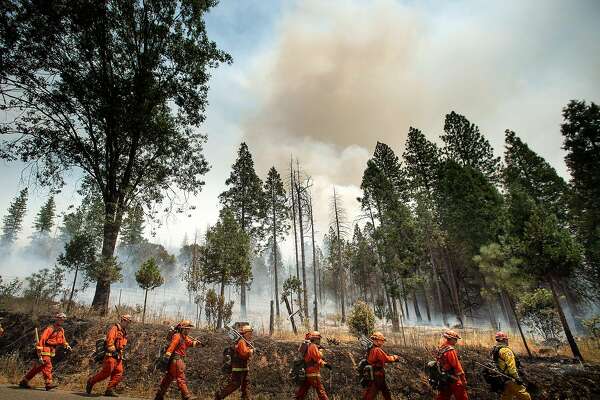
Inmate firefighters battle the Ferguson fire in Jerseydale, California, on July 22, 2018. - A fire that claimed the life of one firefighter and injured two others near California's Yosemite national park has almost doubled in size in three days, authorities said Friday. The US Department of Agriculture (USDA) said the so-called Ferguson fire had spread to an area of 22,892 acres (92.6 square kilometers), and is so far only 7 percent contained. (Photo by NOAH BERGER / AFP) (Photo credit should read NOAH BERGER/AFP/Getty Images) *** BESTPIX ***
Photo: Noah Berger / AFP / Getty Images
Much of the heat that’s gripped California and hastened the spread of deadly wildfires recently is due to a strange but familiar shift in the jet stream — one that’s haunted the West with threatening fire conditions in the past and could cause more hot, dry spells in the future, especially with a changing climate.
The jet stream, the river of wind high above the Northern Hemisphere, has been weaker and wavier in the past few weeks, scientists say. Instead of pushing weather systems along as it usually does, it’s allowing the patterns to stagnate.
Not only has this meant searing temperatures for the West Coast, where the hot spot of Death Valley averaged a record 108 degrees last month, but also for Scandinavia and Japan. Norway and Sweden flirted with a rare 90 degrees at the Arctic Circle this week, while the Japanese city of Kumagaya recently landed that nation’s highest-ever temperature: 106. Other places, such as the East Coast, have endured relentless rain, even flooding.
“We’re seeing this mix of conditions across North America and Europe, but they’re all connected,” said Jennifer Francis, a professor at Rutgers University who studies atmospheric circulation. “The weather patterns are just stuck. They’re trapped.”

A firefighter tries to control a back burn as the Carr Fire spreads near Redding on July 31. Climate scientists say scorching temperatures this summer are making the fire season worse.
Photo: Mark Ralston / AFP / Getty Images
The shift in the jet stream that’s driving the stagnation, say Francis and other climate scientists, is almost certainly tied to global warming.
It’s just one of the ways that climate change is probably contributing to the spree of fires in California that has killed eight people and destroyed more than 1,000 homes.
California’s fire season, most fundamentally, is saddled with higher temperatures — with or without a heat wave, scientist say. The greenhouse gases emitted from cars, power plants and factories, which trap sunlight and warm the atmosphere, have created baseline conditions that are more hospitable to wildfire. Water loss from soil and plants is generally up while snowmelt and river flows are down.
A study last year by researchers at Columbia University and the University of Idaho found that human-caused warming was drying out forests so much that fire seasons across the West are lengthening by more than a week each year.
Other factors are influencing wildfire as well, making it difficult to always draw such precise conclusions about the role of climate change. The nation’s longtime policy of wildfire suppression, for example, has created a dangerous buildup of vegetation that’s making fires more intense. Development in rural areas, meanwhile, is increasing the human toll.
Nevertheless, climate researchers and fire experts agree that global warming is having an impact and that the impact will only grow.
Across California this week, more than 12,000 firefighters were battling several major wildfires. The Carr Fire, in Shasta County, has already become the state’s sixth most destructive blaze, leveling 1,060 homes as of Thursday. The Ferguson Fire, to the south, has been burning along the western edge of Yosemite for weeks, prompting a rare shutdown of much of the national park.
The weak and wavy jet stream behind California’s hot spell has taken hold before. The pattern was firmly established in 2003 when a heat wave killed tens of thousands in Europe, in 2010 when several hundred wildfires ignited in Russia and in 2011 when Texas saw its worst drought in state history.
Research by Michael Mann, a climatologist and geophysicist at Penn State University, suggests that the change in the jet stream is partly the result of warming in the Arctic. When the Arctic gets hotter, the contrast in temperatures between northern latitudes and more southern latitudes is less. That variation causes a disturbance in the atmosphere that shifts the jet stream, Mann said.
“These factors work together to produce the sorts of persistent extreme weather events — droughts, floods, heat waves, wildfires — that we’re seeing across the Northern Hemisphere right now,” Mann said in an email.
He projects that stalls and swerves in the jet stream will happen more often with climate change.
“These patterns usually break down after a couple weeks, but they are increasing in frequency,” he said.
Mann’s findings have yet to become mainstream. But many are eager for more research to be done on the tie between global warming, particularly in the Arctic, and atmospheric fluctuations.
Regardless of the jet stream’s influence, climate researchers are already drawing a connection — and quantifying it — between the current heat wave and climate change.
The World Weather Attribution project, an international coalition of scientists, released a preliminary report last month saying that Europe’s scorching heat was twice as likely to have occurred because of human-caused warming.
Michael Wehner, senior staff scientist at Lawrence Berkeley National Laboratory, did a similar computation for the heat in California. He concluded that 2 to 3 degrees of temperature could be chalked up to climate change.
“When you’re really hot,” he said, “a little bit hotter makes it a lot worse in terms of human health and aggravating fire danger.”
sfchronicle.com |
|



