First evidence of Feb's remarkable global cooling.. It's not official, however.
Monday, March 4, 2019
February NCEP/NCAR global surface anomaly up 0.097°C from January
The Moyhu NCEP/NCAR index rose from 0.296°C in January to 0.393°C in February, on a 1994-2013 anomaly base. That makes it the warmest month since May 2017. The warmth came mainly in a spurt at the end of the month, which is continuing.
It was quite cold in W Canada and the US, although warm in Alaska and the SE USA. Warm in Europe, cold in the Sahara, and mostly warm in Antarctica, with the Arctic mixed.
The BoM ENSO Outlook was is still set to Watch.
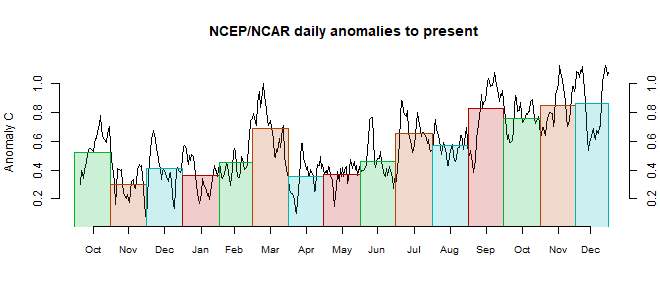
This post is part of a series that has now run for some years. The NCEP/NCAR integrated average is posted daily here, along with monthly averages, including current month, and graph. When the last day of the month has data (usually about the 3rd) I write this post.
The TempLS mesh data is reported here, and the recent history of monthly readings is here. Unadjusted GHCN is normally used, but if you click the TempLS button there, it will show data with adjusted, and also with different integration methods. There is an interactive graph using 1981-2010 base period here which you can use to show different periods, or compare with other indices. There is a general guide to TempLS here.
The reporting cycle starts with a report of the daily reanalysis index on about the 4th of the month. The next post is this, the TempLS report, usually about the 8th. Then when the GISS result comes out, usually about the 15th, I discuss it and compare with TempLS. The TempLS graph uses a spherical harmonics to the TempLS mesh residuals; the residuals are displayed more directly using a triangular grid in a better resolved WebGL plot here.
A list of earlier monthly reports of each series in date order is here:
- NCEP/NCAR Reanalysis report
- TempLS report
- GISS report and comparison with TempLS
moyhu.blogspot.com |



