We've detected that you're using an ad content blocking browser plug-in or feature. Ads provide a critical source of revenue to the continued operation of Silicon Investor. We ask that you disable ad blocking while on Silicon
Investor in the best interests of our community. If you are not using an ad blocker but are still receiving this message, make sure your browser's tracking protection is set to the 'standard' level.
If Airbus had installed an MCAS system on the A330, Bonin could not have stalled the Air France 447 for 15 minutes as the jet fell at a speed of 129 miles per hour because Bonin has the nose pitched-up an insane 40 degrees and never less than 35 degrees.
An MCAS would have made the autotrim place the Air France nose down 8 degrees until the aircraft stopped falling.
The 737-max is an economy model which is not rated to take-off and land fully loaded at high airports like Denver or Quito Ecuador. There are airports lower in elevation where high temperatures can prevent the airline from loading the aircraft fully. This happens at times in a place like Alice Springs, so Qantas puts more powerful aircraft on that route. But a hot day can shit down small aircraft traffic.
This is the pitch the 737-max can achieve on take-off when empty without stalling. Load up the aircraft with luggage and passengers and the MCAS won't let you pitch this steeply on take-off because the engines are not powerful accelerate the plane fast enough.
If you're sure MCAS or some other flight system is doing something you're sure is wrong, you simply flip it off and that part of the flying is now your responsibility.
What if Boeing wanted to attach longer and heavier landing gear to their economy model 737-max, what would they also have to change? To begin with the added weight would change the balance of the airframe.
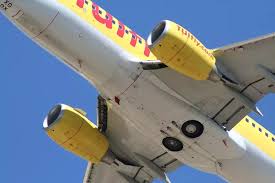
Glancing at this photo, you can see the wheels would have to be placed further apart so the would attach under the wings rather than under the body of the aircraft. The 737 doesn't even have a hatch cover except a small cowling attached to the strut which matches the body profile next to the wing. A special hubcap makes the wheel sufficiently aerodynamic in flight.
So the wing would need to be strengthened and repositioned, changing the handling characteristics of the airframe and the flight envelope. So you install many MCAS like systems to keep the aircraft within the calculated flight envelope. The engines would also need to be placed further out on the wing to move the wheels out of the jetstream.
The baggage hold would now be too high for baggage handlers to load and unload the aircraft by hand, so all of the rural and less affluent airports would have to purchase costly mobile ramp vehicles
If you're willing to pay for all this, Boeing can sell you a 767 which is far more powerful and can take-off quite steeply fully loaded and has a greater range. But to fill it you'll need more passengers.
Delta bought up almost all of the existing 717-200 aircraft, which was originally the McDonnell Douglas 95. Because it's more powerful so it's the aircraft they use when I fly from LAX to Denver.
Being more powerful, the 717 is also less fuel efficient, but a lot of airlines want Boeing to put the 717 back into production. Delta, Hawaiian Air and Southwest don't have any idea what they'll eventually replace their aging 717s with because there's no direct replacement on the market. The 767 is a similar discontinued model which has no direct replacement. Hawaiian even attached gas tanks in their 717 interiors because these inter-island planes would not otherwise have the range to get to their Oakland maintenance base for overhauls.
Currently these airlines will have to go smaller with an Embraer E190-E2 or go more costly with an Airbus A-220 or bigger and more costly still with the 767.
Everything engineered is always a series of trade-offs.
Completely redesigning the 737-max with longer landing gear would have made it into an aircraft far fewer airlines would have wanted. Certainly not Ethiopia Airlines or Lion Air - but they're not a good fit for pilots with limited flight experience, which is the underlying problem.