in the mean time this is how the big boyz wearing big pants play ...
go for the jugular but by acupuncture-precision karate move
I suppose such, already weaponised, shall be tee-ed up the minute team china is cut off of chips supply, without if and or buts, and cardiac arrest shall happen to Intel, AMD, Nvidia, and Cisco, Ericsson, Nokia, and Toshiba, Matsushita and Fujitsu, and and and
whilst the world would still be able to buy any and everything china 2025
is the theory.
Knowing such be the end-game, what should the alleged allies of team USA do? would imagine thinking twice might be well advised, at the very least.
Knowing such, what would enemies of team USA do? edging on the trade war as the Jetson has been doing, I would guess.
let's see
euronews.com
U.S. leaves rare earths, critical minerals off China tariff list
• last updated: 14/05/2019 - 14:04
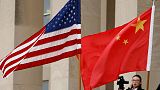
FILE PHOTO: U.S. and Chinese flags are seen before Defense Secretary James Mattis welcomes Chinese Minister of National Defense Gen. Wei Fenghe to the Pentagon in Arlington, Virginia, U.S., November 9, 2018. REUTERS/Yuri Gripas -
Copyright
YURI GRIPAS(Reuters)
BEIJING (Reuters) - The United States has again decided not to impose tariffs on rare earths and other critical minerals from China, underscoring its reliance on the Asian nation for a group of materials used in everything from consumer electronics to military equipment.
The minerals are set to be among the few items spared from U.S. tariffs in an escalating trade war with China, which is by far the world's biggest producer of rare earths.
Beijing, however, is set to raise tariffs on around $60 billion in U.S. goods, including rare earth ores, hitting back at a tariff hike by Washington on $200 billion (154.46 billion pounds) of Chinese goods in the bitter trade dispute.
The office of U.S. Trade Representative Robert Lighthizer also on Monday released a list of further Chinese goods, worth around $300 billion annually, that have been earmarked for a 25 percent tariff. Lighthizer on Friday said this next round of tariffs would cover "essentially all remaining imports from China" not yet hit by tariffs.
The list, which is open for public comments until June 17, does not include rare earth materials and other critical minerals, and also excludes pharmaceuticals and select medical goods, the document said.
"These materials are critical to U.S. industry and defence, and with nowhere else to turn for supplies in the near-term, the tariffs would invoke more suffering on U.S. end-users than China," said Ryan Castilloux, managing director of consultancy Adamas Intelligence, in an e-mail.
In July last year, the U.S. Trade Representative office included rare earths on a provisional list of tariffs on Chinese goods, only to remove it later from the final list.
The United States "won't be unable to find a replacement in the short term ... so if they want to tax rare earth products that would make it worse for themselves," said an analyst at stake-backed Chinese research house Antaike, who asked not to be named.
Rare earths were in a list of 35 minerals deemed critical to U.S. security and economic prosperity published one year ago. Most of these 35 minerals are now subject to the U.S. tariffs on Chinese goods, but rare earths, antimony - used in batteries and flame retardant - helium and natural graphite are not.
Cesium and rubidium, used in research and development and neither of which are mined in the United States, are also spared, as are fluorspar, used to make gasoline, steel and uranium fuel.
Beijing said on Monday it would raise tariffs on U.S. rare earth metal ores from 10 percent to 25 percent from June 1, making it less economical to process the material in China.
The 10 percent tariff still left a profit for the processors, but the higher 25 percent rate will be "quite hard to bear," the Antaike analyst said.
(Reporting by Tom Daly; Editing by Tom Hogue)
|



