Report re the war ...
bloomberg.com
Trump's China Tariffs Boomerang on America
Thanks to trade wars, companies are skimping on new U.S. plants and equipment.
Matthew A. Winkler
December 10, 2019, 6:00 PM GMT+8
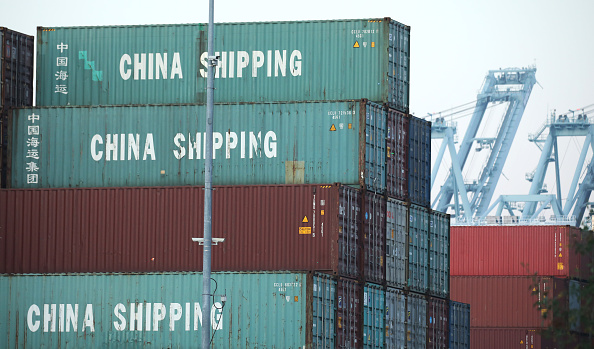
Who’s hurting whom?
Photographer: Mario Tama/Getty Images
As resilient as the U.S. is with unemployment at a 50-year low of 3.5% and personal income up 15% since 2017, cracks are widening in the longest expansion in modern times. Deteriorating business investment, manufacturing, shipping, trucking, logistics and the historically robust trade surplus can all be attributed to the tariffs threatened and imposed by Donald Trump since he became president.
Trump protectionism initially included tariffs of 25% and 10% on steel and aluminum, prompting retaliatory penalties from China, the European Union, Mexico and Canada. Almost everything Americans now buy from China is penalized or targeted for tariffs.
Instead of fortifying the economy, Trump's trade wars taxed chief executive officers (and farmers) with so much financial and geographical disruption on products from medical devices to soybeans that it has made companies eschew new American plants and equipment.
Even the Trump tax cut that was supposed to invigorate animal spirits was reduced to insignificance by the chaos created by the tariffs. That's why Real Private Nonresidential Fixed Investment calculated by the U.S. Bureau of Economic Analysis is down more than 2.5% in the third quarter this year.
Since Trump took office, the best month in U.S. manufacturing production was September 2018, when it increased 3.5% over the previous year. Then it began to shrink this year. The most recent reading: Manufacturing production declined 1.5% in October 2019 from a year ago. This drop in the growth rate in 13 months is the sharpest since September 2011.
Trump is the first president since the Great Depression to assail globalization, which benefits corporate America with an overwhelming 56% share of the market value of the world's 500 biggest companies. Global trade, measured by the 5-year average of exports, fell 2.6% to $17.6 trillion after reaching the high of $18 trillion in 2015 -- the first decline since 1969 when such data was collected.
The retreat in global exports hasn't marked a turning point for China, Trump's nemesis on trade. Since 2016, China's 5-year rolling average of exports increased 8% to $2.4 trillion, while the U.S. was little changed at $1.5 trillion, according to data compiled by Bloomberg.
America's post-World War II transition from industrial superpower to the biggest net exporter of services -- such as intellectual property, travel and transport, computers, finance, insurance, health care, higher education and businesses associated with academia -- climaxed with a record monthly trade balance of $21.9 billion at the end of 2015. But this vital measure of the advanced U.S. economy has fallen almost 3%, to $21.1 billion, since then, according to recent data.
Slipping on ServicesAfter climaxing at the end of 2015, U.S. exports in the service economy are falling
Source: Bloomberg
The trade-weighted dollar's 6.7% rally since 2016 can explain some of the weakness undermining U.S. leadership in the global services economy, where high wages and skilled labor are dominant. But the dollar appreciated 21.5% between 2012 and 2015, when the trade balance for services increased 21.6%, according to data compiled by Bloomberg.
The diminishing services surplus coincides with the first drop in enrolled international students since the height of the U.S. wars in Iraq and Afghanistan between 2003 and 2006. The 2.1% decline to 872,214 enrolled foreign students between 2018 and 2019 followed a 1.3% decline during the previous academic year, when Trump pursued his ban on immigrants from seven countries, five of them with Muslim majorities.
Trump tariffs and retaliatory penalties from China and elsewhere are essentially taxes on American businesses, farmers and consumers. They also hurt American shippers. Containers sent to Asia from North America, where the U.S. is the biggest exporter, declined in 8 of 11 quarters since 2017, measured in 20-foot equivalent units.
During the same period, TEUs shipped to North America from Asia increased in 10 of 11 quarters with China as the region's biggest exporter. Asia's shipping to sub-Saharan Africa also increased in 10 of 11 quarters since 2017, according to data compiled by Bloomberg.
The newfound U.S. affinity for tariffs are correlated with the weakest sentiment among truckers since 2016. The buoyant job market notwithstanding, concerns about decelerating growth, repeated threats of more tariffs and slowing manufacturing are driving record-low expectations for trucking volume growth during the next six months. Just 42% of respondents to the Bloomberg/Truckstop.com survey expect volume to rise.
American companies that make up the logistics industry, which handles the details of importing and exporting goods, are poised to underperform their global peers, especially in China, over the next three years, according to analysts surveyed by Bloomberg. Among the 64 logistics services companies from 17 countries with a minimum market capitalization of $500 million, the 9 U.S.-based companies will suffer a 1% decline in sales.
That's the third-worst performance in the entire group, which will see an average increase of 12%; 20 Chinese companies will see an increase of 67% -- a trend that will persist in 2020 and 2021. Landstar System Inc., the largest flatbed hauler in North America, is poised to report an 11% decline in revenues, the worst results since 2009.
Trump two years ago predicted U.S. gross domestic product “could go to 4%, 5% or even 6%, ultimately.” GDP grew 2.9% last year and 2.3% in 2019, according to 76 economists surveyed by Bloomberg.
The economists predict growth will slow to 1.8% in 2020, not least because Trump tariffs are putting the brakes on American business.
This column does not necessarily reflect the opinion of the editorial board or Bloomberg LP and its owners.
To contact the author of this story:
Matthew A. Winkler at mwinkler@bloomberg.net
To contact the editor responsible for this story:
Katy Roberts at kroberts29@bloomberg.net |



