| | | 
By Ben Eisen and Laura Kusisto
Jan. 25, 2020
wsj.com
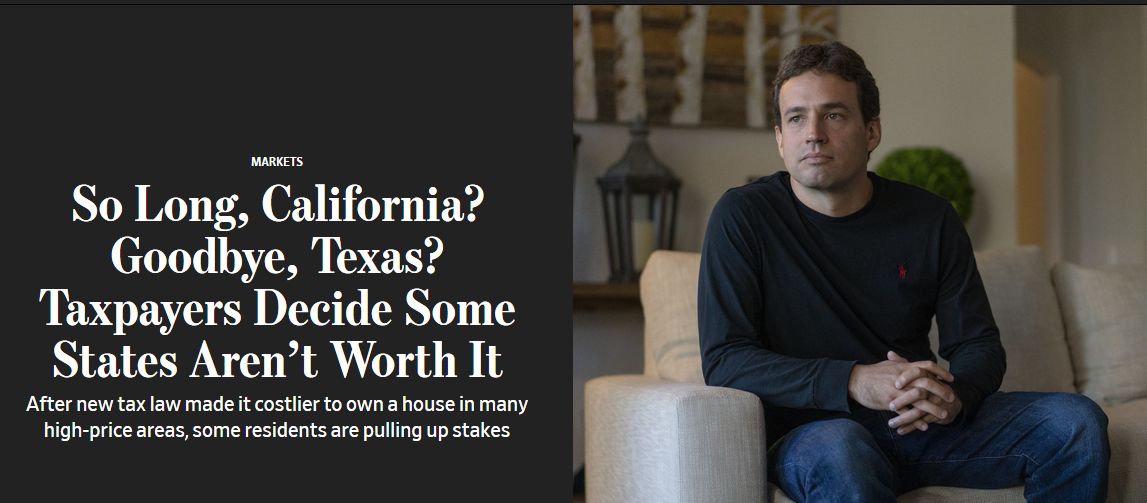
Larry Belardi and Bobbie LaPorte are longtime San Francisco residents, but they are planning to leave California for Nevada next year.
A turning point was the federal tax overhaul that Congress passed in late 2017. The law made it costlier to own a house in many high-price, high-tax areas, reshaping the economics of homeownership in those slices of the U.S.
Two years after President Trump signed the tax law, its effects are rippling through local economies and housing markets, pushing some people to move from high-tax states where they have long lived. Parts of Florida, for example, are getting an influx of buyers from states such as New York, New Jersey and Illinois.

Many people saw their overall taxes go down after the 2017 law was passed. But the law had two main changes making it tougher to live in high-cost, high-tax states, especially compared with lower-taxed options. It essentially curbed how much homeowners can subtract from their federal taxes for paying local property and income taxes, by capping the state and local tax deduction at $10,000. It also lowered the size of mortgages for which new buyers can deduct the interest, to $750,000 from $1 million.
These changes have the biggest impact on a sliver of the population who have high incomes and live in expensive areas. They tend to have white-collar jobs and the ability to pick up and move. Many own their own businesses, work remotely or are nearing retirement.
Critics say the changes have hurt everyone who lives in high-tax states, by taking a bite out of tax revenue. New York Gov. Andrew Cuomo, for example, panned the state and local tax cap last year. “It has redistributed wealth in this nation from Democratic states—we’re also called blue states—to red states,” he said at the time.
The average property tax bill in the U.S. in 2018 was about $3,500, according to Attom Data Solutions, a real-estate data firm. But many residents in New York, New Jersey, Connecticut and California had been deducting well over $10,000 a year. In Westchester County, N.Y., the average property-tax bill was more than $17,000, the highest in the country. |
|



