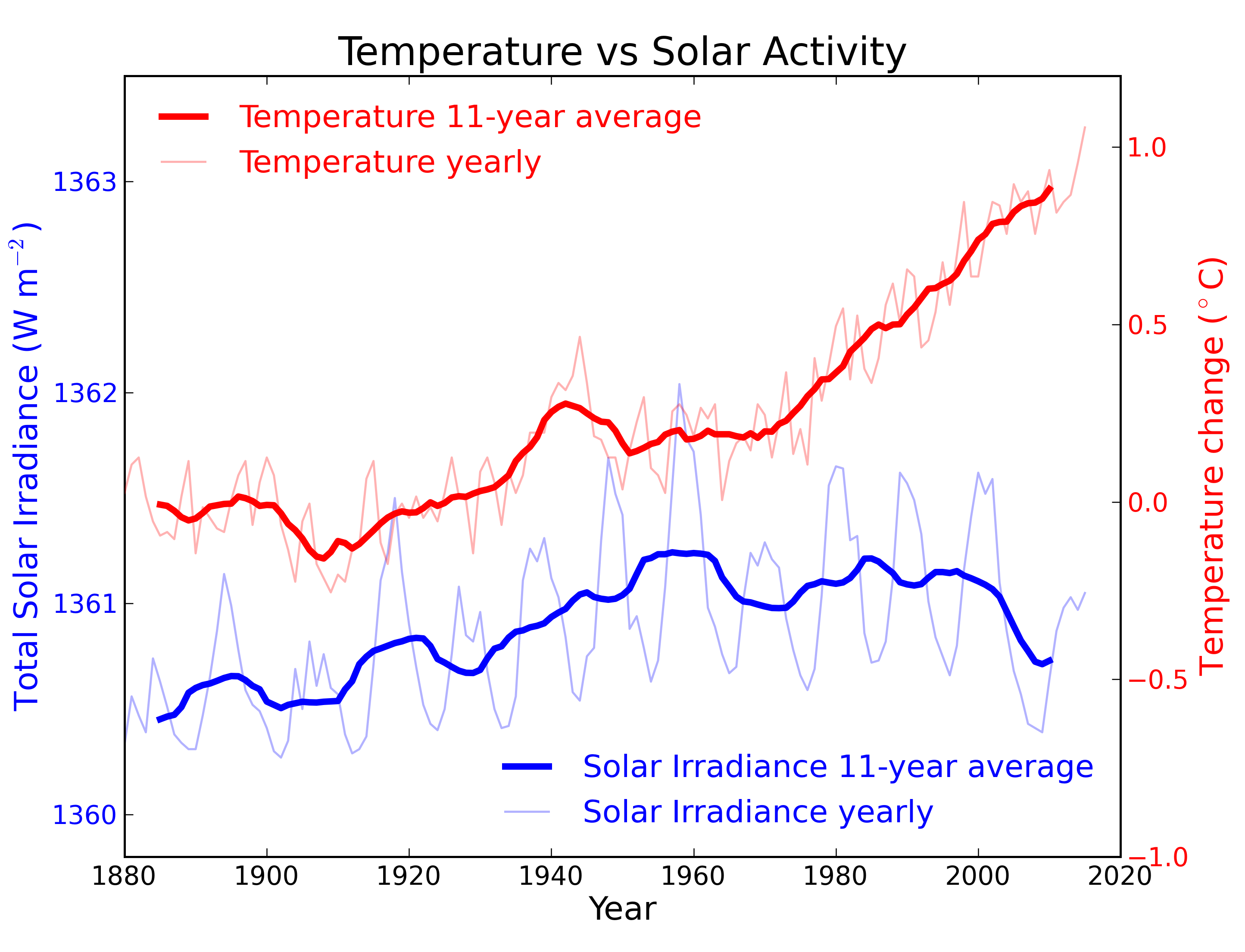
"the climate change activists refuse to attribute any change in climate to the sun."
Solar activity is down, and temps are up.
Monthly Temperature: January 2020
The global land and ocean surface temperature for January 2020 was the highest in the 141-year record, with a temperature departure from average of 1.14°C (2.05°F) above the 20th century average. This value was only 0.02°C (0.04°F) higher than the now second highest January temperature departure from average set in 2016. The four warmest Januaries on record have occurred since 2016, while the 10 warmest Januaries have occurred since 2002. The only Januaries with a global land and ocean surface temperature departure from average above 1.0°C (1.8°F) occurred in 2016 and 2019.
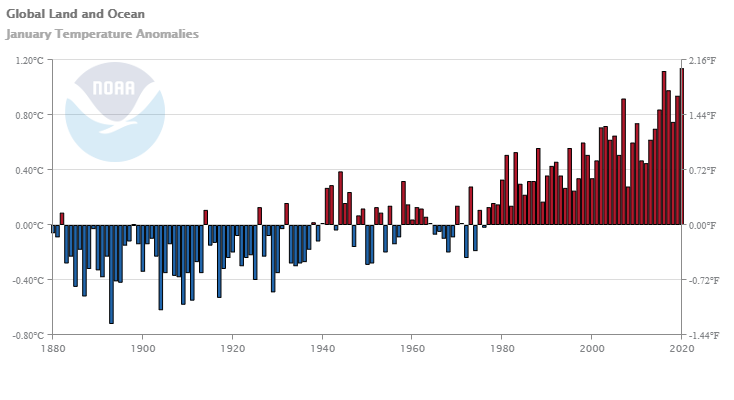
The January global land and surface temperature departure was also the fourth highest monthly temperature departure in the 1681-month record. Only March 2016, February 2016, and December 2015 had a greater temperature departure; all months that had a strong warm phase El Niño / Southern Oscillation (ENSO) present in the tropical Pacific Ocean. ENSO, which is a periodic fluctuation in sea surface temperature and air pressure of the overlying atmosphere across the tropical Pacific Ocean, can influence global temperatures. A warm phase ENSO, also known as El Niño, tends to have a warming influence on global temperatures, while the cold phase (La Niña) tends to have a cooling influence.
However, the January 2020 global land and ocean surface temperature departure from average was the highest for any month during ENSO neutral conditions, meaning El Niño or La Niña was not present in the tropical Pacific Ocean. March 2017 (+1.08°C / +1.94°F), December 2019 (+1.05°C / +1.89°F), and February 2017 (+1.02°C / +1.84°F) were the other months where the global land and ocean surface temperature departure from average was above 1.0°C (1.8°F) during ENSO neutral conditions in the tropical Pacific Ocean.
ncdc.noaa.gov
==
Paris climate target is 1.5 degrees above pre-industrial.
Jan. was 1.14 degrees above 20th century baseline.
IIRC, 20CB is 0.3+ above pre-industrial, so we're there....again.It gets a bit confusing cuz groups use different baselines for both pre-industrial and 20th century.
BTW, 2016 was an intense El Nino, 2020 is neutral.
This is 2016.
A Climate Central analysis shows that the world will have to dramatically accelerate emissions reductions if it wants to meet that goal. The average global temperature change for the first three months of 2016 was 1.48°C, essentially equaling the 1.5°C warming threshold agreed to by COP 21 negotiators in Paris last December.
February exceeded the 1.5°C target at 1.55°C, marking the first time the global average temperature has surpassed the sobering milestone in any month. March followed suit checking in at 1.5°C. January’s mark of 1.4°C, put the global average temperature change from early industrial levels for the first three months of 2016 at 1.48°C.

NASA’s data alone showed a February temperature anomaly of 1.63°C above early industrial levels with March at 1.54°C
scientificamerican.com |



