"At least we stopped climate change"
Feb's data is out. I'm thinking we might break 2016's record. IIRC, '16 cooled fairly quickly beginning in March. Here are some highlights.
Monthly Temperature: February 2020
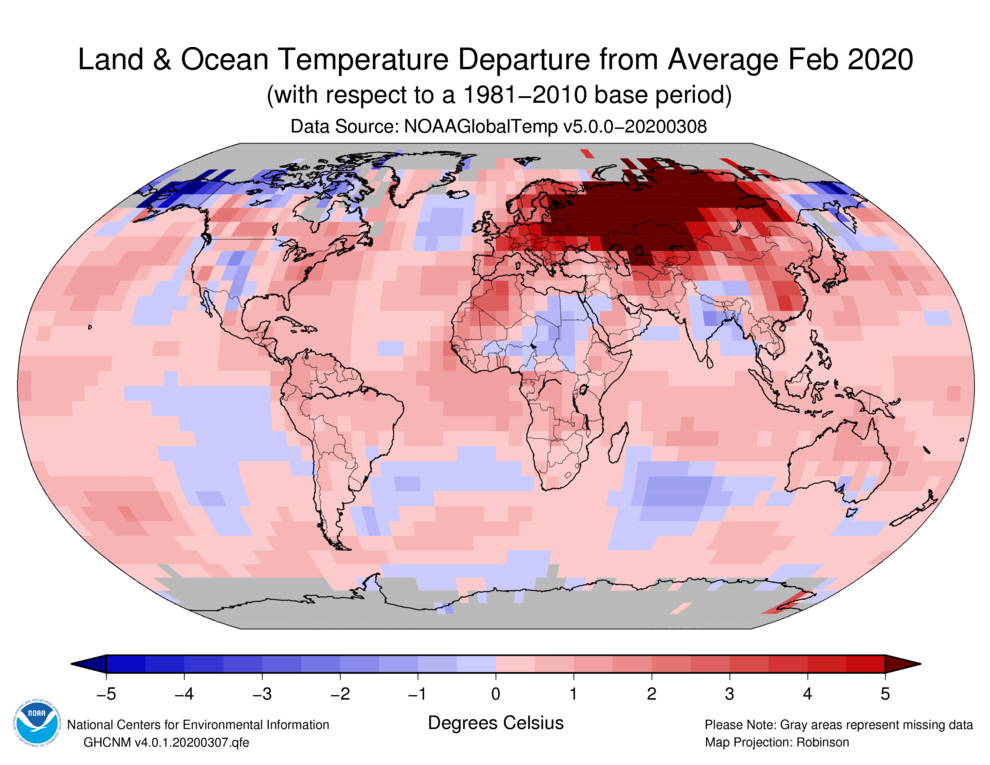
The month was characterized by warmer-than-average conditions across much of the land and ocean surfaces, with the most notable warm temperatures across much of Europe and western and central Asia where temperature departures were at least 4.0°C (7.2°F) above average or higher. Meanwhile, Alaska, northern Canada, and Far East Russia had the most notable cool temperature departures at 3.0°C (5.4°F) below average or cooler. Much of this warmth across the mid-latitude and cool temperatures across Alaska and Polar Regions can be attributed to the positive phase of the Arctic Oscillation (AO). During a positive AO, very strong winds circulate in the jet stream which trap very cold air at the poles, while the mid-latitudes tend to have warmer-than-average temperatures. During February 2020, the daily AO index was very high, setting a new all-time record high value on 21 February 2020 at 6.07. Please see our Synoptic Discussion page for additional information.
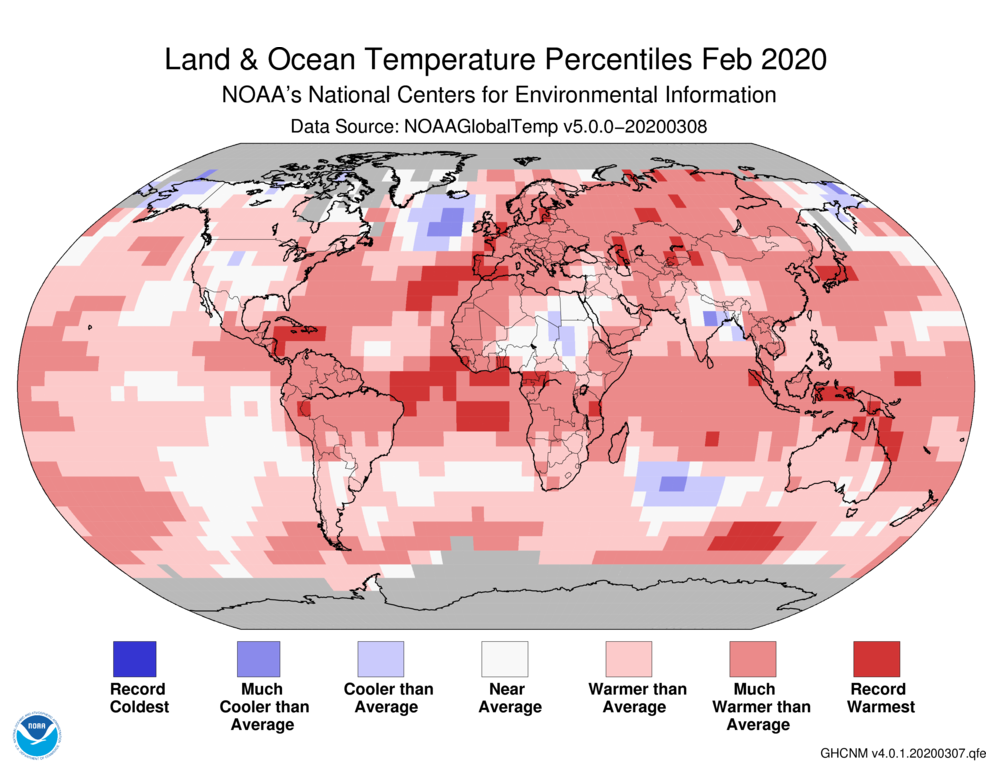
Although unusually warm temperatures engulfed much of Russia and Europe during February 2020, only a few locations had record warm February temperatures. Other record warm temperatures were present across parts of the Atlantic, Indian, and western Pacific oceans.
February 2020 Blended Land and Sea Surface
Temperature Anomalies in degrees Celsius
February 2020 Blended Land and Sea Surface
Temperature Percentiles
Averaged as a whole, February 2020 was near-record warm with a global land and ocean surface temperature departure from average of 1.17°C (2.11°F) above the 20th century average. Only February 2016 was warmer. This month marked the 44th consecutive February and the 422nd consecutive month with temperatures, at least nominally, above the 21th century average. The 10 warmest Februarys have occurred since 1998. The February 2020 temperature departure from average was also the third highest monthly temperature departure from average for any month in the 1,682-month record. Only March 2016 (+1.31°C / +2.36°F) and February 2016 (+1.26°C / +2.27°F) had a higher temperature departure.
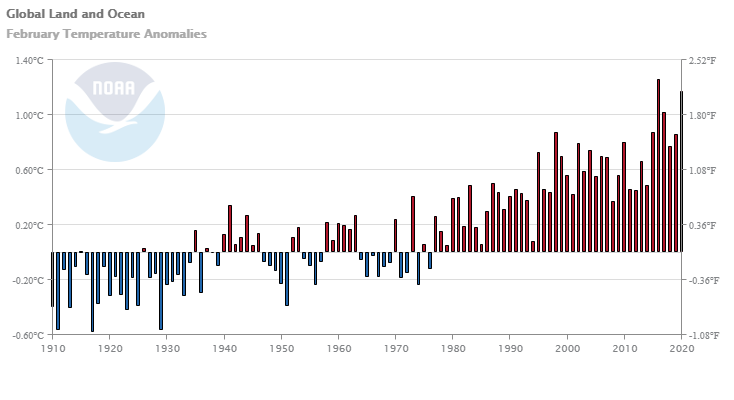
According to NOAA's Climate Prediction Center (CPC), ENSO-neutral conditions were present across the tropical Pacific Ocean during February 2020. This means that the February 2020 global land and ocean surface temperature departure from average was the highest monthly temperature departure without an El Niño present in the tropical Pacific Ocean, surpassing the previous record set only last month (January 2020). The months of February and March 2017, December 2019, and January 2020 were the other months with temperature departures above 1.0°C (1.8°F) during ENSO-neutral conditions. CPC states that ENSO-neutral is favored during the Northern Hemisphere winter (Southern Hemisphere summer). This forecast focuses on the ocean surface temperatures between 5°N and 5°S latitude and 170°W to 120°W longitude, called the Niño 3.4 region....
Seasonal Temperature: December–February 2020
The December–February period is defined as the Northern Hemisphere's meteorological winter and the Southern Hemisphere's meteorological summer.
The second warmest December, warmest January, and second warmest February gave way to the second warmest December–February seasonal period in the 141-year record. The global land and ocean surface temperature for the three-month season was 1.12°C (2.02°F) above the 20th century average. The three-month period of December 2015–February 2016 had a higher temperature departure at 1.18°C (2.12°F). This value also tied with the three-month period of March–May 2016 as the fourth highest three-month period of any three-month period on record. Only January–March 2016 (tied warmest), February–April 2016 (tied warmest), and December 2015–February 2016 (third warmest) were warmer.

The global land-only surface temperature was the highest on record for December–February at 2.04°C (3.67°F) above the 20th century average. This value was only 0.01°C (0.02°F) warmer than the now second warmest such period set in 2016. The seasonal three-month land-only surface temperature departure was also the third highest three-month global land temperature departure for any three-month period on record, trailing behind February–April 2016 (+2.30°C / +4.14°F) and January–March 2016 (+2.21°C / +3.98°F).
ncdc.noaa.gov |