Here's part of the Wikipedia page on Herd Immunity. It's interesting to note that herd immunity with Covid-19 is reached at a relatively low estimated percentage of 29-74%. The antibody tests should figure out where we're at pretty soon.
en.wikipedia.org
Mechanics [ edit]
Further information: Mathematical modelling of infectious disease
Individuals who are immune to a disease act as a barrier in the spread of disease, slowing or preventing the transmission of disease to others. [3] An individual's immunity can be acquired via a natural infection or through artificial means, such as vaccination. [3] When a critical proportion of the population becomes immune, called the herd immunity threshold (HIT) or herd immunity level (HIL), the disease may no longer persist in the population, ceasing to be endemic. [5] [29]
This threshold can be calculated by taking R0, the basic reproduction number, or the average number of new infections caused by each case in an entirely susceptible population that is homogeneous, or well-mixed, meaning each individual can come into contact with every other susceptible individual in the population, [9] [29] [42] and multiplying it by S, the proportion of the population who are susceptible to infection:
R 0 · S = 1. {\displaystyle \ R_{0}\cdot S=1.}  S can be rewritten as (1 - p) because p is the proportion of the population that is immune and p + S equals one. Then, the equation can be rearranged to place p by itself as follows: S can be rewritten as (1 - p) because p is the proportion of the population that is immune and p + S equals one. Then, the equation can be rearranged to place p by itself as follows:
R 0 · ( 1 - p ) = 1 , {\displaystyle \ R_{0}\cdot (1-p)=1,}  ? 1 - p = 1 R 0 , {\displaystyle 1-p={\frac {1}{R_{0}}},} ? 1 - p = 1 R 0 , {\displaystyle 1-p={\frac {1}{R_{0}}},}  ? p c = 1 - 1 R 0 . {\displaystyle p_{c}=1-{\frac {1}{R_{0}}}.} ? p c = 1 - 1 R 0 . {\displaystyle p_{c}=1-{\frac {1}{R_{0}}}.} 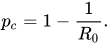 With p being by itself on the left side of the equation, it can now be written as pc to represent the critical proportion of the population needed to become immune to stop the transmission of disease, or the "herd immunity threshold". [9] R0 functions as a measure of contagiousness, so low R0 values are associated with lower HITs, whereas higher R0s result in higher HITs. [29] [42] For example, the HIT for a disease with an R0 of 2 is theoretically only 50%, whereas with disease with an R0 of 10 the theoretical HIT is 90%. [29] With p being by itself on the left side of the equation, it can now be written as pc to represent the critical proportion of the population needed to become immune to stop the transmission of disease, or the "herd immunity threshold". [9] R0 functions as a measure of contagiousness, so low R0 values are associated with lower HITs, whereas higher R0s result in higher HITs. [29] [42] For example, the HIT for a disease with an R0 of 2 is theoretically only 50%, whereas with disease with an R0 of 10 the theoretical HIT is 90%. [29]
These calculations assume that the entire population is susceptible, meaning no individuals are immune to the disease. In reality, varying proportions of the population are immune to any given disease at any given time. [9] To account for this, the effective reproductive number Re, also written as Rt, or the average number of infections caused at time t, can found by multiplying R0 by the fraction of the population that is still susceptible. When Re is reduced to and sustained below 1, the number of cases occurring in the population gradually decreases until the disease has been eliminated. [9] [29] [56] If a population is immune to a disease in excess of that disease's HIT, the number of cases reduces at a faster rate, outbreaks are even less likely to happen, and outbreaks that occur are smaller than they would be otherwise. [1] [9] If Re increases to above 1, then the disease is neither in a steady state nor decreasing in incidence, but is actively spreading through the population and infecting a larger number of people than usual. [43] [56]
A second assumption in these calculations is that populations are homogeneous, or well-mixed, meaning that every individual comes into contact with every other individual, when in reality populations are better described as social networks as individuals tend to cluster together, remaining in relatively close contact with a limited number of other individuals. In these networks, transmission only occurs between those who are geographically or physically close to one another. [1] [42] [43] The shape and size of a network is likely to alter a disease's HIT, making incidence either more or less common. [29] [42]
In heterogeneous populations, R0 is now considered to be a measure of the number of cases generated by a "typical" infectious person, which depends on how individuals within a network interact with each other. [1] Interactions within networks are more common than between networks, in which case the most highly connected networks transmit disease more easily, resulting in a higher R0 and a higher HIT than would be required in a less connected network. [1] [43] In networks that either opt not to become immune, or are not immunized sufficiently, diseases may persist despite not existing in better-immunized networks. [43] |



