| | | The epic battle against coronavirus misinformation and conspiracy theories
Analysts are tracking false rumours about COVID-19 in hopes of curbing their spread.
Philip Ball &Amy Maxmen
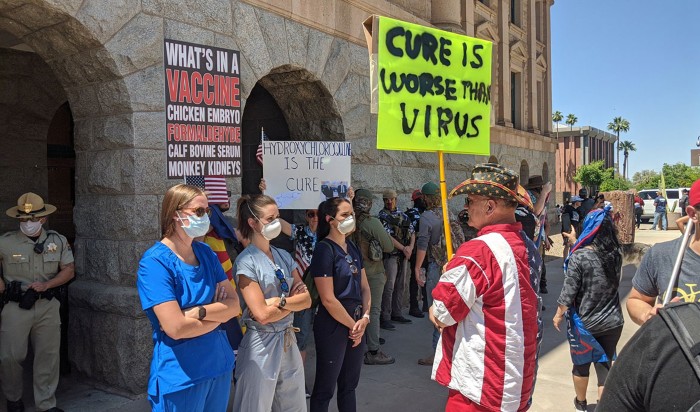
Protesters rallying in Arizona against lockdowns held up signs carrying anti-vaccine messages and promoting unproven treatments. Credit: Adam Waltz/ABC15 Arizona
PDF version
In the first few months of 2020, wild conspiracy theories about Bill Gates and the new coronavirus began sprouting online. Gates, the Microsoft co-founder and billionaire philanthropist who has funded efforts to control the virus with treatments, vaccines and technology, had himself created the virus, argued one theory. He had patented it, said another. He’d use vaccines to control people, declared a third. The false claims quietly proliferated among groups predisposed to spread the message — people opposed to vaccines, globalization or the privacy infringements enabled by technology. Then one went mainstream.
On 19 March, the website Biohackinfo.com falsely claimed that Gates planned to use a coronavirus vaccine as a ploy to monitor people through an injected microchip or quantum-dot spy software. Two days later, traffic started flowing to a YouTube video on the idea. It’s been viewed nearly two million times. The idea reached Roger Stone — a former adviser to US President Donald Trump — who in April discussed the theory on a radio show, adding that he’d never trust a coronavirus vaccine that Gates had funded. The interview was covered by the newspaper the New York Post, which didn’t debunk the notion. Then that article was liked, shared or commented on by nearly one million people on Facebook. “That’s better performance than most mainstream media news stories,” says Joan Donovan, a sociologist at Harvard University in Cambridge, Massachusetts.
Donovan charts the path of this piece of disinformation like an epidemiologist tracking the transmission of a new virus. As with epidemics, there are ‘superspreader’ moments. After the New York Post story went live, several high-profile figures with nearly one million Facebook followers each posted their own alarming comments, as if the story about Gates devising vaccines to track people were true.

Coronavirus misinformation needs researchers to respond
The Gates conspiracy theories are part of an ocean of misinformation on COVID-19 that is spreading online. Every major news event comes drenched in rumours and propaganda. But COVID-19 is “the perfect storm for the diffusion of false rumour and fake news”, says data scientist Walter Quattrociocchi at the Ca’Foscari University of Venice, Italy. People are spending more time at home, and searching online for answers to an uncertain and rapidly changing situation. “The topic is polarizing, scary, captivating. And it’s really easy for everyone to get information that is consistent with their system of belief,” Quattrociocchi says. The World Health Organization (WHO) has called the situation an infodemic: “An over-abundance of information — some accurate and some not — rendering it difficult to find trustworthy sources of information and reliable guidance.”.....
==
Where are you?
nature.com |
|



