Republican loyalty to Trump won’t survive a November lossHistory shows politicians put their self-interest above all else. If the president is defeated, Republicans will be forced to reinvent themselves while leaving Trump behind.
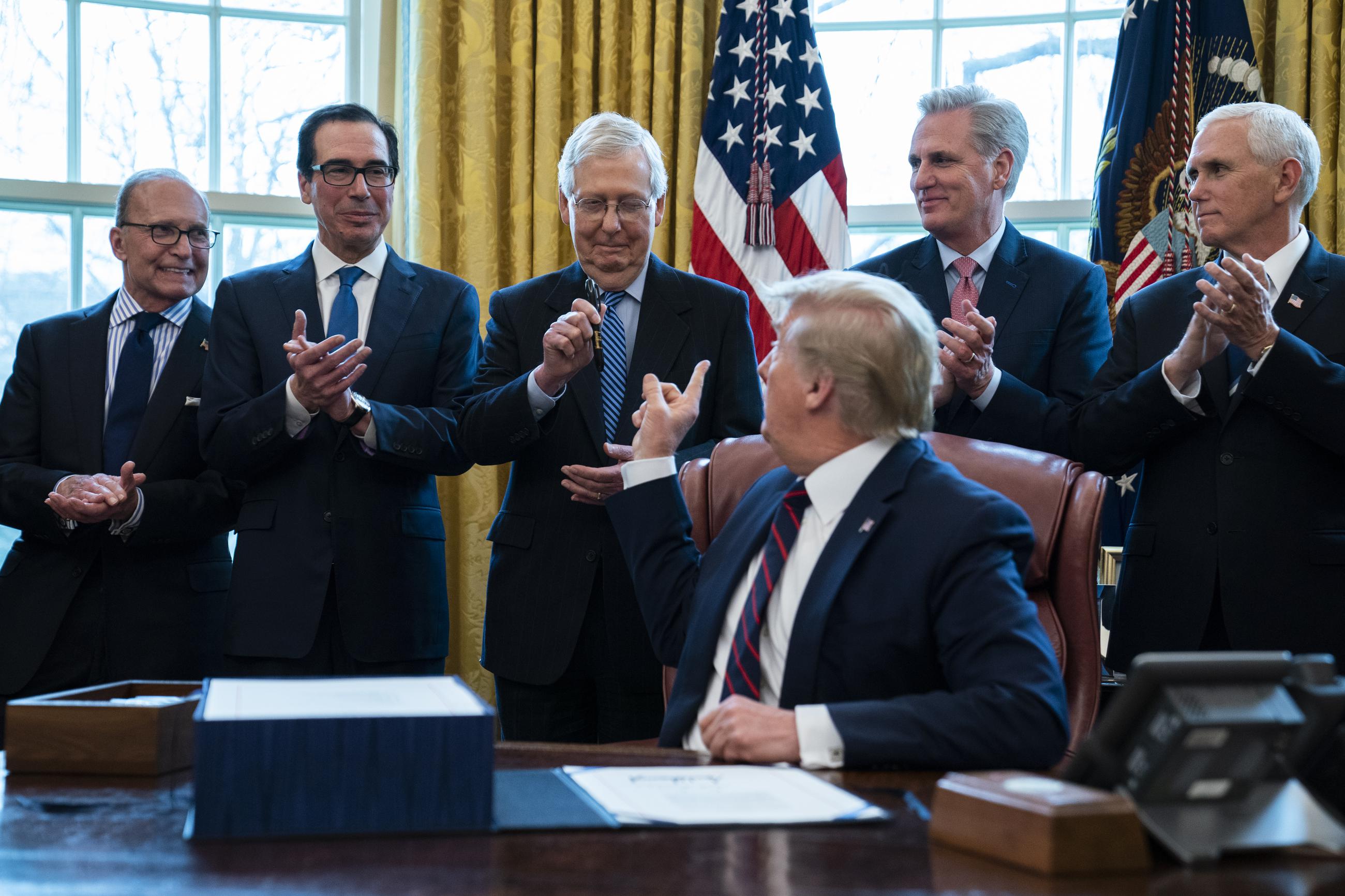
AP Photo/Evan Vucci
Josh Kraushaar
June 7, 2020, 6 a.m.
The latest wave of polls continues to paint a grim picture for the Trump White House: The president is losing by double digits to Joe Biden in a new Monmouth survey, he’s down by 9 points in battleground Wisconsin, and he’s either losing or statistically tied in states that he comfortably carried in 2016, like Ohio and Texas. All this raises a significant question: If Trump is repudiated decisively at the ballot box, what would a post-Trump Republican Party look like?
There are two schools of thought, roughly speaking. One, articulated by Anne Applebaum in a provocative Atlantic essay comparing Trump’s Republican allies to Vichyite enablers and Communist functionaries, analyzes the myriad reasons that mainstream Republicans have abandoned their principles to work for an immoral and unstable president. It ends on a sanguine note, concluding that careerist Republicans and ideologues alike will adapt to a new reality when he’s out of office, evolving again just as Communist apparatchiks did after the fall of the Berlin Wall.
“At some point, after all, the calculus of conformism will begin to shift. It will become awkward and uncomfortable to continue supporting ‘Trump First,’ especially as Americans suffer from the worst recession in living memory and die from the coronavirus in numbers higher than in much of the rest of the world,” she writes.
The one flaw with her analysis is that ignores the key difference between the Cold War dictatorships of Eastern Europe and the broken democracy of the current-day United States. Communist bureaucrats were intimidated into silence and complicity by the threat of punishment by the ruling regime. Voters had no say in the state of their countries’ affairs.
But in the United States, it’s Trump’s democratic hold on Republican Party voters that’s cowing most GOP elected officials into submission or silence. It’s a sign of broken institutions: Voters are receiving their news on polluted social media instead of traditional news sources, while the collapse of party organizations allows self-interested ideological actors to drive the party to extremes.
The main reason Lindsey Graham has morphed into Trump’s most reliable ally while Mitt Romney emerged as a steadfast critic is mainly a consequence of the voters they represent. Graham is up for reelection in a conservative state where his standing with Republican voters had always been shaky. To have any chance of winning his primary, he needs to have Trump’s back. Romney was elected in Utah, one of the few states where Republican voters aren’t all that enamored with the president. He was able to win his primary in 2018 without kowtowing to the president, and isn’t up for reelection for another four years.
Blame Trump’s GOP allies for not putting their principles ahead of their self-interest, but understand that’s the way the democratic American system works. We want our leaders to be responsive to voters. We just never realized that a critical mass of voters would be drawn to an unstable authoritarian-minded figure, regardless of the outside circumstances.
The most intriguing question is to what degree a Trump loss would puncture this group psychology. Will an embarrassing defeat shatter the mirage of strength that his supporters believe? Will he lose his influence without wielding the levers of power or will his Twitter feed remain a reliable megaphone to keep Republicans in line? Will Democrats allow the Republican Party to move on, or will they continue to use the specter of Trump to rally their own voters in the future?
There aren’t any obvious answers to those questions. Like Applebaum, famed anti-Trump conservative columnist George Will thinks that the Republican Party will turn fairly quickly away from Trump. "I’m fairly confident that Mr. Trump will be defeated in the election. The next morning, a lot of Republicans will say, ‘Trump? I don’t recognize the name.’ They’ll get over this fairly fast,” Will said on MSNBC last week.
Arguing against Applebaum and Will, The Bulwark’s Jonathan Last holds the more commonly held view that Trumpism is here to stay. “The error that Applebaum makes is that she views Trump's hold on power to be the power of the presidency. I would argue that Trump's tenure as president is an accident that is incidental to his real seat of power: ownership of the Republican Party,” he writes.
The history of losing one-term presidents suggests that those repudiated at the ballot box become largely irrelevant in retirement. We didn’t hear much from George H.W. Bush or Jimmy Carter after they lost badly. Herbert Hoover, despite his overall record of good works, was consigned into political ignominy after presiding during the Great Depression.
Trump is different, of course. He’s not going to slink quietly away from the political scene. He will be raising a ruckus on Twitter and beyond, and will still have a loyal cadre of allies willing to promote his divisive messages even out of power. He’s even toyed with the idea of starting his own media company.
But even though Trump doesn’t follow the traditional political playbook, the politics of the Trump era have been awfully predictable. After winning the 2016 election, Republicans have been routed in nearly every election since. They’ve lost control of the House. They’re on track right now for a political shellacking, at risk of being shut out of power entirely in Washington.
If Republicans want to win elections into the future in a diversifying America, they’re going to need to keep some distance from the president. They’re not suicidal. In the Trump era, they’ve been making the amoral but strategically sound judgment that there’s no way they can survive without maintaining a good relationship with the president. Just look at the careers of apostates like Jeff Flake or Mark Sanford to see what happened to Republicans who disagree with Trump. On the other hand, they haven’t won many swing-state elections with him, either.
The most likely scenario is that an out-of-power Trump will still be viewed favorably by most Republicans, but will no longer be the political force that can handpick primary winners and dictate the party’s legislative strategy. There won’t be a sudden break with Trump, but rank-and-file Republicans will no longer show him abject loyalty. There will be a new faction of Republican leaders, like Sen. Ben Sasse, that will build a power base entirely independently from Trump’s orbit.
And if back-in-power Democrats overreach, governing to appease vocal left-wingers when their coalition depends on support from suburban moderates, the Republican Party won’t have a difficult time recreating itself as a vehicle to stop the worst excesses of a Biden administration. That’s the way politics works.
nationaljournal.com |



