| | | they torn down this guys statue Victor Schœlcher (French: [vikt?? ?œl?e?]; 22 July 1804 – 25 December 1893) was a French politician and writer, best known for his work towards the abolition of slavery in France.
Contents
1Biography 2Works 3Legacy 4Notes 5References 6External links
Biography[ edit]

Bust of Victor Schœlcher, Pondicherry, India.
Schœlcher was born in Paris. His father, Marc Schœlcher (1766–1832), from Fessenheim in Alsace, was the owner of a porcelain factory. [1] His mother, Victoire Jacob (1767–1839), from Meaux in Seine-et-Marne, was a laundry maid in Paris at the time of their marriage. Victor Schœlcher was baptized in Saint-Laurent Church on 9 September 1804.
He studied at the Lycée Condorcet, became a journalist, opposing the government of Louis Philippe and making a reputation as a pamphleteer. After 1826 he devoted himself almost exclusively to advocacy of the abolition of slavery throughout the world, contributing a part of his large fortune to establish and promote societies for the benefit of blacks.
He was sent to visit America for business from 1829 to 1830. While in America he visited Mexico, Cuba and some of the southern states of the U.S. On this trip Schœlcher learned a lot about slavery and began his career as an abolitionist writer. From 1840 to 1842 he visited the West Indies, and from 1845 to 1847 Greece, Egypt, Turkey, and the west coast of Africa to study slavery.
He was responsible for the publication of many articles regarding slavery between 1833 and 1847 in which he focused on positive aspects of abolishing slavery. Schœlcher was also intent on social, economic, and political changes being made in the Caribbean colonies. He thought that the production of sugar should continue in the colonies but large central factories should be constructed rather than using slave labor. Schœlcher was the first European abolitionist to visit Haiti and had a large influence on the abolitionist movements in all of the French West Indies. He was actively against the debt collected from the Haitians as French slave owners sought reparations for their lost property after the Haitian Revolution. [2]
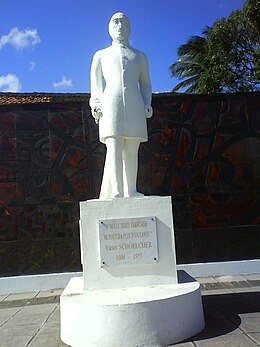
Victor Schœlcher statue in Schœlcher, Martinique
On 3 March 1848, he was appointed under-secretary of the navy, and caused a decree to be issued by the provisional government which acknowledged the principle of the enfranchisement of the slaves through the French possessions. As president of a commission, Schœlcher prepared and wrote the decree of 27 April 1848 in which the French government announced that slavery was abolished in all of its colonies. |
|




.jpg)