| | | Migration: The Great Transformation of Germany
Posted on September 14, 2020 by Baron Bodissey
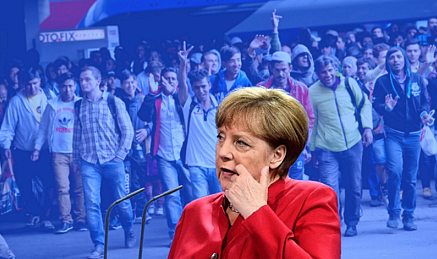
Many thanks to Hellequin GB for translating this article from Tichys Einblick:
Migration: The Great Transformation of Germany
Merkel’s “We can do it”* creates a different Germany:
When it comes to converting to a new migration society, non-immigrant Germans are even to be disadvantaged in order to prevent “racial inequality”.
Can that go well?
Since 2015 [Chancellor Angela] Merkel and her political allies have refused to say where their immigration policy should actually lead.
The illusions of that time have burst: Germany cannot integrate hundreds of thousands of young men — but it cannot get rid of them, either, and yet more new migrants are encouraged to come.
A transformation is being pursued with energy and largely without contradiction from politics, the goals of which remain in the dark and the costs of which are concealed.
The division of the cities
Germany is in the process of a rapid ethnic and cultural transformation.
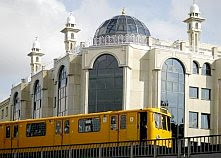
It is becoming visible in more and more city quarters that are evacuated by locals and dominated by immigrants from the Arab and North African regions.
Germany’s segregation is progressing rapidly: in cities such as Stuttgart half of the population are migrants; in Frankfurt the situation is similar.
The Taunus suburbs, on the other hand, are “white”.
In Munich-Grünwald, in Bogenhausen or in Berlin-Wilmersdorf, the locals keep largely to themselves, apart from the domestic staff.
Berlin-Neukölln, on the other hand, is an Arabized district that hardly a police officer dares to venture into.
“We keep taking note of the fact that certain sections of the population not only ignore our rule of law, the constitutional organs, but also the police, public order and rescue workers, but even attack and fight them,” complains the local deputy mayor Falko Liecke in an interview with Tichys.
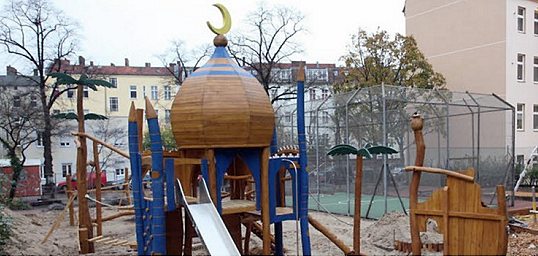
Society is divided along ethnic lines because the ability to integrate has long been exceeded.
The praised diversity separates itself more and more into different single-color spots every day.
It has long since ceased to be about Merkel’s “We can do it” in the Syrian refugee crisis, nor is it about the high costs of providing for migrants, nor the question of whether Germany is a country of immigration.
Since 2015 it has become a country without borders and without controls on immigration and its consequences.
The question of integration has long since ceased to arise: it doesn’t exist.
Asylum seekers whose applications have been rejected are simply given another residence permit, if necessary under the radar of the authorities.
Deportations are practically non-existent because they are too laborious for the authorities to deal with the phalanx of lawyers, churches and bureaucratic obstacles.
Most immigrants are allowed to remain as clients of the social system.
Immigration without a goal or justification
Germany is the only country in the world that takes in large numbers of immigrants — over two million since 2015 — without defining what form the society advertised under the heading of “diversity” should actually take.
There are no clear rules for coming or staying.
At the state party conference of the CDU in Mecklenburg-Western Pomerania in February 2017, Merkel declared: “The people are everyone who lives in this country.”
Her statement describes an open immigration country without borders, comparable to the USA in the 19th century: Whoever crosses the border comes, whether with papers or without, willing to integrate or not; is just there.
That fits into the prairie from which the Indians are expelled, but not with the Basic Law.
It was never politically negotiated, but describes the egg dance around the new reality of the country quite well:
We can’t do it, we can do it, at some point most of them have to go back, but actually everyone should stay and belong.
In 2020, around a quarter of a million people without a secure residence status will live in Germany, i.e. migrants who are neither entitled to asylum nor are they considered refugees, and whose applications were sometimes rejected years ago.
This legal no-man’s-land is twice as big today as it was in 2014.
The Chancellor, Interior Minister Horst Seehofer and state politicians assure again and again that anyone who receives neither asylum nor recognition as a refugee will eventually be deported.
In reality, the number of deportations has been falling since 2016.
At that time there were 25,375 people who were removed from the country — not many in any case — and the number fell to 22,097 in 2019.
In addition, the Federal Ministry of the Interior had to admit: of so-called Dublin cases, i.e. deportations from Germany to Italy and Greece, around a third return immediately to the Federal Republic.
All you need is a ticket for the next Flixbus.
The internal police ridicule it with: “one, two, flix”.
Refusals at the border, which Seehofer wanted to enforce against Merkel in the summer of 2018, are so legally complicated that they hardly ever take place.
From mid-2018 to early 2019, federal police officers sent 11 migrants back to other EU countries, according to the Interior Ministry.
The former President of the Federal Constitutional Court Hans-Jürgen Papier said in 2019: “Sedative pills for the population.”
The demand of the State Secretary for Integration in North Rhine-Westphalia, Serap Güler (CDU), sounds almost forever yesterday:
Integration policy should invest in symbols for “identification with being German” and stories about the “rising republic”.
Analogous to the “American Way of Life” or “Stars and Stripes”, immigrants’ sense of belonging can also be increased in Germany through national symbols.
A proper roll call in front of the German flag in the temporary accommodation and the singing of the Germany song together?
Unimaginable with Merkel, who is grinding up national symbols.
It sounds more like a sedative pill.
What is more effective is a counter-model that Naika Foroutan, a professor at Berlin’s Humboldt University and the director of the German Center for Integration and Migration Research (DeZIM), calls the “post-migrant society”, a socio-politically desirable development, namely the “utopia of equality that goes beyond the migrant and lies outside of one’s origin.”
This is absolutely true for the welfare state, one of the core pieces of German identity and, after all, comprising a third of the entire economic output.
This equality in the welfare state results from equating those “who have lived here for a long time” (Merkel) with those who join them every day.
The entitlements to the welfare system acquired through taxes and contribution payments should not count:
“The welfare state is there indiscriminately for everyone who is here or who comes every day.
For this equality, the one who is already here becomes the paymaster for new arrivals.”
Legal downgrade of locals
To this end, a new “social narrative” is to be enforced to create “a common space of diversity beyond ancestry”.
And because “locals” and parts of the corrupted guest-worker population fear for their material livelihood and cultural identity in the face of ever-new “diversity” through archaic, Muslim social structures, Foroutan proposes a “re-education program”, as the Allies allowed the Germans to do after 1945.
It is an “overturning plan” for society as a whole, according to Thomas A. Becker, former head of research at the Gottlieb Duttweiler Institute.
It could be dismissed as academic madness.
But the “overthrow” has long been EU law, for example in the form of the EU anti-racism directive, which was first implemented in Germany in the Berlin Police Act: If plaintiffs substantiate facts that “suggest” discrimination, “the defendant must prove” that the principle of equal treatment has not been violated. In the future, the Berlin police officers will have to prove that they have not discriminated.
“Racial profiling” will soon be banned, for example when police officers spot dealers with their experienced eyes.
Punishment threatens the police, not the perpetrators.
In future, police officers will check groups of pensioners in the train station who are returning from their hiking excursion. This is unproblematic because whites cannot be discriminated against, because they are not “structurally” disadvantaged. On the other hand, there is no control of dealers from North Africa because this could be “structural discrimination” or “racial profiling”.
It is mostly overlooked that the Berlin Police Act is only the logical continuation of a legal political development. The Federal Anti-Discrimination Act of 2006 (AGG) only implemented the anti-discrimination directives of the EU. It restricts the freedom of contract, among other things with job allocation and apartment rental. Consequence: A group of African “refugees” and a young family with many children without a migrant background apply for the same apartment. Only the former enjoy protection against discrimination.
However, the AGG does not affect any authorities, but only the legal relations between citizens. There was therefore an implementation deficit. The Berlin State Anti-Discrimination Act (LADG) closes this gap: For the first time, the public administration is put on the anti-discrimination curb. In addition to compensation for damages, the facilitation of evidence was also introduced: If facts make a discriminatory motive “predominantly likely”, the employee must prove that it was not decisive. Pitfalls lurk for police officers, teachers, municipal employees, etc. Affected associations should bring momentum into such matters, which is also an EU requirement.
Discrimination against locals
Public employees are not personally liable, but the country is.
However, the consequences for their professional advancement can be serious.
All public bodies must take “diversity skills” into account when assessing performance, especially in the case of “superiors and employees with management functions”. Adaptive crawling must now encourage careers.
The real crux, however, lies in the fact that this legislative development, initiated by the EU, encourages discrimination against the majority of the population:
Unequal treatment is justified insofar as “disadvantages of structurally disadvantaged people” are to be “compensated for” by measures (Paragraph 5).
The law thus encourages the state government to support minorities financially or to issue compensatory quota regulations, for example in public broadcasting. Population groups that do not meet the criteria for minority protection, however, may be disadvantaged: German families, heterosexuals, Christians, old white men.
It is the locals who are all identified as suspects, if not as perpetrators.
It’s a quiet overthrow; driven by laws from top to bottom.
There has never been a political debate or vote on it since Merkel removed the borders of Germany and its legal and social system with an administrative coup in summer 2015.
And it seems irreversible, because it is wanted by the so-called political elite.
Five years ago the Green politician Katrin Göring-Eckardt called out: “Our country will change drastically. And I tell you — I’m looking forward to it.”
Five years later the changes become obvious.
Many politicians are determined to accept them.
Horst Seehofer, formerly a rhetorical critic (“Rule of Injustice”), largely avoids the subject.
His concrete policy is unconditional submission to Merkel’s general line.
Most recently he has an expert council against anti-Muslim hatred in which representatives of Islamist organizations are included.
His successor in the party office, Markus Söder, does not even mention it.
SPD politicians who point out the consequences of the unguided migration policy are pushed out of the party ranks, such as the former Berlin Senator for Finance, Thilo Sarrazin.
Others, like the long-time Essen local politician Karlheinz Endruschat, leave the party via resignation. Tübingen’s Mayor Boris Palmer, who occasionally describes the problems unfiltered, would like to throw many Greens out of the party.
The AfD is isolated, the FDP is silent.
From a political point of view, Merkel’s transformation is proceeding silently.
|
|



