BABA / 9988.HK
Story that might be better than TSLA, but more complicated that bitcoin
bloomberg.com
Alibaba’s Secret Three-Year Experiment to Remake the Factory
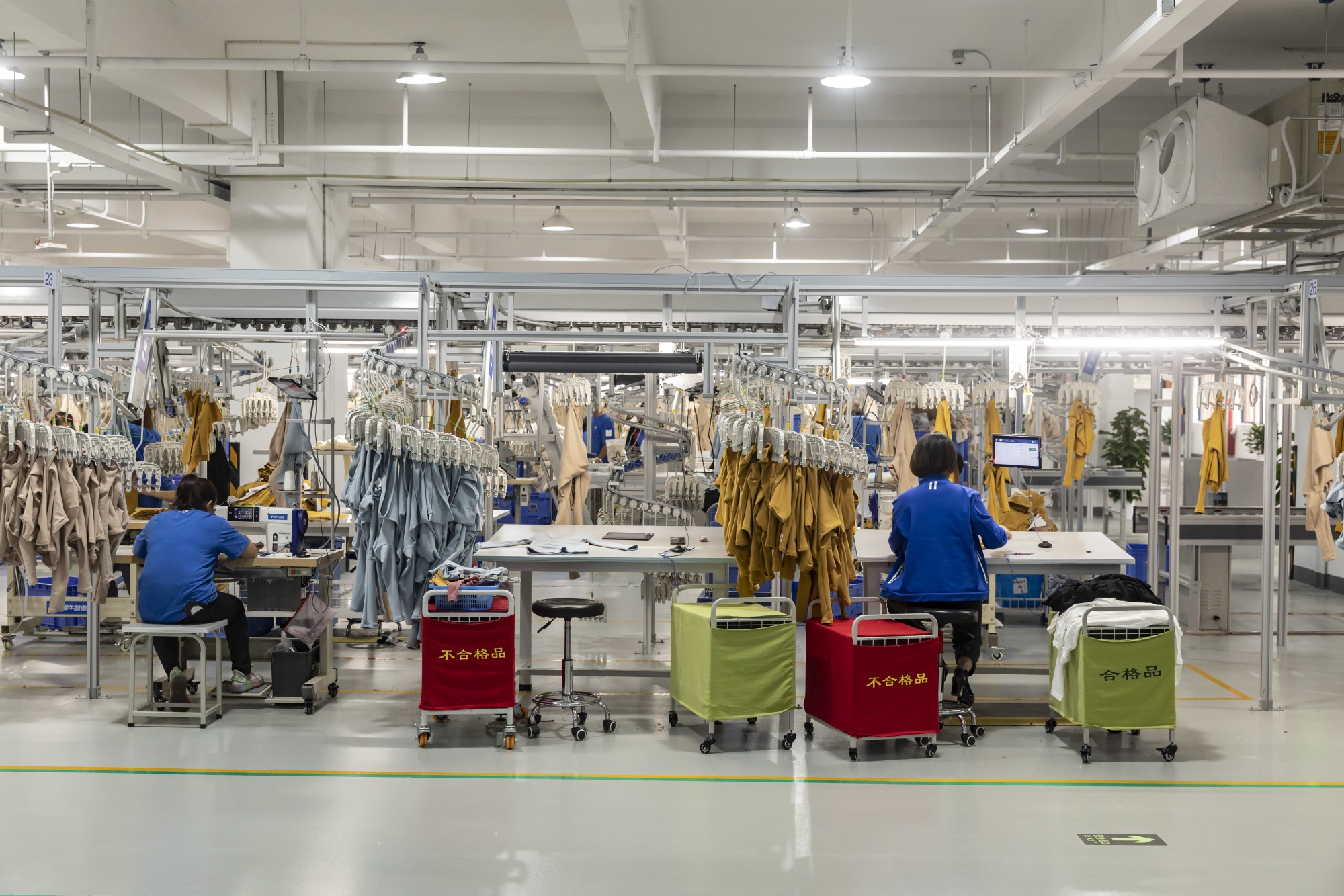
“Pass” and “Fail” bins at quality control on the Xunxi production line. Photographer: Qilai Shen/Bloomberg Sign up for Next China, a weekly email on where the nation stands now and where it's going next.
After helping more than a million brick-and-mortar Chinese retailers modernize their operations, Alibaba Group Holding Ltd. has now set its sights on a new target: the country’s outdated factories.
China’s largest corporation unveiled in September its first smart factory, a secret experiment that Alibaba’s been conducting for three years on the outskirts of its hometown of Hangzhou. The three-story facility known as Xunxi -- translated literally as “fast rhino” -- is the company’s attempt at leveraging its consumer data and technologies to help the multi-trillion-dollar manufacturing arena improving efficiency and meet rising consumer expectations.
Read more: Alibaba’s Newest Business: Modernizing China’s Factories
Here is a quick peek into Alibaba’s newest business.
Alibaba’s path to smart manufacturing starts with garments, a market worth 2.2 trillion yuan ($328 billion) in China last year based on Euromonitor International’s estimates. Alibaba has said that one in four clothes purchases in the country was shipped via its e-commerce platforms, granting it access to an ocean of data that it’s now deploying to assist domestic garment makers in design and production planning.
It’s also centralizing the material procurement process to help reduce costs. Artificial intelligence, robotic arms as well as many other in-house technologies have also been put into use at the Xunxi factory prototype.
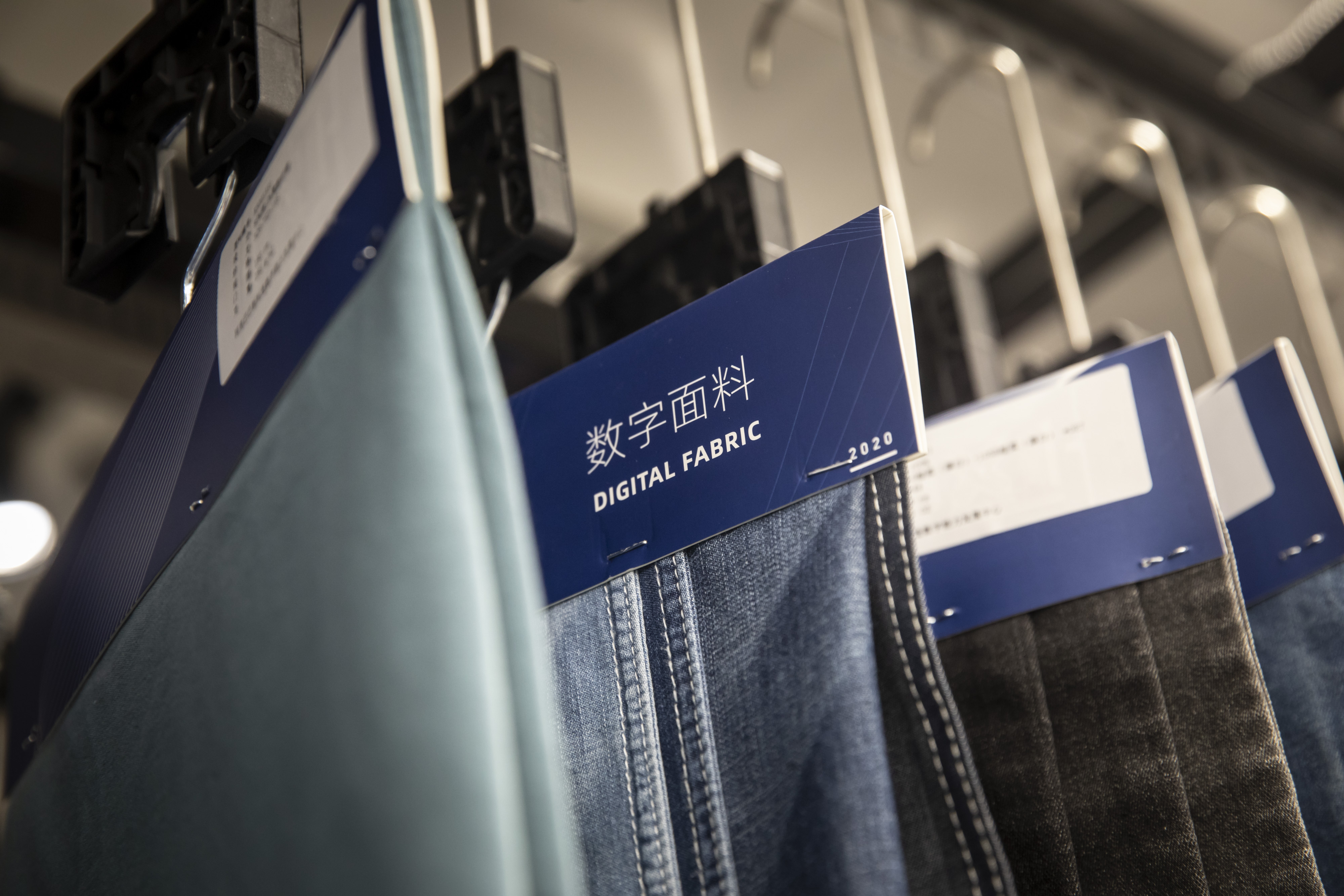
Samples of so-called digital fabric.
Photographer: Qilai Shen/Bloomberg
It usually takes months for apparel companies to bring a new design from the runway to stores, but Alibaba claims it is able to cut order lead times by 75% with its solutions. This would address the growing demand for instant gratification among China’s Gen-Z consumers. For instance, with the help of AI, designers can review simulated rendering effects on so-called digital fabrics on their computer screens, rather than going through a time-consuming process to dye the fabric.
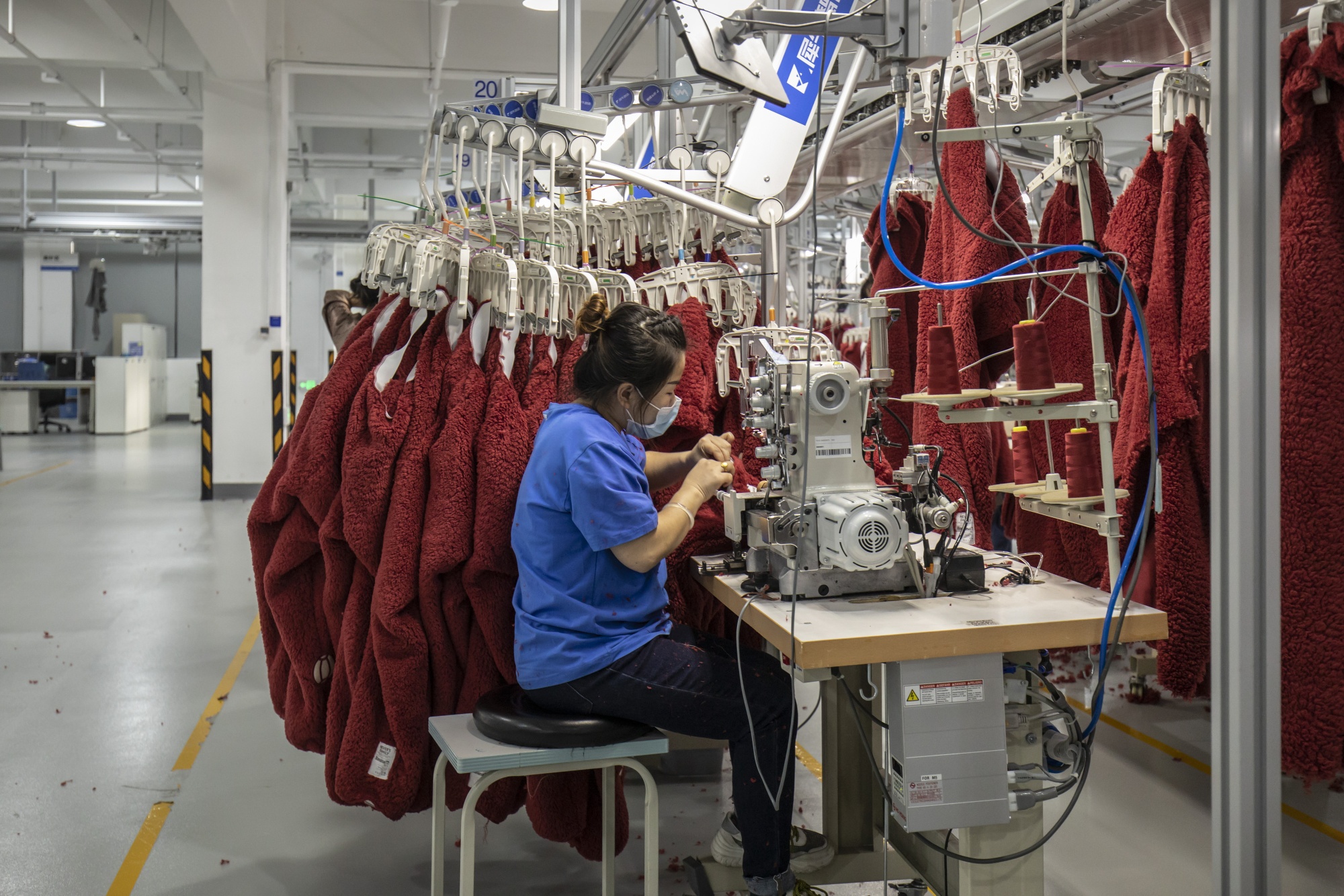
The factory churns out apparel for clothing merchants on its Taobao and Tmall marketplaces.
Photographer: Qilai Shen/Bloomberg
Garment workers at the factory have high-tech assistants, such as AI-enabled cutting machines and internet-connected sewing devices, that help fine-tune their work.
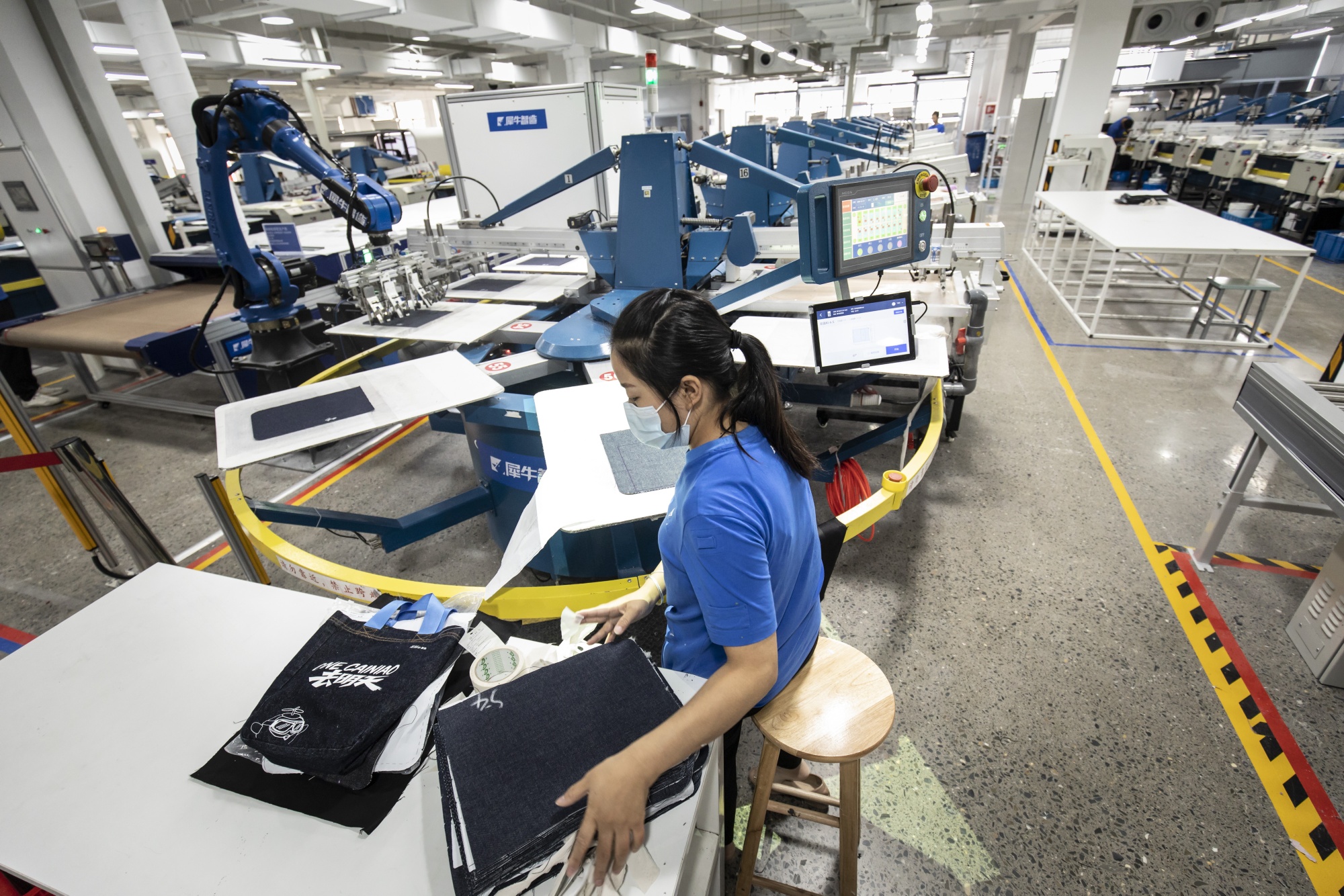
Garments make their way to the next station via conveyor.
Photographer: Qilai Shen/Bloomberg
Once a step has been completed, the item will be transferred to the next work station via a conveyor belt. Since the entire workflow is recorded digitally, factory management no longer have to stay on site. Instead, they can track the progress remotely on computers or through their mobile phones.
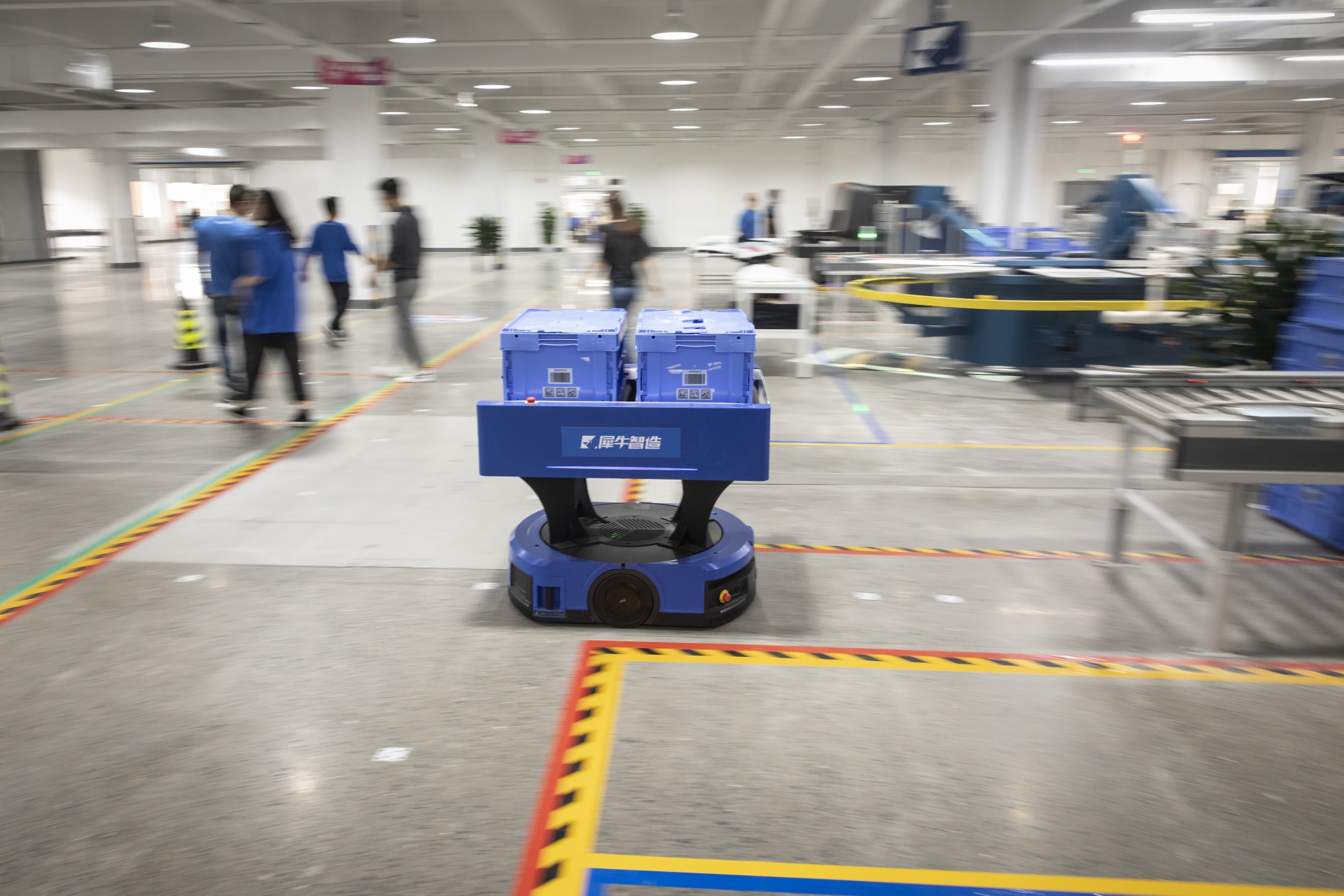
A robot makes a delivery through the Xunxi factory.
Photographer: Qilai Shen/Bloomberg
The data and technology deployed at the Xunxi factory mean merchants, which typically need at least 90 days to get their goods ready for the storefront, can decide what items to make and the scale of the production over the course of two weeks, reducing the need to accumulate inventory.
Xunxi was one of 10 factories identified by the World Economic Forum this year as adopting so-called fourth industrial revolution technologies to transform manufacturing. They join 44 others on the list. “In the future, large-scale standard production will be transformed into very flexible small-scale production,” Chief Executive Officer Daniel Zhang told a WEF meeting in September.
Its ultimate goal, according to Alibaba, is to become a one-stop production solution provider for garment merchants on its Taobao and Tmall marketplaces.
— With assistance by Coco Liu, and Daniela Wei
(Updates with comment from Alibaba CEO in 10th paragraph)
Before it's here, it's on the Bloomberg Terminal.
LEARN MORE |



