This should be interesting.
When the Brazilians first announce the Sinovac result, they specifically noted that the inactive-virus-based vaccine was more than 50% effective, and the media poopooed the announcement to mean '50% effective' out of presumably childish agenda.
Now the Brazilians can choose, to remain unvaccinated, vaccinate w/ traditional Sinovac inactive-virus vaccine, or go for the Moderna / Pfizer RNA-based vaccine
In HK we have the same choices and am veering towards the tradition and others do the geewhizbang DNA-changing go (the extra bit of supposed effectiveness, 95% vs 78%, seems trivial for the risk.
In any case We have no particular intention to go for vaccination until 6-8 months after others more gusto go for such.
Let us watch.
bloomberg.com
Sinovac’s Covid Shot Proves 78% Effective in Brazil Trial
Andre Romani Pinto
7 January 2021, 22:19 GMT+8
The experimental vaccine developed by China’s Sinovac Biotech Ltd. was 78% effective against Covid-19 in late-stage trials in Brazil, the most definitive result so far on the shot’s efficacy after previous data sparked confusion and doubt.
The protection rate, confirmed by Sao Paulo state officials, was derived from Sinovac’s most advanced final-stage trials in Brazil involving about 13,000 participants. The rate is shy of the roughly 95% effectiveness seen in mRNA vaccines developed by Pfizer Inc. and Moderna Inc.
The latest Covid updatesMake sense of the headlines and the outbreak's global response with the Coronavirus Daily.
The vaccine was 78% effective in preventing mild cases of Covid-19 and 100% effective against severe and moderate infections, said Dimas Covas, director of the Butantan Institute that partnered with Sinovac to produce the shot locally. The institute plans to request emergency use authorization from Brazil’s regulator Friday, he said. The regulator, known as Anvisa, has about 10 days to analyze such requests.
Missing DetailsThe trial saw about 220 participants infected -- 160 in the placebo group and almost 60 among those who received the vaccine, Covas said. Officials declined to provide a more detailed breakdown of the study, including information about age groups and side effects of the shot, and didn’t specify when the full documentation will be published.
It wasn’t clear how the Brazilian researchers calculated the efficacy rate. The institute declined to elaborate further, saying it had no information beyond what was released at the press conference.
Like some other vaccines, CoronaVac is given in two shots, 14 days apart. Butantan is considering spacing them out by as much as 28 days to get more people their first inoculations quickly, Covas said.
Sao Paulo Governor Joao Doria is attempting to expedite vaccinations as Brazil sees a resurgence of the virus and the central government delays presenting concrete vaccination dates. Almost 11 million doses of Sinovac’s vaccine, called CoronaVac, have already been shipped to the country.
Read More: Bolsonaro Says Most Brazilians Don’t Want Covid Vaccine
Doria, a political rival of President Jair Bolsonaro, plans to obtain swift approval and begin vaccinating the state of some 45 million people on Jan. 25. Pressure from other governors led the health ministry to include the shot, which has been publicly shunned by Bolsonaro, to the country’s vaccination plans.
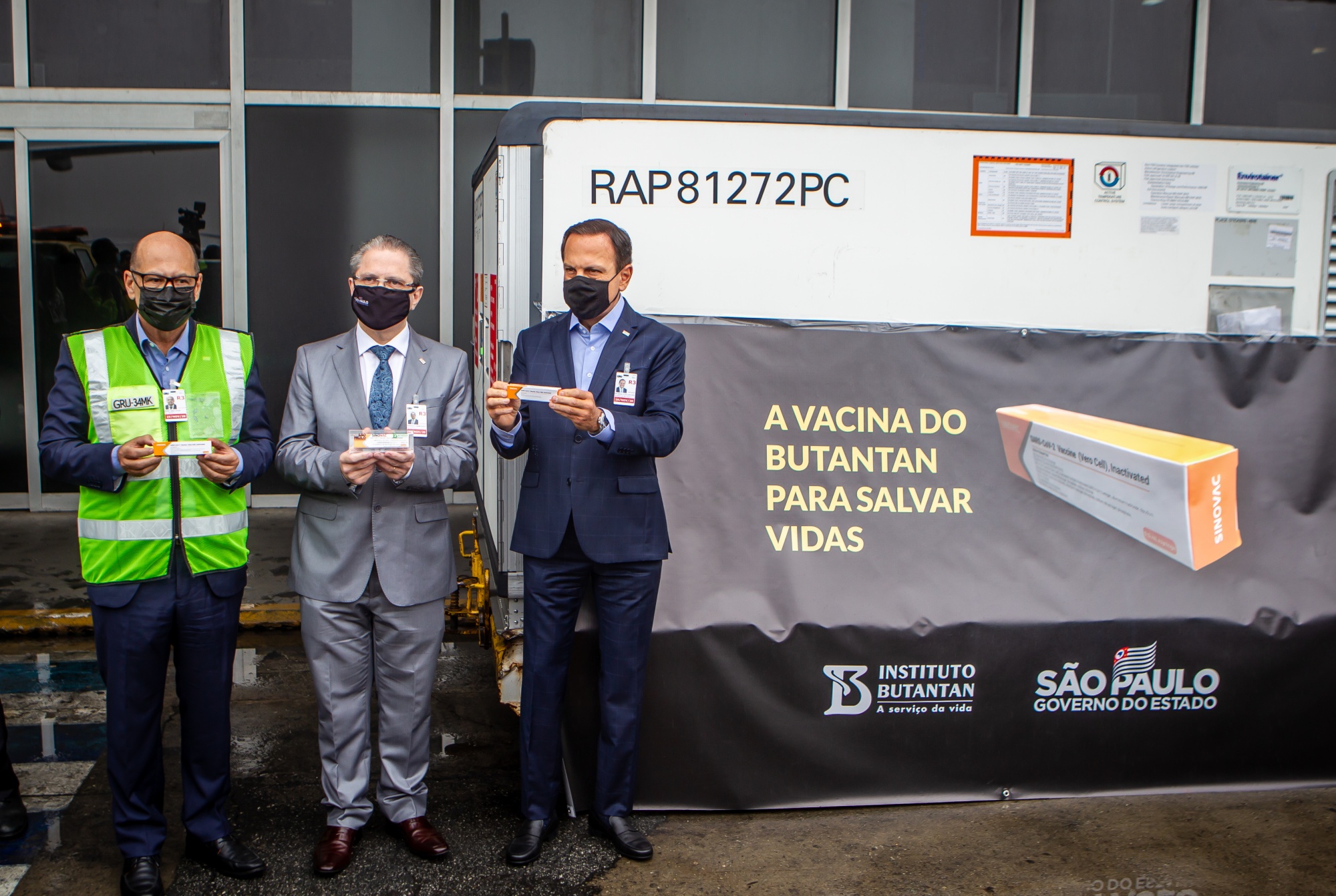
Dimas Tadeu Covas, director of the Butantan Institute, from left, Jean Gorinchteyn, Sao Paulo’s health secretary, and Joao Doria, Sao Paulo’s governor, hold boxes of the Sinovac Biotech Ltd. coronavirus vaccine at Guarulhos International Airport in Sao Paulo, Brazil, on Nov. 19, 2020.
Photographer: Jonne Roriz/Bloomberg
Conflicting and incomplete information from Sinovac’s trials last month created confusion over exactly how effective its shot is in protecting people. Researchers in Brazil delayed releasing complete data on CoronaVac in late December, saying only that it was found to be more than 50% effective. Sao Paulo state Health Secretary Jean Gorinchteyn later said the vaccine didn’t reach 90% efficacy. Further confusing matters, Turkey said its trial showed an estimated efficacy rate of 91.25%, though that was based on only 29 cases.
Shore Up ConfidenceThe release of more definitive data on the vaccine’s efficacy was delayed because the Beijing-based vaccine developer needed to reconcile results from different trials using varying protocols, according to a person familiar with the matter.
While Sinovac’s disclosure now provides a clear picture of its vaccine’s effectiveness and should shore up confidence in countries where it has inked supply deals like Indonesia and Brazil, the Chinese developers’ lack of timely and clear disclosures have contributed to a lack of trust.
More Than 15.9 Million Shots Given: Covid-19 Vaccine Tracker
China has already administered more than 4.5 million doses under emergency use authorization, and aims to inoculate 50 million people against the virus by early February, ahead of the annual Lunar New Year holiday.
Both Sinovac and state-owned developer China National Biotec Group Co., whose shot last week became the country’s first to be approved for general public, have seen conflicting data disclosed on their vaccines. CNBG said its vaccine is effective in preventing Covid-19 in 79.3% of people, less than the 86% reported earlier from its trials in the United Arab Emirates.
600 Million DosesSinovac can make more than 600 million doses a year at its production facilities in China. The company has orders from countries involved in vaccine trials, including Brazil, Turkey and Indonesia, and will also supply Singapore and Hong Kong in addition to the Chinese mainland.
Sinovac and CNBG’s vaccines use an inactivated version of the coronavirus to stimulate the body’s immune response. They can be stored at refrigerator temperature (2 to 8 degrees Celsius), making them potentially better choices for distribution and use in the developing world than mRNA vaccines from Pfizer and Moderna that require deep freezing.
— With assistance by Julia Leite, Dong Lyu, and Ney Hayashi Cruz
(Updates with rate calculation in fifth paragraph.)
Before it's here, it's on the Bloomberg Terminal.
LEARN MORE |



