| | | Plume of Saharan Dust Makes Europe Look Like the Red Planet
EU’s Copernicus climate observers say the weather system lowers air quality and solar power production
By Jonathan Tirone
9 de fevereiro de 2021, 10:18 WET
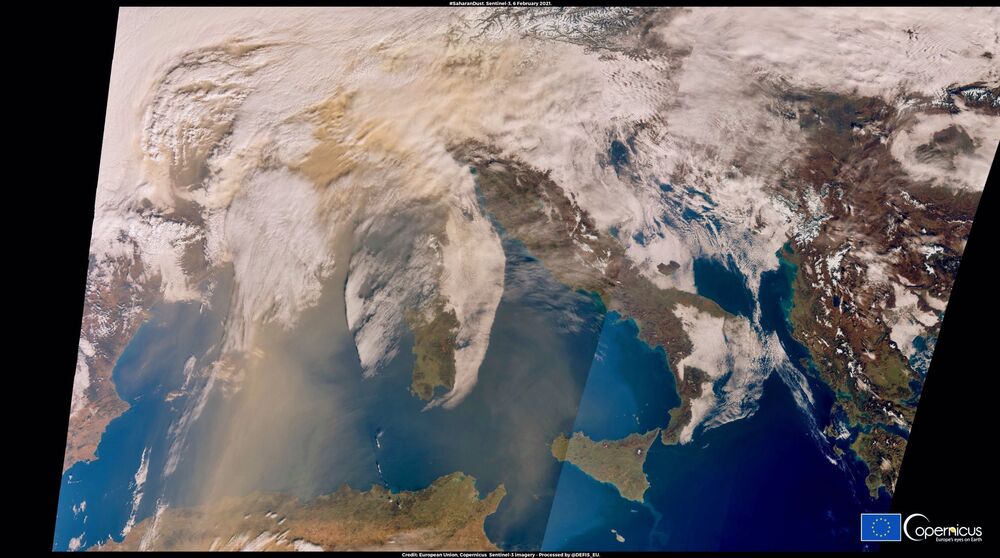
An influx of dust from the Sahara that began last week triggered air-quality alarms and left a reddish-brown trail in its wake
Credit: Copernicus
A massive plume of Saharan-desert dust has painted European landscapes a reddish-brown hue reminiscent of Mars, reducing air-quality and solar-power production across southern swathes of the continent.
Dust kicked up by storms over Algeria last week was transported north and deposited throughout European mountain ranges stretching from the Pyrenees to the Alps, climate monitors reported Tuesday. Measurements of air-born particulate matter that can endanger health were several orders of magnitude larger than normal.
“We saw air quality values in the affected regions drop significantly,” said Mark Parrington, a scientist at the Copernicus Atmosphere Monitoring Service. “The impact of the Saharan dust clouds is clearly visible for affected cities, such as, for example, Barcelona or Marseille.”

Europe’s climate service has tracked the dispersion of dust from previous Saharan storms as far as the Gulf of Mexico. This week’s event was predicted by Copernicus models, which combine data from scientists in the U.K., France, Germany, Italy and the U.S. The agency uses billions of measurements from satellites, ships, aircraft and weather stations around the world for its monthly and seasonal forecasts.
“Our forecasts, even those from Feb. 2, were very reliable in describing the size and extent of the dust plume as well as its development and direction,” Parrington said. Airlines and utilities are among the companies that use Copernicus data to make business decisions.

Sentinel-2 satellite image showing reddish-brown snow over Mont d’Olmes in France on Feb. 6
Credit: Copernicus
Improving the accuracy of weather forecasts has become increasingly critical as the world tries to mitigate climate change. Timely information about wind flows and solar radiation are needed for grid operators to plan intermittent electricity. Air quality and emissions data inform policy decisions on congestion management and tariffs. |
|



