The tech industry is looking to replace the smartphone — and everybody is waiting to see what Apple comes up with
PUBLISHED SAT, FEB 20 20219:00 AM ESTUPDATED SAT, FEB 20 20217:14 PM EST
Kif Leswing
Key Points
- Smartphone sales have dropped for the last two years straight, and all the big tech players are casting around for the next big thing.
- They seem to have settled upon augmented reality -- a face-worn computer or glasses that superimposes computer-generated objects on the real world.
- Apple’s plans have started to leak, and everybody’s waiting to see if it can revolutionize AR like it did with smartphones.
In 2007, Apple unveiled the iPhone.
Apple didn’t invent the smartphone — companies like Palm and Blackberry had been selling them for years. But the iPhone introduced a totally new way to interact with computers. The always-on internet connectivity, finger-friendly touch screen, and interface based around clickable app icons all seem commonplace now. But at the time, the whole package felt revolutionary.
The smartphone was a seismic shift for the technology industry, creating entirely new business models — apps became $100 billion companies -- while replacing everything from digital cameras to in-car GPS systems.
But smartphone sales have dropped two calendar years straight for the first time, according to Gartner. Smartphones are old news.
The tech industry’s next bet is a series of technologies usually called augmented reality (AR) or mixed reality. The vision usually involves some kind of computer worn in front of the user’s eyes.
Users will still be able to see most of the real world in front of them — unlike virtual reality, which completely immerses the user in a computer-generated fantasyland, augmented reality layers computer-generated text and images on top of reality.
Industry watchers and participants think that Apple has a good chance to validate and revolutionize AR like it did with smartphones. Apple has been prototyping headsets for years, and recent reports from The Information and Bloomberg suggest that Apple could release a headset as early as 2022 that could cost as much as $3,000.
But Apple’s not the only company working on these products. All the big tech players — Microsoft, Google, Facebook, and Amazon — are in the game as well.
Futurists and screenwriters have conjured blue-sky visions of what could happen with advanced computer glasses — one episode of the dystopian anthology “Black Mirror” explored a world where people could “block” certain people out of their view. More positive visions imagine having important information coming directly into your view, exactly when you want it.
Today, the most common use cases are much more mundane, including smartphone-based games and apps like Pokemon Go or Apple’s Ruler app, which use the phone’s screen and camera rather than relying on glasses or another set of screens sitting on your face. The few companies who are actively producing AR glasses are mostly focused on work scenarios, like manufacturing and medicine.
“That’s where we now sit in spatial computing’s lifecycle. It’s not the revolutionary platform shift touted circa-2016,” said Mike Boland, technology analyst and founder of ARtillery Intelligence, in a recent report. “It’s not a silver bullet for everything we do in life and work as once hyped. But it will be transformative in narrower ways, and within a targeted set of use cases and verticals.”
Here’s what the biggest companies in tech are doing to try and make augmented reality the next big thing:
Apple
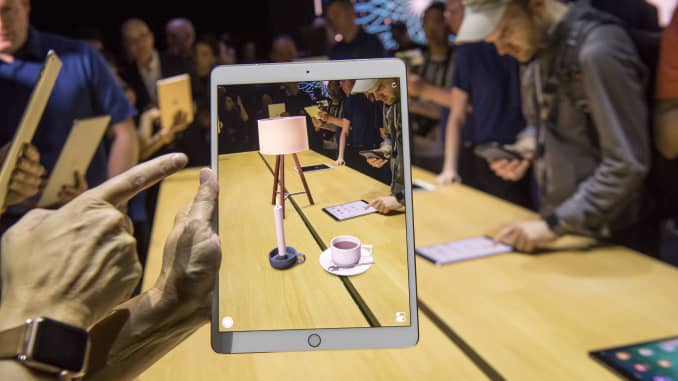
An attendee demonstrates the ARKit, augmented reality tool, on an Apple Inc. iPad Pro during the Apple Worldwide Developers Conference (WWDC) in San Jose, California, U.S., on Monday, June 5, 2017. David Paul Morris | Bloomberg | Getty Images
Apple’s generation-defining success with the iPhone has made it the company to watch in augmented reality -- even though the company has never confirmed it is working on a headset, glasses or any other kind of head-worn computer.
Boland says that if Apple were to release a pair of AR glasses, it could “determine the fate of the AR industry,” given the company’s track record of popularizing new technologies.
continues at cnbc.com |



