EARTH’S MAGNETIC FIELD JUST STRUGGLED WITH A WEAK CME: SIGN OF THE TIMES
MAY 14, 2021 CAP ALLON
On May 12, a weak Coronal Mass Ejection (CME) released from the Sun hit Earth. The event was supposed to pass by uneventfully — it would perhaps spark a few auroras, but nothing more. So how did a strong G3 geomagnetic storm ensue?
Nobody was expecting a level 3 event from this CME.
Nobody saw the KP Index hitting 7.
 [ spaceweathernews.com] [ spaceweathernews.com]
And when I say nobody, I mean nobody predicted this: not NASA, NOAA, ESA or IPS in Australia.

The CME’s speed peaked at just 500 km/s (purple line below).
The Changing Jet Stream
Play Video
This is a little stronger than your standard solar wind, but weak in terms of a Coronal Mass Ejection.
 [ spaceweathernews.com] [ spaceweathernews.com]

It was not dense, and the filament released was hardly cause for concern.
“There is absolutely nothing in the history of space weather that advises the expectation of a strong geomagnetic storm off a mild CME produced by the eruption of a small plasma filament,” says Ben Davidson of SpaceWeatherNews.com.
And while a G3-storm / KP7 reading isn’t scary in of itself, the fact that Earth’s ever-waning magnetosphere couldn’t handle such a weak solar event is a cause for concern, particularly given that our planet’s magnetic field was calm at the time–there were no previous impacts or coronal hole streams which preceded the CME.
“The best explanation,” continues Davidson, “is that Earth’s magnetic field is weaker than we’ve all realized.”
In the year 2000, we knew the field had lost 10 percent of its strength since the 1800s.
Another 5 percent was lost by 2010.
Further accelerations occurred in recent years, 2015 and 2017, but we laymen were not privy to any additional loss data–with guesses on why that might be quickly sending you down a conspiracy rabbit hole.

Given the last solid data point we have, that of 2010, our magnetic field should have handled Wednesday’s impact far better.
What happens when the next one hits on the heels of a coronal hole stream?
Or if the filament was bigger?
What happens when that X-class solar flare is launched in our direction?
 What happens when our first line of defense fails? What happens when our first line of defense fails?

The Sun is capable of much MUCH more, particularly as it continues its ramp-up into Solar Cycle 25.
The Solar Maximum of 25 isn’t due until 2024/25, meaning we have 4-or-so years of increasing threat left to go.
“If indeed the severity of [this recent] geomagnetic event is caused by the weaker magnetic field of our planet, we are not going to get through this sunspot cycle,” concludes Davidson.
“The field can’t be taking hits from Nerf balls when bullets are about to start flying from the Sun in the next few years.”
Prepare for a grid-down scenario.
One is coming.
Soon.
NEW SUNSPOTThe Sun is about to add another spot.
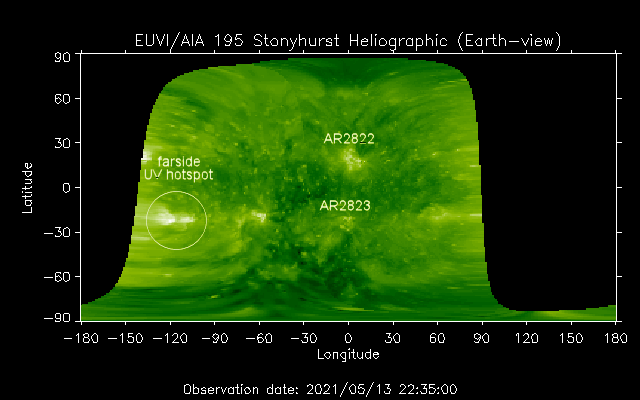
NASA’s STEREO-A spacecraft is monitoring an ultraviolet hotspot on the farside of the sun–probably a sunspot:

 [ spaceweather.com] [ spaceweather.com]
If so, dark cores will rotate into view over the sun’s southeastern limb this weekend.
Could this be the one?
Stay tuned for updates.
The COLD TIMES are returning, the mid-latitudes are REFREEZING, in line with the great conjunction, historically low solar activity, cloud-nucleating Cosmic Rays, and a meridional jet stream flow (among other forcings).

Both NOAA and NASA appear to agree, if you read between the lines, with NOAA saying we’re entering a ‘full-blown’ Grand Solar Minimum in the late-2020s, and NASA seeing this upcoming solar cycle (25) as “ the weakest of the past 200 years”, with the agency correlating previous solar shutdowns to prolonged periods of global cooling here.
Furthermore, we can’t ignore the slew of new scientific papers stating the immense impact The Beaufort Gyre could have on the Gulf Stream, and therefore the climate overall.


Prepare accordingly— learn the facts, relocate if need be, and grow your own. |