Benjamin Franklin in his autobiography said:
“In 1736 I lost one of my sons, a fine boy of four years old, by the smallpox taken in the common way. I long regretted bitterly and still regret that I had not given it to him by inoculation. This I mention for the sake of the parents who omit that operation, on the supposition that they should never forgive themselves if a child died under it; my example showing that the regret may be the same either way, and that, therefore, the safer should be chosen.” 1
ncbi.nlm.nih.gov
==
An Act Relative to Quarantine (1796)
February 9, 2020 admin Leave a comment
An Act Relative to Quarantine
The first federal quarantine law
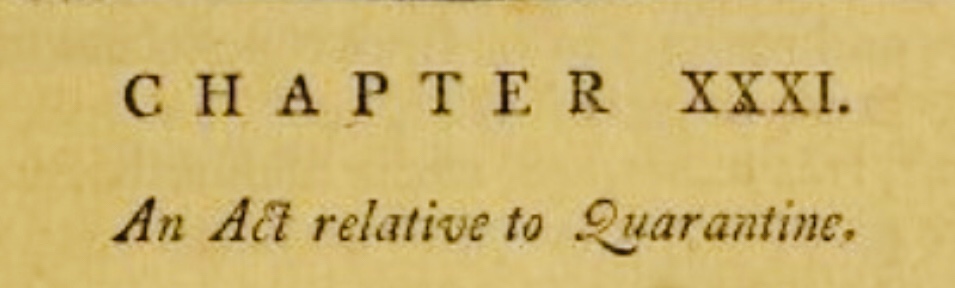 In May of 1796, Congress adopted the first federal quarantine law in response to a series of deadly yellow fever epidemics. The law, entitled “An Act Relative to Quarantine”, 1 Stat. 474, was adopted by the Third Congress and signed by George Washington without much controversy. The remarkably simple law consisted of a single paragraph which provided as follows: In May of 1796, Congress adopted the first federal quarantine law in response to a series of deadly yellow fever epidemics. The law, entitled “An Act Relative to Quarantine”, 1 Stat. 474, was adopted by the Third Congress and signed by George Washington without much controversy. The remarkably simple law consisted of a single paragraph which provided as follows:
. . . That the President of the United States be, and he is hereby authorized, to direct the revenue-officers and the officers commanding forts and revenue-cutters, to aid in the execution of quarantine and also in also in the execution of the health-laws of the states, respectively, in such manner as may to him appear necessary.
statutesandstories.com
==
Benjamin Franklin, on the other hand, grasped such knowledge and was ahead of his time by nearly a century. Though French microbiologist Louis Pasteur wouldn’t discover germ theory until the 1860s, Franklin determined viruses and germs existed and were being “spread by contagion” as early as 1770.
Conventional wisdom of the day held that the common cold was caused by dampness in the air or from wearing wet clothing, but Franklin knew better. In 1773, he wrote to renowned physician Dr. Benjamin Rush: “People often catch cold from one another when shut up together in close rooms, coaches, etc., and when sitting near and conversing so as to breathe in each other’s transpiration.”
Such knowledge led to an amusing encounter in 1776 between Franklin and another Founding Father, John Adams. On the way to a meeting on Staten Island, Franklin and Adams spent the night in New Brunswick. The inn there was so full that Adams and Franklin had to share not only a room but also a bed. Franklin knew Adams was suffering from a cold, so he left the small window open in their room before retiring to bed. When Adams tried to close the window, Franklin said, “Don’t shut the window. We shall be suffocated.” When Adams protested, Franklin explained that Adams was “not acquainted with (his) theory of colds,” and that if he closed the window, “the air within this chamber will soon be worse than that (air) outdoors.” Adams conceded to his roommate’s wishes. Historian Walter Isaacson notes, “In addition to winning the argument over leaving open the window, it should be noted that Franklin did not catch Adams’ cold.”
elemental.medium.com |



