| | | As COVID-19 strains Houston hospitals, small facilities scramble to transfer patients out of state
Zach Despart, Staff writer
Aug. 6, 2021Updated: Aug. 6, 2021
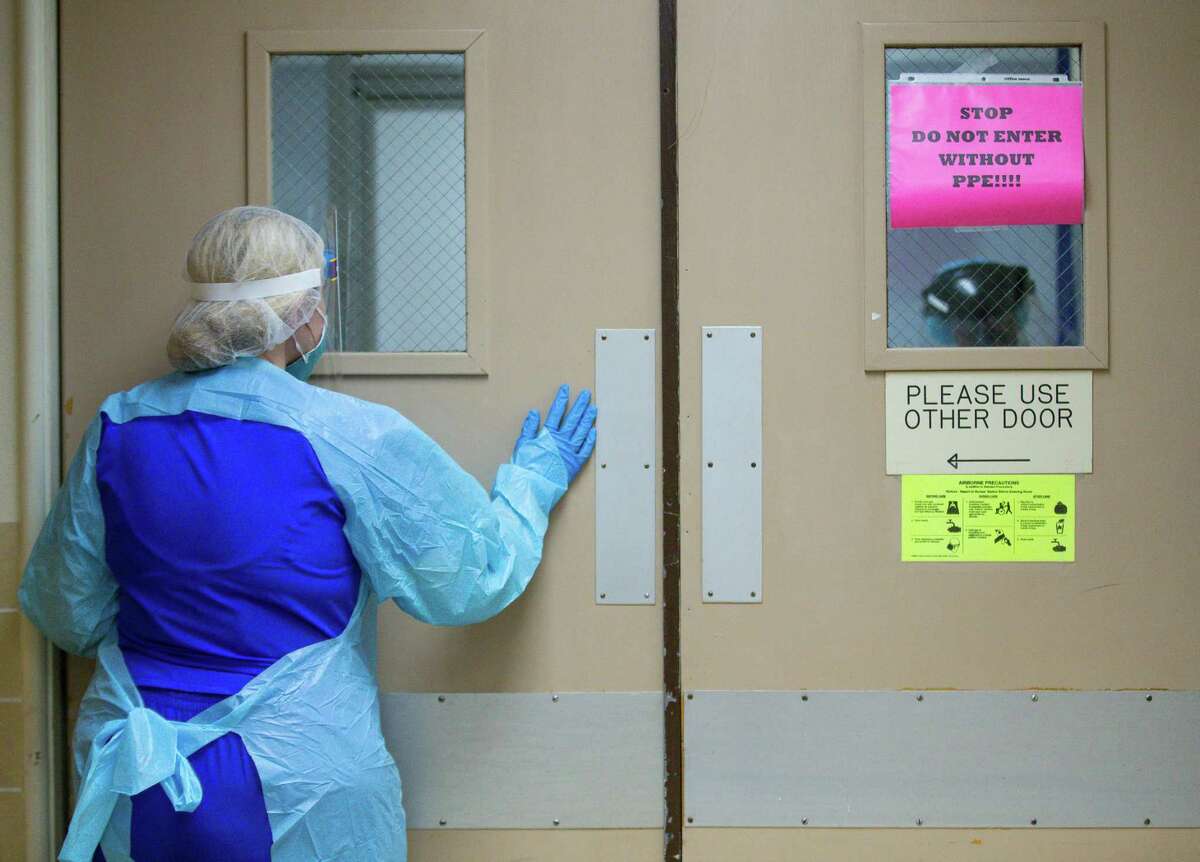 1of4Phlebotomist Alyssa Hvamstad, left, waits to enter the COVID-19 wing at Bayside Community Hospital's emergency room on Thursday, Aug. 5, 2021, in Anahuac. 1of4Phlebotomist Alyssa Hvamstad, left, waits to enter the COVID-19 wing at Bayside Community Hospital's emergency room on Thursday, Aug. 5, 2021, in Anahuac.
Godofredo A. Vásquez, Houston Chronicle / Staff photographer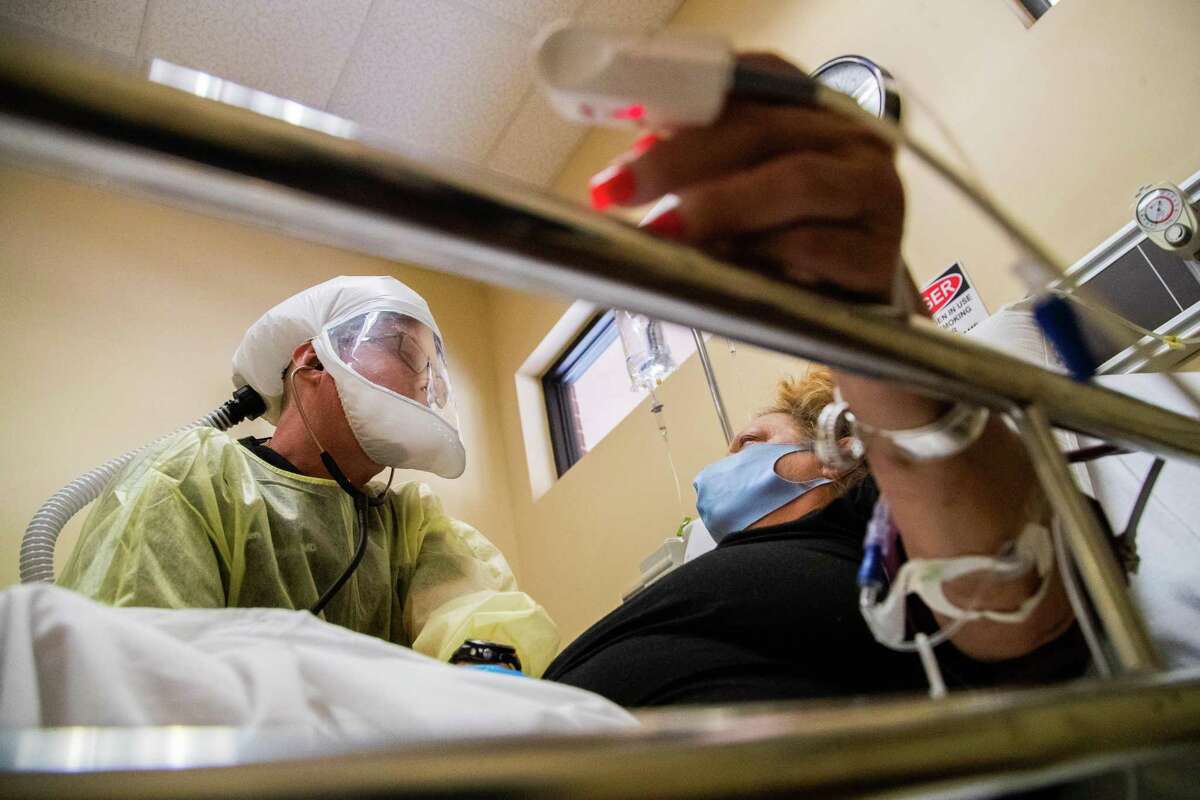
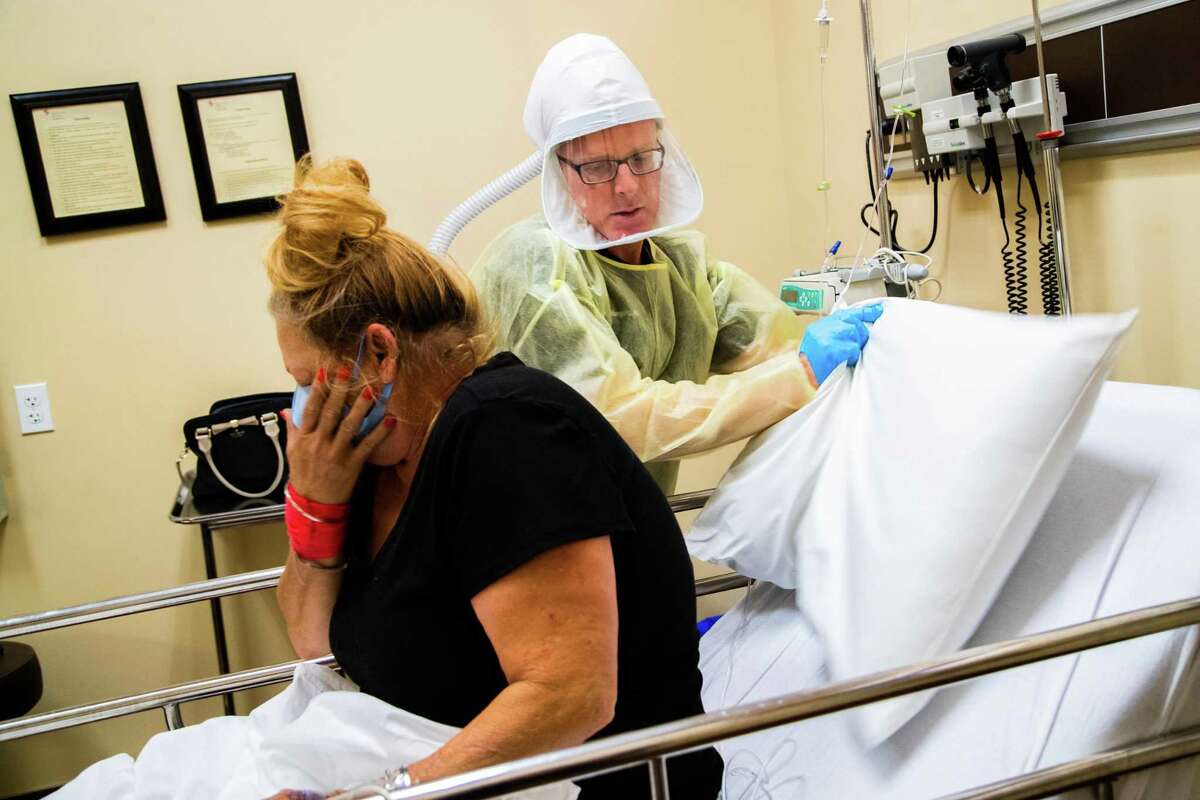
LUMBERTON — For the past week, Brooke Hale has been told “no” about 80 times a day. The executive assistant at Altus Lumberton Hospital has spent her shifts on the phone in a windowless office, repeatedly asking other facilities within an 800-mile radius the same question: Can you take one of our critical COVID-19 patients?
On Thursday, there were three. They needed intensive care, and without it they could die. Hale tried hospitals in Texarkana and Tyler, Lubbock and Lufkin, Oklahoma, Louisiana and Mississippi. None had room.
“I feel helpless,” Hale said through her green N95 mask. “I feel like I can’t help patients like I need to.”
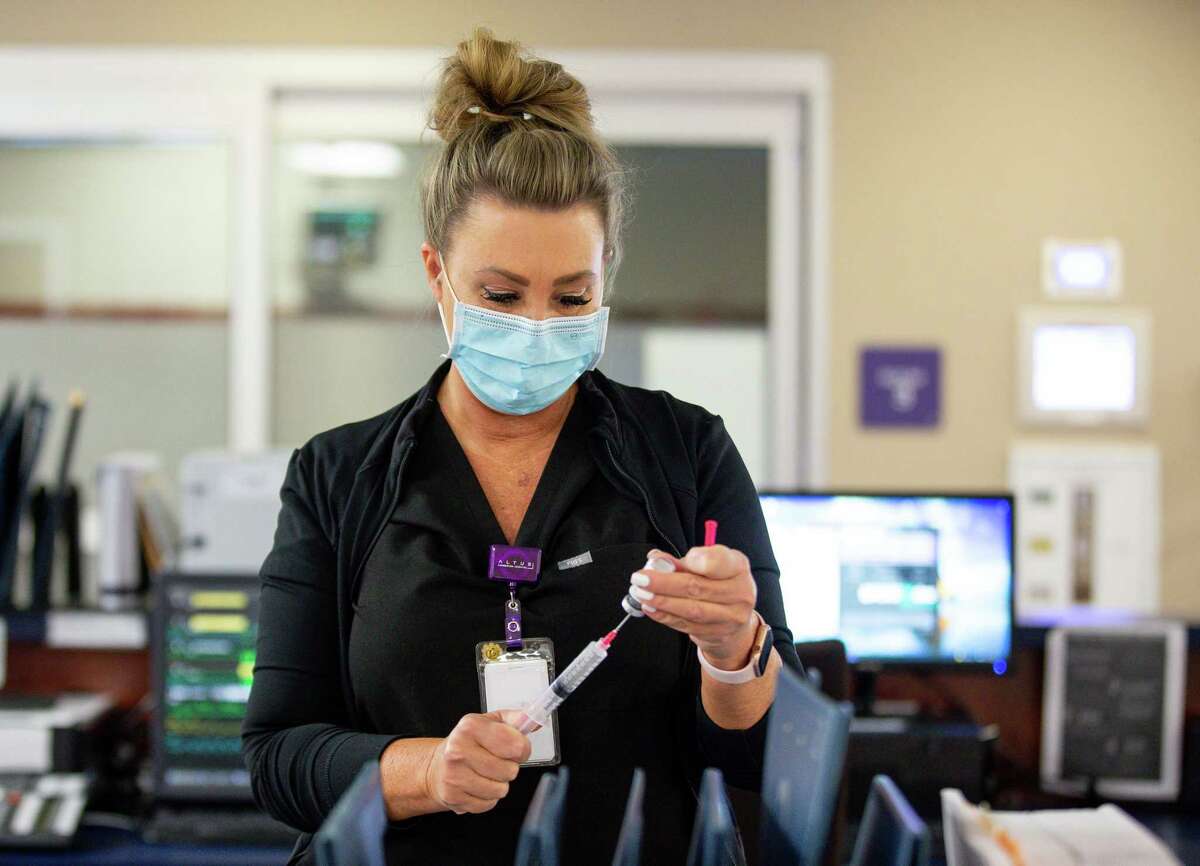 Altus Emergency Center registered nurse Jennifer Webb prepares medication before entering a patient's room on Thursday, Aug. 5, 2021, in Lumberton. Altus Emergency Center registered nurse Jennifer Webb prepares medication before entering a patient's room on Thursday, Aug. 5, 2021, in Lumberton.
Godofredo A. Vásquez, Houston Chronicle / Staff photographerThe same scene is being repeated throughout Southeast Texas, as rural hospitals and freestanding emergency rooms are scrambling to send critical patients to other regions and states because Houston medical centers, full with COVID-19 patients, refuse to accept transfers.
For small facilities, what once was a routine transport to local hospitals has become a frantic process of cold calling and cajoling health care providers in hopes of securing an open bed. In the meantime, patients who must receive intensive care languish in places that are unable to provide it.
By Thursday afternoon, 543 patients in the 25-county hospital region anchored by Houston were waiting for staffed hospital beds, according to the SouthEast Texas Regional Advisory Council; 62 more waited to be admitted to an ICU. The gridlock also extends to ambulance crews, who wait longer outside of crowded ERs to admit patients.
And health officials predict the region’s COVID-19 hospitalizations, which have grown for three straight weeks to more than 2,500, will swell further through August.
The result is a strained health care system that is more dangerous for anyone in need of acute care, from a critically ill COVID-19 patient to a car accident victim who requires surgery. And like last summer’s surge, researchers fear this wave will bring an increase in non-COVID deaths, attributable to delays in care caused by the pandemic.
“Typically, it takes less than an hour to find a bed,” said Dr. Swapan Dubey, chief medical officer at Texas Emergency Care Center, which has two Houston-area freestanding ERs. “Nowadays in my own centers, we’re hearing cases that are taking 30 to even 50 hours.”
Finding beds to transfer patients is more difficult now than the previous two surges of COVID-19 in Texas, administrators at small facilities said. On paper, the Houston hospital region reports 93 available ICU beds, but that figure does not consider hospitals’ ability to staff them.
Darrell Pile, CEO of SETRAC, said the region is “reaching a crisis” because of a nursing shortage exacerbated by the state health department’s decision to no longer provide supplemental staff to virus hot spots, as it had in previous surges.
“A hospital is able to increase its capacity pretty quickly, and they have plans to do that,” Pile said. “But never have we anticipated a complete loss of this supplemental staffing.”
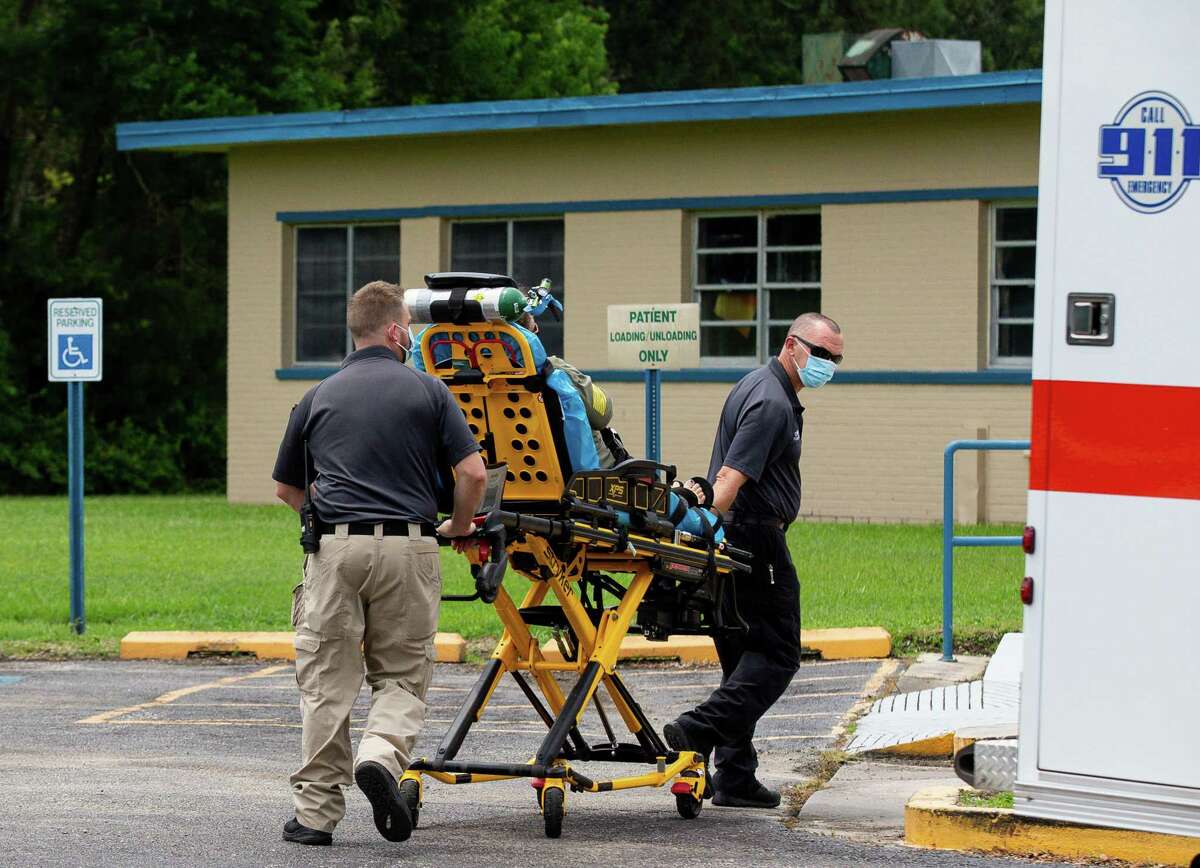 Paramedics transport a patient to the Bayside Community Hospital's emergency room on Thursday, Aug. 5, 2021, in Anahuac. Paramedics transport a patient to the Bayside Community Hospital's emergency room on Thursday, Aug. 5, 2021, in Anahuac.
Godofredo A. Vásquez, Houston Chronicle / Staff photographerHarris County’s safety net hospitals, Ben Taub and Lyndon B. Johnson, are short 250 nurses, limiting their ability to treat existing patients, let alone accept transfers. Better-resourced Texas Medical Center hospitals, including St. Luke’s and Houston Methodist, say they remain able to staff all beds.
Altus Lumberton is the only hospital in Hardin County, east of Houston and home to 51,000 residents. Though it has no ICU, it serves as a nearby emergency room where local patients can be stabilized and transferred to a larger facility for critical care.
That system has broken down. By 9 a.m. Thursday, the three critical COVID-19 patients had been stranded in the emergency room for 96, 72 and 36 hours. Staff found beds in New Mexico and North Dakota for the two patients waiting the longest, but airlifting the fragile man and woman proved to be too expensive.
Dr. Adriano Goffi is making do, improvising along the way. He does not have respiratory therapists or advanced breathing machines like an ICU would. He does have orthopedic pillows, which staff use to prop patients in positions that allow them to breathe more easily. Still, the level of care is lower than they would receive elsewhere.
“These patients, for us to feed them, they have to take off a mask that’s keeping them alive,” Goffi said. “So, fatigue sets in, dehydration and starvation. … We sit with them and see if we can just get some bread in for a second, and then replace the mask.”
Richelle Blackburn, Lumberton’s administrator, worries about the hospital’s ability to accept many more COVID-19 patients. The highly transmissible delta variant has caused an explosion of new infections across Texas, and just 26 percent of residents in Hardin County are fully vaccinated, well below the state average. Lumberton serves many communities in its swath of East Texas forest.
“If people can’t come here, they’re in a bind,” Blackburn said.
The transfer problem extends beyond virus patients. Dubey, from the Houston freestanding ERs, said he faced long waits to transfer two patients with appendicitis and another with a ruptured bowel.
At Bayside Community Hospital in Anahuac, staff have been trying for 10 days to transfer an elderly woman with a serious heart and lung condition. Nurse Felicite Louviere said that because Texas currently has no central database of available beds at all hospitals, she recently found an online directory and began calling Oklahoma hospitals at random, without success.
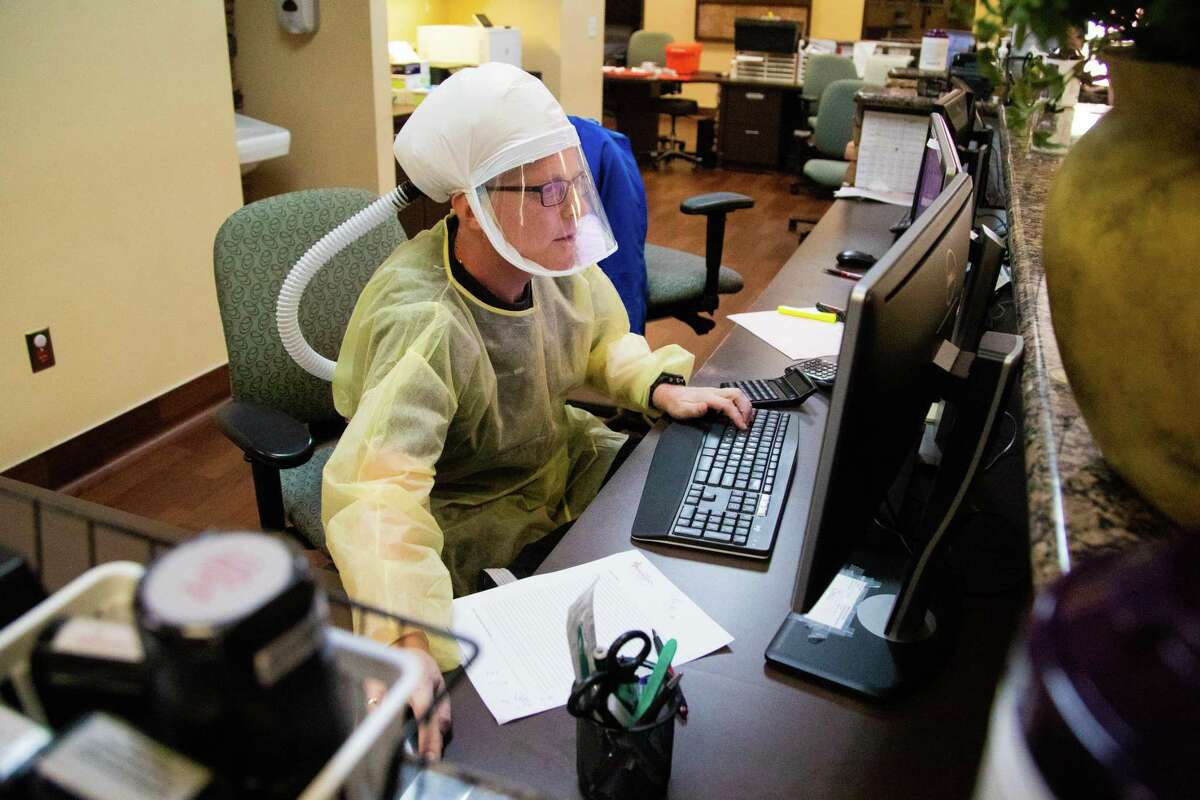 Texas Emergency Care Center medical doctor Kenneth Margolis works on paperwork wearing a air-purifying respirator, Wednesday, Aug. 4, 2021, in Atascocita. Margolis started using again an air-purifying respirator now that the COVID-19 rates are high again. Texas Emergency Care Center medical doctor Kenneth Margolis works on paperwork wearing a air-purifying respirator, Wednesday, Aug. 4, 2021, in Atascocita. Margolis started using again an air-purifying respirator now that the COVID-19 rates are high again.
Marie D. De Jesús, Houston Chronicle / Staff photographerBayside CEO William Kiefer said he has an affiliation agreement with a Pasadena hospital, but that facility has refused transfers, citing its own patient overload. Kiefer said even if he could secure a bed out of state, the travel may be too expensive for a patient or their family.
“When we have indigent patients in rural Texas, if we were to send them far out, how do they ever get back?” Kiefer said. “The transport is quote-unquote ‘covered’ … but the same is not true for the return trip.”
The lack of available beds has compounding consequences: Patients across the region wait longer to be moved from emergency rooms, which leaves ambulances waiting longer outside to deliver new ones.
So far in August, Houston Fire Department crews have reported waiting an average of 29 minutes to drop off patients at hospitals, 10 minutes longer than June and longer than any other month of the pandemic. Four crews waited more than two hours on Thursday, said Dr. David Persse, the city’s health authority.
At Lumberton, Hale continued working the phones. Dallas said no. So did Austin. Tiny Cuero, near San Antonio, offered to take patient information in case a bed opened up.
As 4 p.m. approached, a breakthrough: A hospital in Beaumont called to say it had a tentative opening. Staff prepared the woman for transport and crossed their fingers.
An hour later an ambulance arrived. Within minutes, she was gone. Goffi and the ER staff cheered and high-fived. Upstairs, Hale exhaled in relief.
Two days earlier, the patient was close to needing intubation. Now, Blackburn said, she stands a better chance of surviving.
“She’s going to get the care that we can’t provide,” Blackburn said. “Getting her out — that’s a big accomplishment right now.”
The woman had been in Lumberton’s emergency room for 104 hours.
houstonchronicle.com
-----------------------------------
Other info from Chronicle:
HISD Superintendent Millard House II said he plans to propose a mask mandate for ratification before next week's board meeting.
Earlier this week, the Chronicle polled 32 area school districts about their masking plans. At least 17 districts said they wouldn't challenge Gov. Greg Abbott's order by instituting mask mandates.
|
|
|
|



