Pondering in the wilderness re big issues of the days, and nights, they be, in no particular order / priority
- Climate
- Covid
- Conflicts
- Education
- Resource use
- …
In some sense, lucky us, all eyes on solutions by GOP / DNC, and CCP. Winner takes all, and better, for whomever wins, we all win.
In the meantime, Covid, a puzzle, dictates the pacing.
bloomberg.com
The World May Never Reach Herd Immunity Against Covid-19
Michelle Fay Cortez
August 14, 2021, 5:00 AM GMT+8
As Covid-19 surged last year, governments worldwide touted the hope of “herd immunity,” a promised land where the virus stopped spreading exponentially because enough people were protected against it. That’s now looking like a fantasy.
The thinking was that the pandemic would ebb and then mostly fade once a chunk of the population, possibly 60% to 70%, was vaccinated or had resistance through a previous infection. But new variants like delta, which are more transmissible and been shown to evade these protections in some cases, are moving the bar for herd immunity near impossibly high levels.
Delta is spurring widening outbreaks in countries like the U.S. and U.K. that have already been walloped by the virus, and presumably have some measure of natural immunity in addition to vaccination rates of more than 50%. It’s also hitting nations that have until now managed to keep the virus out almost entirely, like Australia and China.

A nurse checks on a patient in the ICU Covid-19 ward in Arkansas, on Aug. 4.
Photographer: Houston Cofield/Bloomberg
This month, the Infectious Diseases Society of America estimated that delta had pushed the threshold for herd immunity to well over 80% and possibly close to 90%. Public health officials like Anthony Fauci have drawn controversy by shifting the goalposts over the past year, increasing the number of people who need protection before hitting herd immunity. Meanwhile, vaccine hesitancy and supply issues mean most countries won’t get close to even the original numbers.
“Will we get to herd immunity? No, very unlikely, by definition,” said Greg Poland, director of the Vaccine Research Group at the Mayo Clinic in Rochester, Minnesota.
Even a vaccination rate of as high as 95% wouldn’t achieve it, he said. “It is a neck and neck race between the development of ever more highly transmissible variants which develop the capacity to evade immunity, and immunization rates.”
Not NatureNature isn’t going to solve the problem, either. It’s unclear how long natural immunity gained by surviving Covid-19 will last, and whether it will be effective at fighting off new strains. Future variants, including some that could evade immunity even more efficiently than delta, raise questions about how – and when – this will be over.
“If it was as simple as getting the infection once means you are immune for life, that would be great, but I don’t think that’s the case,” said S.V. Mahadevan, director of South Asia Outreach at the Center for Asian Health Research and Education at Stanford University Medical Center. “That’s a troubling problem.”
Already there are signs that some people, and some places -- like Brazil and other countries in South America -- are being battered a second time by newer strains.
Without herd immunity, the virus could linger for decades in some form, possibly forcing the world’s most powerful nations to adjust their diverging strategies on opening borders and economies.
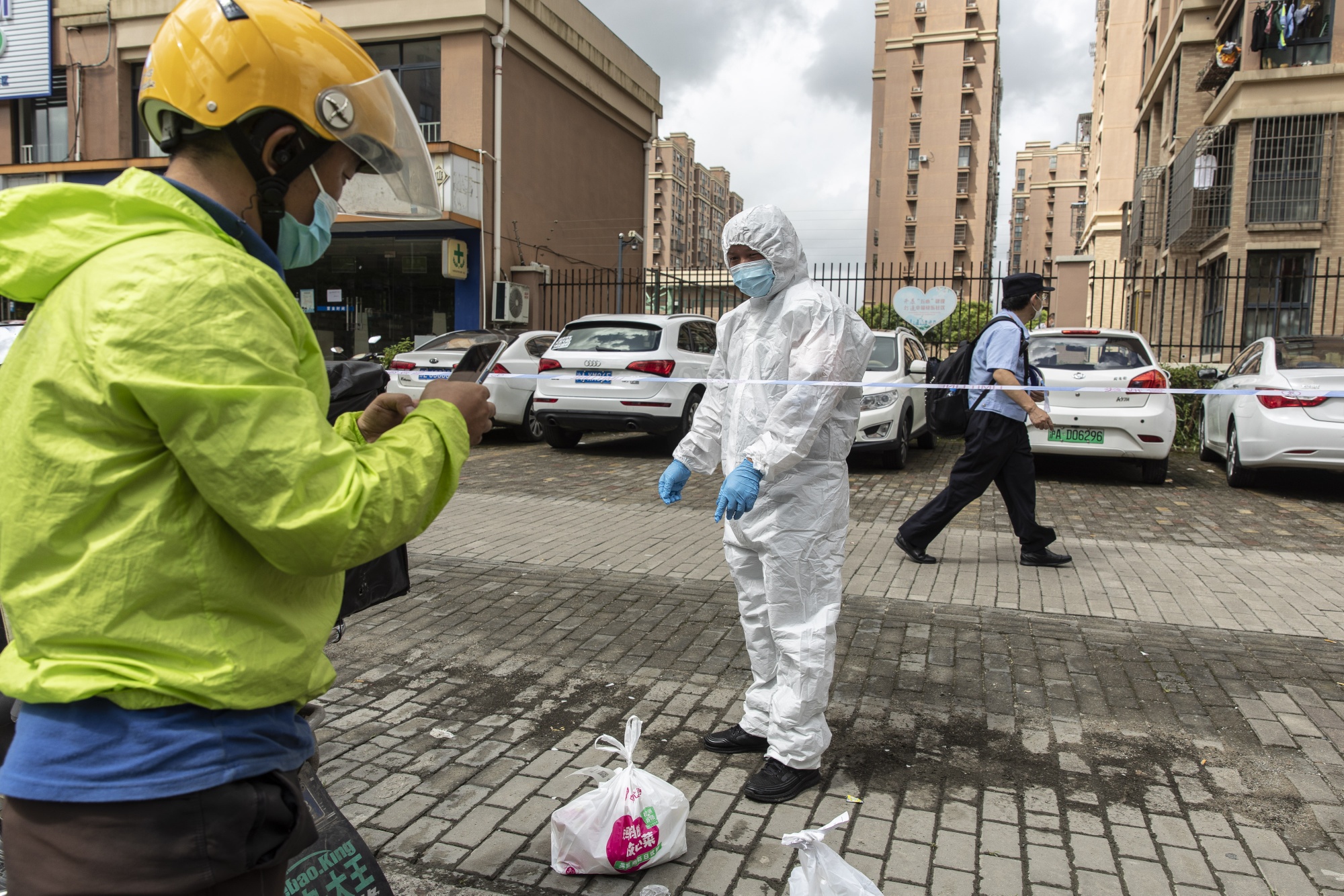
A worker delivers food and other necessities from couriers to residents of a neighborhood under lockdown in Shanghai, on Aug. 3.
Photographer: Qilai Shen/Bloomberg
Countries like China that have pursued tight Covid-Zero policies by attempting to wipe out every infection, may eventually have to consider a looser stance. Others like the U.S. and U.K. which have opened up despite a resurgence in the virus run the risk of wave after wave of infection.
Vaccines so far haven’t been the quick fix some had hoped for. Israel, among the most vaccinated countries in the world, has already started administering booster shots, amid evidence that the current immunizations aren’t offering the protection that was hoped.
The latest Covid updatesMake sense of the headlines and the outbreak's global response with the Coronavirus Daily.
Sign up to this newsletter
The most powerful vaccines, including the mRNA shots from Pfizer Inc., BioNTech SE and Moderna Inc., would make it easier to get high levels of immunity since they are so effective. Yet breakthrough infections are possible with even these shots. The benefits of other approaches, including those made by China’s vaccine manufacturers, AstraZeneca Plcand Johnson & Johnson, may offer even less protection.
Building ImmunityCountries with the highest vaccination rates
Source: Bloomberg's Covid-19 Vaccine Tracker, as of Aug. 12
Note: Only places with a population of more than 1 million are displayed
Herd immunity is a real thing, protecting much of the world against viral threats from the measles to polio. Scientists credit it for helping eradicate smallpox. Having it as a goal likely helped the world embrace measures like wearing masks and social distancing. But it also created a false narrative.
“The focus on ‘herd immunity’ has, in my view, been quite damaging,” said William Hanage, an epidemiologist and expert in communicable disease dynamics at the Harvard T.H. Chan School of Public Health. “It presents people with an unrealistic vision of how the pandemic comes to a close and doesn’t account for the evolution of either the virus or the nature of disease in reinfections.”
Some countries learned the shortfalls of herd immunity the hard way. U.K.Prime Minister Boris Johnson originally planned to use it as a primary approach to Covid-19, suggesting some of his constituents could “take it on the chin” with natural infections before the magnitude of the damage became apparent.
Others are now throwing in the towel, with Indonesia most vocally leading the way. The world’s fourth-most populous nation determined that it would be impossible to stop the virus even if everyone in the country was immunized. It’s redoubling its efforts to promote mask wearing and social distancing, while continuing to boost its vaccination rate.
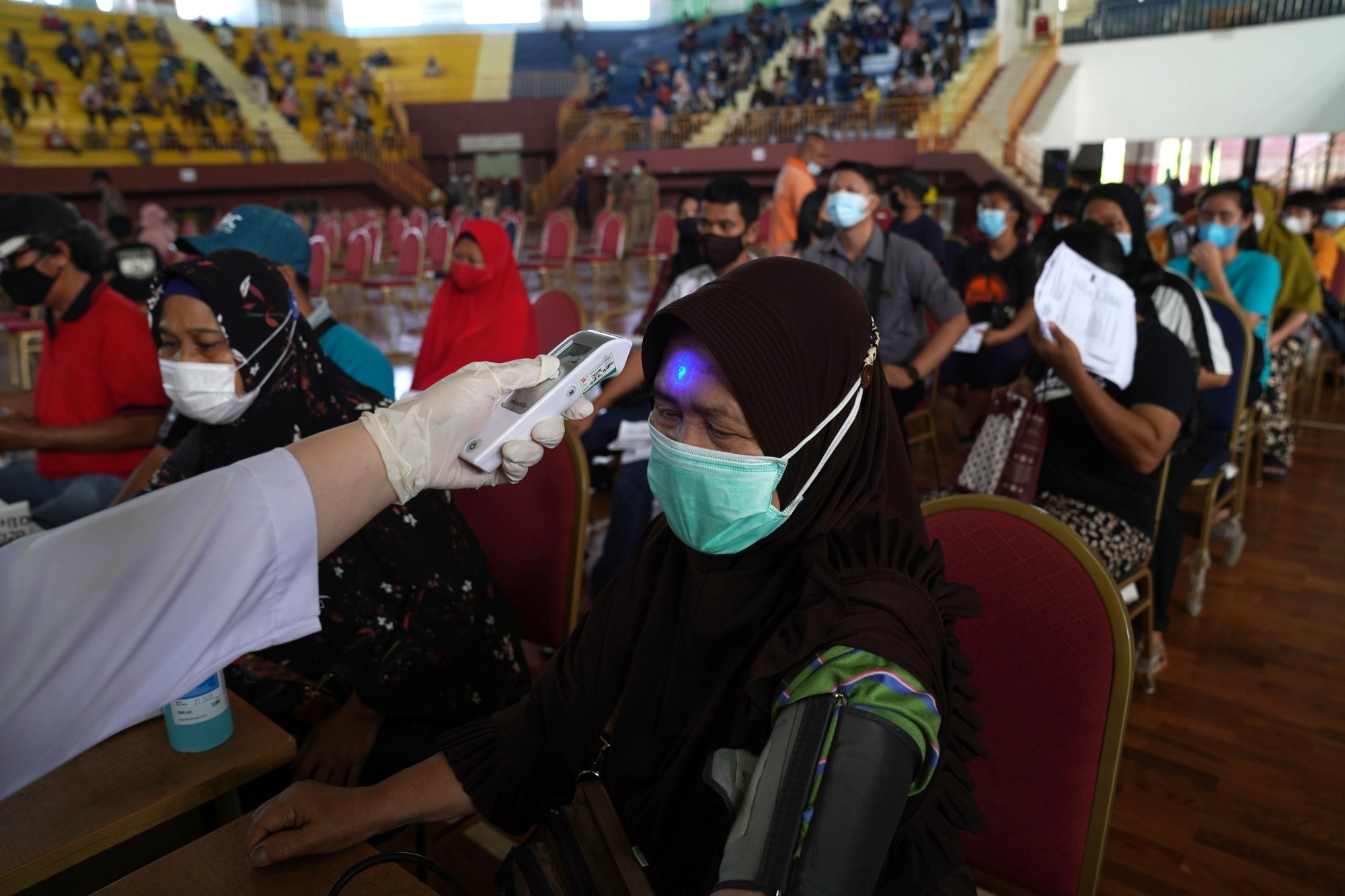
A member of the public gets her temperature checked at a vaccination center in Jakarta, on Aug. 4.
Photographer: Dimas Ardian/Bloomberg
Meanwhile, Singapore and Australia are easing into opening, promising they will do so as they hit sufficiently high vaccination levels.
The EndDespite evidence that it will be difficult or impossible to reach herd immunity, many public health officials aren’t willing to give up on it. Governments worldwide are focusing on widening inoculation programs.
Yet the individualistic approach by many countries, and vaccine shortages, are contributing to the global problem. The risk will remain for everyone, as long as any nation is experiencing massive outbreaks.
The world is unlikely to put the pandemic behind it until 2022 at the earliest, experts say. That target could be push back if the virus mounts another metamorphosis to become even more transmissible or even better at evading resistance.
There is hope for new vaccines and other approaches that could stop transmission more dramatically, but none of those are in human trials yet. It will be a few years before this is a real possibility.
Regardless, the end may not come via herd immunity. Instead, the virus has a high likelihood of remaining entrenched globally, causing outbreaks that are hopefully mitigated partly by vaccinations, masking and other interventions.
“Delta is not something we will be able to eradicate,” Hanage said. “Even Alpha would have been hard. However with sufficient immunity, ideally achieved by vaccination, we can expect it to become a much milder illness.”
Revisiting 1918
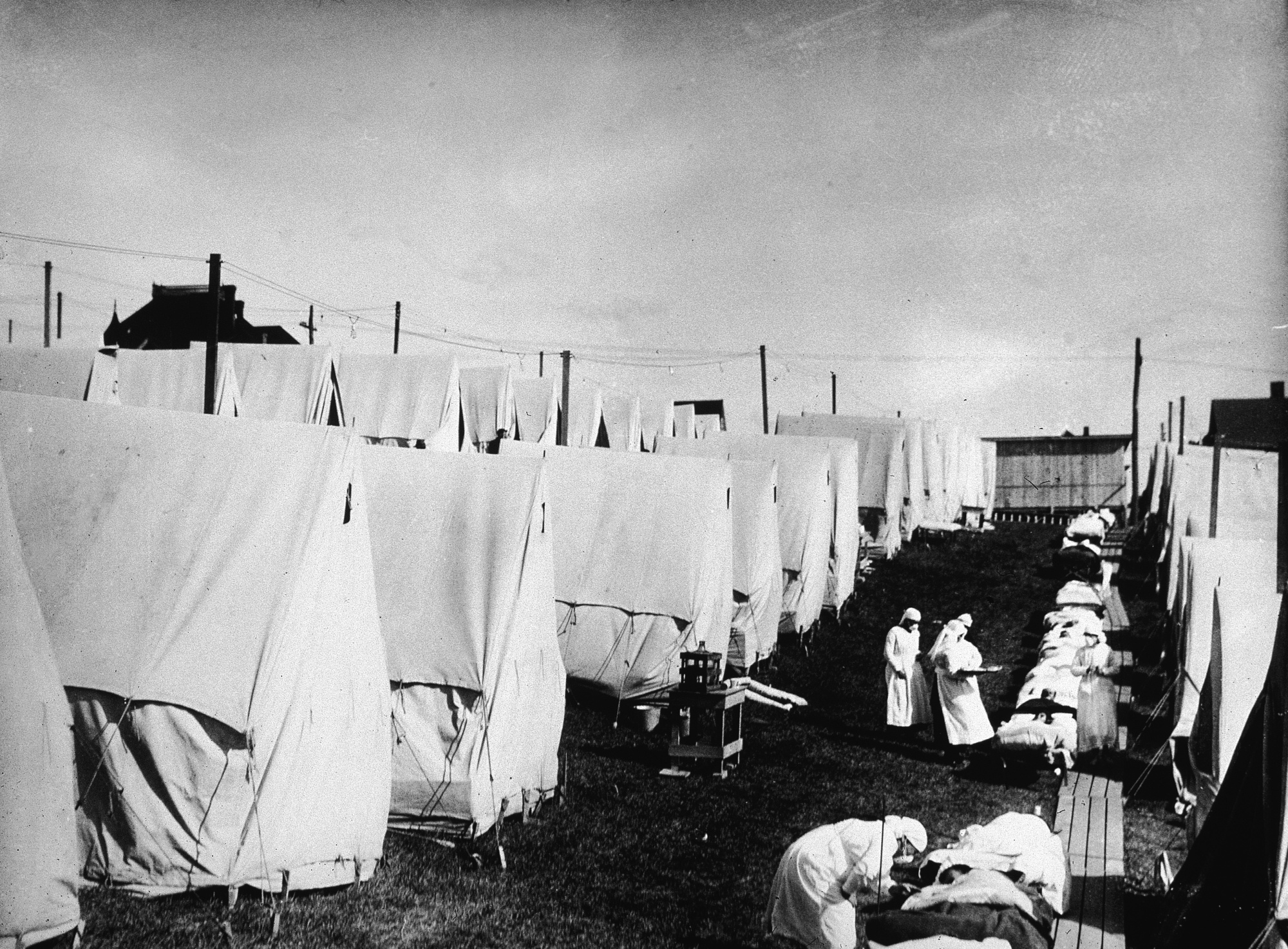
Nurses care for victims of the Spanish influenza epidemic in Massachusetts, in 1918.
Photographer: Hulton Archive/Getty Images
The Spanish flu of 1918 may show how Covid may play out, the Mayo Clinic’s Poland said. It’s likely that variants will continue to emerge, forcing the use of boosters or routine immunizations, targeted to the newer strains.
“Then, if we are lucky, what is likely to happen is that this will become something more akin to influenza, where we will always have it,” Poland said. “It’ll become more seasonal, just like the coronaviruses that are already circulating, and we will just have to keep immunizing.” If things do play out like the flu, the world may have some version of Covid-19 a hundred years from now.
Before it's here, it's on the Bloomberg Terminal.
LEARN MORE
Sent from my iPad |



