"What's the average income (after expenses) relative to purchase price ?"
Yes, I understand what you're getting at, but I fail to see the relevance of that calculation at a point in time. There are at least two Primary VARIABLES involved in owned rentable property which change with time, .... The monthly rental goes up annually and the value of the property generally increases, so an investment in a property has to be considered as a long term one. It also depends on the location of the property which influences its demand.
If I take, as an example, one of my apartments that I have owned for just over 11 years, its value has increased by ~130%, from 1,500,000 units to ~3,450,000 units. Its accumulated rental income, less expenses (levies, rates, maintenance), is 1,535,000 units. That gives a total current Investment Value of 4,985,000 units. In my case there's no Bond repayments as I generally pay the full price for my apartments up front.
Putting that into .... 4985000 = 1500000(1+r/100)^11 gives an annual compounded "r" = ~11.5%.
If we exclude the net rental income we get an annual compounded "r" = ~8%.
Yes, inflation has to be considered but that's much the same for most other investments.
That "rate of return" will be greater in a year's time as the net rental income will go up and the property value is likely to increase, all of which is compared to an original fixed investment amount.
I suspect you're going to refer to REITs and take a somewhat "armchair investment" approach ....
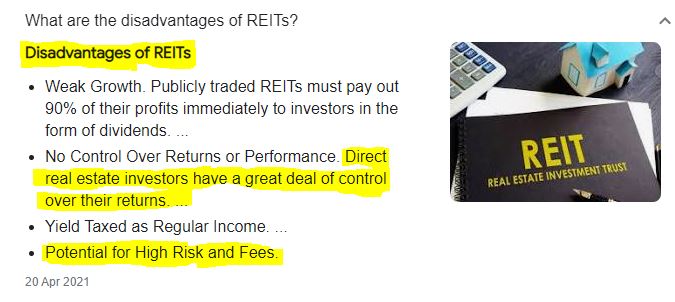
There's nothing wrong with investing in a REIT but IMO there are aspects of them to consider :-
 |



