Re <<tripolar>>
Must be budget season, but perhaps explains Milley's call to his China counterpart
cbsnews.com
Exclusive: No. 2 in U.S. military reveals new details about China's hypersonic weapons test
Updated on: November 16, 2021 / 6:57 PM
By David Martin
In an exclusive interview with CBS News, General John Hyten, vice chairman of the Joint Chiefs of Staff and the No. 2 person in the U.S. military, revealed new details of last summer's Chinese hypersonic weapons test, which sent a missile around the world at more than five times the speed of sound.
"They launched a long-range missile," Hyten told CBS News. "It went around the world, dropped off a hypersonic glide vehicle that glided all the way back to China, that impacted a target in China." Asked if it hit the target, Hyten replied, "Close enough."
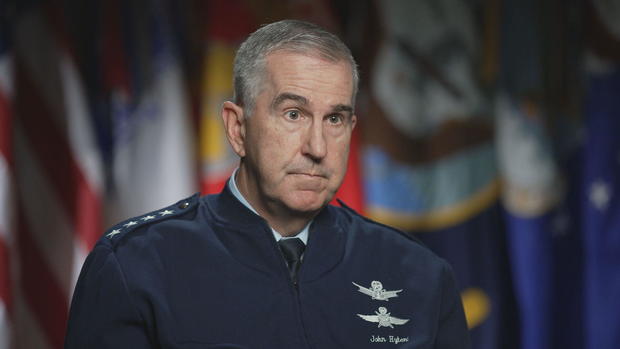
Vice Chairman of the Joint Chiefs of Staff General John Hyten interviewed by CBS News' David Martin
Unlike intercontinental ballistic missiles which travel in a predictable arc and can be tracked by long range radars, a hypersonic weapon maneuvers much closer to the earth, making it harder for radars to detect. Combined with hundreds of new missile silos China is building, Hyten believes the Chinese could one day have the capability to launch a surprise nuclear attack on the U.S.
"They look like a first-use weapon," Hyten said. "That's what those weapons look like to me."
For decades, the nuclear balance between the U.S. and Russia has depended on neither side having the capability to launch a successful first strike. If China is now trying to develop a first-strike capability, that balance would be in jeopardy.
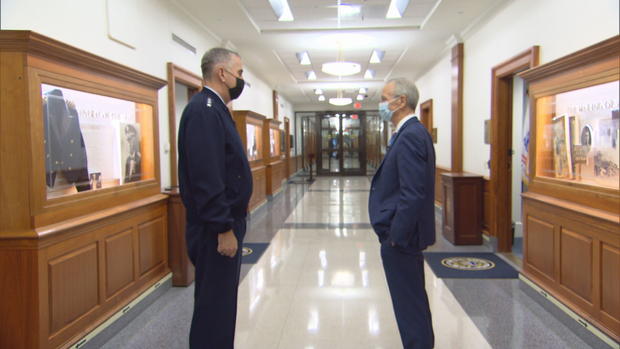
Vice Chairman of the Joint Chiefs of Staff Gen. John Hyten talks with CBS News senior national security correspondent David Martin.
The U.S. is developing its own hypersonic weapons — but not as quickly as China. Hyten told CBS News that in the last five years, China has carried out hundreds of hypersonic tests, while the U.S. has conducted just nine. China has already deployed one medium-range hypersonic weapon, while the U.S. is still a few years from fielding its first one, according to Hyten.
China's round-the-world hypersonic test took place on July 27 and has been compared to the moment in 1957 during the arms race with the Soviet Union when Moscow launched the Sputnik satellite, becoming the first nation into space and catching the U.S. by surprise.
Asked if he would compare the Chinese test to Sputnik, Hyten replied that "from a technology perspective, it's pretty impressive. . . But Sputnik created a sense of urgency in the United States. . . The test on July 27 did not create that sense of urgency. I think it probably should create a sense of urgency."
Trending News
David Martin
David Martin is CBS News' National Security Correspondent.
First published on November 16, 2021 / 6:05 PM
© 2021 CBS Interactive Inc. All Rights Reserved. |



