In the meantime, a total aside, it seems that Global Britain is cutting off northern Britain :0)
bloomberg.com
Why the U.K.’s High-Speed Rail Plan Was Cut in Half
Boris Johnson’s government announced that an ambitious rail initiative would be drastically trimmed, angering northern cities that were promised upgraded service and faster trains.
Feargus O'Sullivan
25 November 2021, 01:35 GMT+8
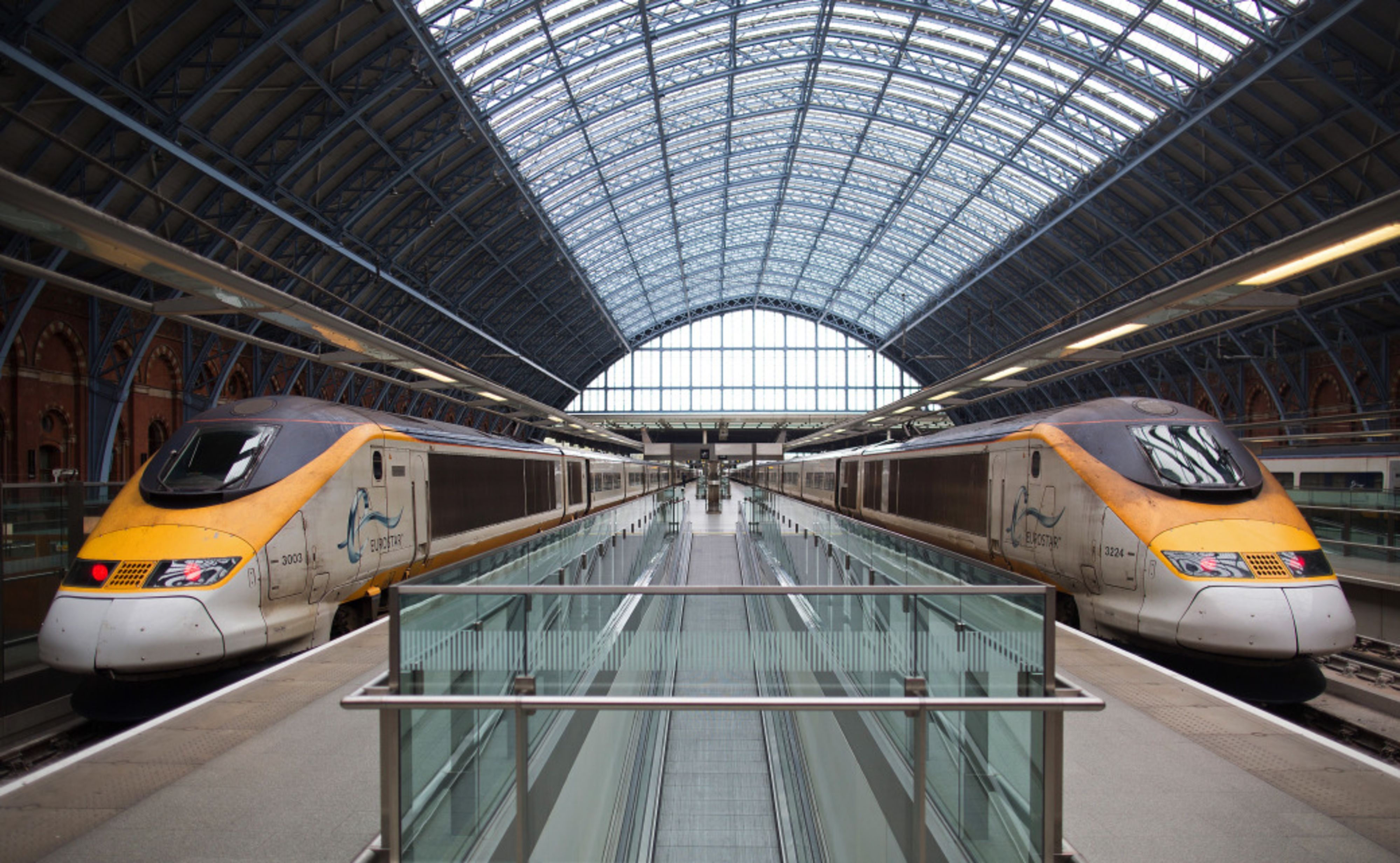
Eurostar passenger trains at St. Pancras rail station in London. A plan to extend high-speed service into northern England is underway, but budget cuts have eliminated some lines.
Photographer: Simon Dawson/Bloomberg
In Manchester, some locals are mourning a train station that never was.
Back in January 2019, Transport for the North, a transit body set up by Britain’s Boris Johnson-led coalition government, announced a makeover of Northern England’s rail infrastructure, an initiative that came to be known as Northern Powerhouse Rail. The plan was designed to radically improve ailing rail service in the region, with a mix of new high-speed and conventional lines and major upgrades of existing services. For Manchester, the plan meant that the city would get a new underground railway station for a coming extension of the HS2 high-speed rail line. Built along the lines of facilities in Berlin and Antwerp, the so-called “through station” would have had trains passing through the city via tunnels, rather than backing in and out of a dead end as in a conventional terminus.
But last week, the government radically scaled down the rail plan, and now Manchester is set to get a regular station, with trains elevated on viaducts — a scheme the city’s Labour Party mayor, Andy Burnham, derisively called “ HS2 on stilts”.
Billed as a key tool to help bring northern England further in line with the generally more prosperous south — and to counteract decades of relative under-investment in the region — Northern Powerhouse Rail was supposed to deliver a new high-speed rail connection between Manchester and Leeds (known as HS3), and between Leeds and Birmingham (on HS2, a line whose already approved stretch between London and Birmingham is due to open in 2029), thus linking England’s four largest urban areas with faster train service. Now the project’s proposed £34 billion ($45.6 billion) budget is being slashed by half.
Other northern cities face even more extreme cutbacks than Manchester. The Leeds-to-Birmingham high-speed line is essentially canceled (some high speed tracks will be installed on a short stretch north of Birmingham), and the Manchester-to-Leeds line has been reduced to an upgrade of the existing line with a much shorter high-speed section.
The government has said that the switch away from building high-speed links would hasten the delivery of better rail to the North. By upgrading existing tracks instead, U.K. Transport Secretary Grant Shapps said, the North would see benefits “up to 10 years sooner than previously planned.”
The cost savings are nonetheless likely to be the predominant cause in a country hit both by Brexit and the pandemic, as Britain’s Chancellor Rishi Sunak already implied in October prior to revealing the autumn budget. With a few cracks starting to appear in the government’s united front, there have also been suggestions that, in promising a high-speed line from Leeds to Manchester, Prime Minister Johnson was committing the government to an investment his colleagues never had the means or will to deliver.
Some elements of the original Northern Powerhouse Rail plan have survived: The U.K. is still building a high-speed line from London to Birmingham and Manchester — England’s three largest urban areas — and other routes will get faster journey times, contactless ticketing and other improvements. But the trimmed-down initiative doesn’t resemble the bold rethink of Britain’s rail system once promised, and that’s triggered widespread condemnation among northerners. Manchester Mayor Burnham said that the cut could “hold back the north for another 100 years,” while Liverpool City Region Mayor, Labour’s Steve Rotheram said that the region was being given “scraps off the table.” West Yorkshire Mayor Tracy Brabin, also a Labour Party representative whose constituency covers the cities of Leeds and Bradford, warned that the changes represented a “betrayal of the Government’s levelling-up promise.”
For rail passengers, the cuts will mean missing out on some long-desired service upgrades. Current journey times in the region can be shockingly slow by European standards — the fastest train between Manchester and Leeds takes 49 minutes to travel just 36 miles. The other major issue is capacity: Many busy routes in northern England are heavily congested. By creating a fast intercity track alongside the existing network, the original version of Northern Powerhouse Rail would have freed up track space for more regular local trains. While the pandemic has slashed demand for commuter rail services, there are still reports of cramped trains crossing the region.
Geopolitically, yet more is at stake. Northern Powerhouse Rail is just the most high-profile part of an overarching government plan to attract investment and jobs to northern England and rebalance the country’s wealth and investment map — plans that have also seen it dub the old Ministry for Housing as the Department for Levelling Up, Housing and Communities. This commitment was an important component of the Conservative Party’s success in breaking down the so-called “ red wall”— a band of urban constituencies in central and northern England that have historically been largely Labour-supporting but which swung right to in the 2019 election to elect Conservative MPs.
Since the decay of their manufacturing and coal mining industries in the 1980s, parts of northern England have struggled economically. While major cities such as Manchester and Leeds have enjoyed some growth in recent decades, many smaller cities are still languishing, and there remains an entrenched north-south divide in household income and life expectancy. This divide is more complex than it is often presented — southwestern Cornwall is in fact one of Britain’s poorest regions, while the country’s most impoverished town overall is just outside London. But when northerners say they feel ignored and under-resourced by a London-based political and business elite, they have a sheath of data to support their grievances.
“It’s the same old story, again and again,” Liverpool City Region Mayor Steve Rotheram said at a press conference. “If the North had received the same per capita funding as London over the last decade, we’d have had £86 billion more.”
Marcus Johns, research fellow at the think tank Institute for Public Policy Research North, said that the chronic lack of investment in the region manifests in a multitude of ways. “The North is now reliant on creaking Victorian infrastructure that undermines its economy, its people’s quality of life and its ability to reduce emissions,” he declared in a statement.
Comments like these have rankled some in London, with one London Assembly member pointing out that while the capital has pockets of acute poverty, “northern leaders sometimes gloss over this and pretend all of London’s streets are paved with gold.” But when it come to infrastructure, it’s hard not to see the area’s decided advantages. London possesses Britain’s only existing high-speed track — linking the city to mainland Europe via the Channel tunnel — and is due to inaugurate an additional underground heavy rail system, called Crossrail, in 2022.
Not everyone is disappointed to see Northern Powerhouse Rail turned down a notch. MPs representing rural areas have long warned that building the route would mean the demolition of homes, while some environmental campaigners have expressed relief that, of the 693 wildlife sites and 108 ancient woodlands in the high-speed links paths, the ones on the now-canceled Birmingham-to-Leeds link will be spared.
The line’s other environmental costs and benefits are a matter of some dispute. HS2 is positioned as a key player in the county’s transition to a lower-carbon future, but critics have noted that the enormous emissions involved in its construction could wipe out those gains, and then some. For those who see fast trains as a critical means of reducing demand for air travel and vehicle trips, the scaled-down plans represent a new setback. The U.K. has one of Europe’s smaller proportions of high-speed rail as part of its overall network, lagging behind continental leaders in fast rail transit such as Spain, Finland and France, as well as Denmark and Poland. The latest cuts might not entirely derail HS2, but trimming the system does mean that Great Britain won’t be catching up anytime soon.
Before it's here, it's on the Bloomberg Terminal.
LEARN MORE |



