Boosters Today, Boosters Tomorrow, Boosters Forever
Posted on December 15, 2021 by Baron Bodissey
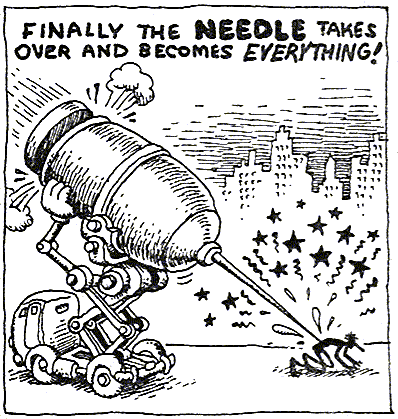
In the German state of North Rhine-Westphalia, citizens can now get “boosted” pretty much whenever they want. If you’re in NRW and feel a need for your mRNA fix, just hie you on down to the nearest vaccination center and bare your arm — that needle will feel oh-so-good when it goes in.
Many thanks to Hellequin GB for translating this article from PolitikStube:
Now comes the turbo charge: Booster vaccination in North Rhine-Westphalia possible after 4 weeks
In NRW, booster vaccinations are now possible much earlier. As early as four weeks after the second vaccination, citizens may get the booster in the vaccination centers of municipalities and counties, reports the Siegener Zeitung, which is a partner of the RedaktionsNetzwerk Deutschland (RND). Previously, this period was five months.
A corresponding decree went out to all circles, a spokeswoman for the health ministry confirmed to the newspaper. The aim of the decree is that nobody is turned away from the vaccination center just because less than five months have passed since one’s second vaccination.
The shortened vaccination interval is based on the current recommendation of the Standing Vaccination Commission, according to which a booster vaccination for people with severely impaired immune systems and an expected severely reduced immune response can be given as an optimization four weeks after the second vaccine dose.
The Standing Vaccination Commission has generally recommended an interval of six months. In view of the expected rapid spread of the Omicron variant, however, experts such as the chairman of the German Society for Infectious Diseases, Bernd Salzberger, have recently pushed for a shortening of the interval between the second and third vaccination.
A faster booster vaccination could influence the spread of both the delta and the omicron variant, “the experiences from Israel show that very impressively,” Salzberger told the newspapers of the Funke media group on Saturday.
Source: editorial network Germany
PolitikStube: The “experiences from Israel” probably consist in the fact that the vaccination subscription is becoming a reality in the boosted country and that there is already talk of a fifth, sixth, and seventh vaccination there. |



