Australian Researchers Find Lockdowns “Detrimental” To Mental Health
- RETARDS HAD TO RESEARCH THIS!!!
www.theepochtimes.com /australian-researchers-find-lockdowns-detrimental-to-mental-health_4308291.html
Australian researchers have confirmed that lockdowns are detrimental to mental health, according to a new study conducted by the Australian National University (ANU).
The study which focused on Melbourne during the second wave of lockdowns found that despite the effectiveness of the restrictions in controlling the spread of the CCP virus, the approach “adversely impacted [Melbourne residents’] levels of depression and loneliness.”
Melbourne, which endured the world’s longest period in lockdown under the authority of state Premier Daniel Andrews in Victoria, weathered 6 lockdowns over the first two years of the pandemic.
Lockdown is estimated to have increased depressive symptoms by approximately 23 percent and feelings of loneliness by 4 percent,” the study’s authors said.
There is “robust evidence on the short-term mental health impacts of COVID-19 lockdowns,” the authors concluded.
“These results illustrate the importance of the social environment on individuals’ mental health and the need for future research and interventions in this area.”
The team, led by ANU researcher James O’Donnell conducted three surveys on Melbourne residents from May to Oct. 2020, coinciding with the “second wave” of cases and lockdown restrictions due to an outbreak from Victoria’s hotel quarantine in late May 2020.
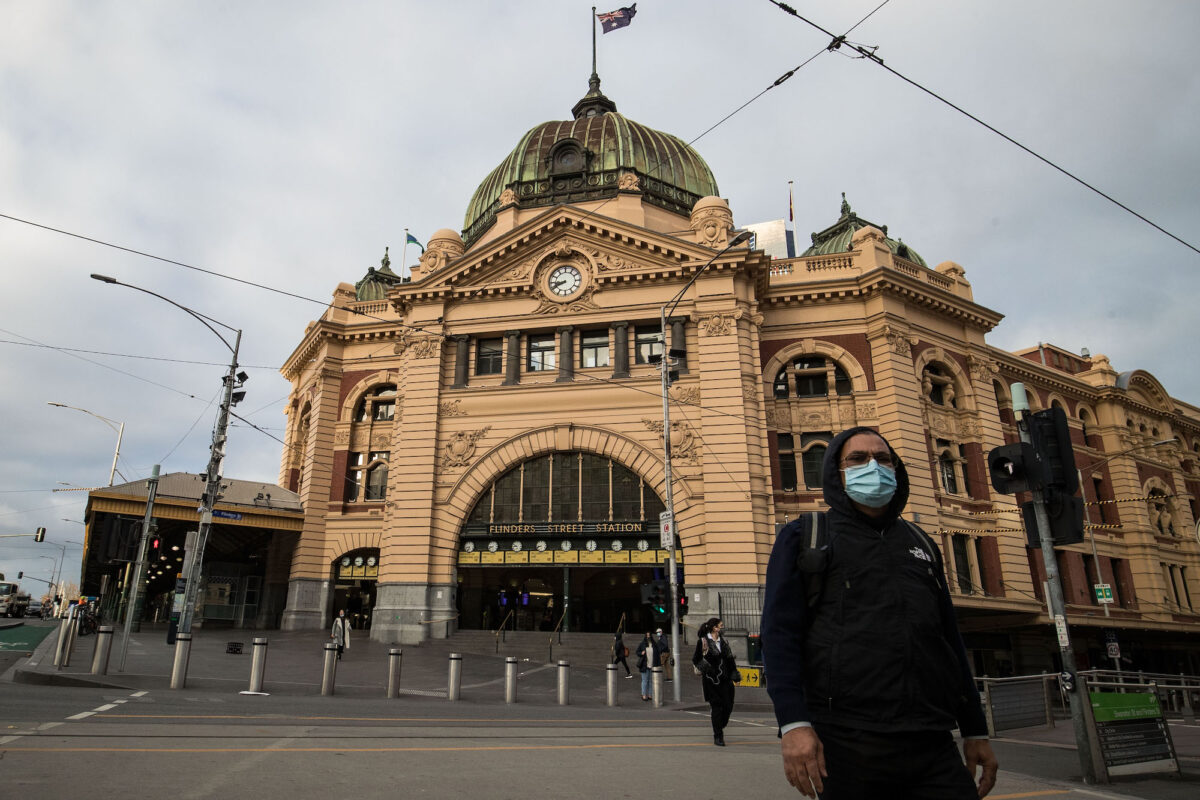
 A man crosses the normally busy intersection of Flinders Street and Swanston Street in Melbourne, Australia on May 28, 2021. (Darrian Traynor/Getty Images)The second survey was taken from mid-June to mid-July 2021 and coincided with periods of lifted restrictions in early June and reimposed lockdowns in mid-July. A man crosses the normally busy intersection of Flinders Street and Swanston Street in Melbourne, Australia on May 28, 2021. (Darrian Traynor/Getty Images)The second survey was taken from mid-June to mid-July 2021 and coincided with periods of lifted restrictions in early June and reimposed lockdowns in mid-July.
Mental health was examined using the DASS-21 test for both depression and anxiety. Loneliness was tested on responses to the three-item Loneliness Scale with questions such as “how often do you feel isolated from others” with respondents needing to answer from hardly ever, sometimes, or often.
The team found higher depression scores for the first survey and third survey—both were taken during lockdowns—with respondents falling into the bracket for mild levels of depression.
In comparison, the second survey, taken primarily during lifted restrictions had a lower score for depression with respondents scoring an average of less than 1 and leaning to the normal range of 0-9 for depression.
 Police place a face mask on an arrested protester at the Shrine of Remembrance in Melbourne on Sept. 5, 2020 during an anti-lockdown rally protesting the state’s strict lockdown laws as a preventive measure against the COVID-19 coronavirus. (William West / AFP via Getty Images)Loneliness levels were also higher for the first and third surveys, while the second also showed a drop in levels in line with the depression study. Police place a face mask on an arrested protester at the Shrine of Remembrance in Melbourne on Sept. 5, 2020 during an anti-lockdown rally protesting the state’s strict lockdown laws as a preventive measure against the COVID-19 coronavirus. (William West / AFP via Getty Images)Loneliness levels were also higher for the first and third surveys, while the second also showed a drop in levels in line with the depression study.
The team also found, whilst 2021 studies in Europe and surveys on NSW taken at the same time as the study showed that anxiety also went up from lockdowns, those findings were not observed in the Melbourne study.
In fact, scores for anxiety appeared to decrease; going from mild levels of anxiety in survey 1 to normal levels for both the second and third surveys.
However, researchers argued this could be due to erosion of respondents as the study progressed with the sample size decreasing from 3028, to 2034, then 1723 respondents for each subsequent study. |