Re <<Nazis>> … dunno.
Let’s see how the hot war goes, and should it go Team Russia’s way, a de-Nazi-fication campaign promised by Putin assuming there are Nazis around at that time.
I remain agnostic.
In the meantime, Stratford, a slightly different organization since George Friedman left, intones that (a) trade war not going according to plan, (b) cannot exactly be stopped (just like real wars, surprise), and (c) cannot fix any issues.
geopoliticalmonitor.com
Ending America’s Trade War with China Won’t Stop Inflation
By Jessica Darby, Ron Gordon, & Dave Ketchen
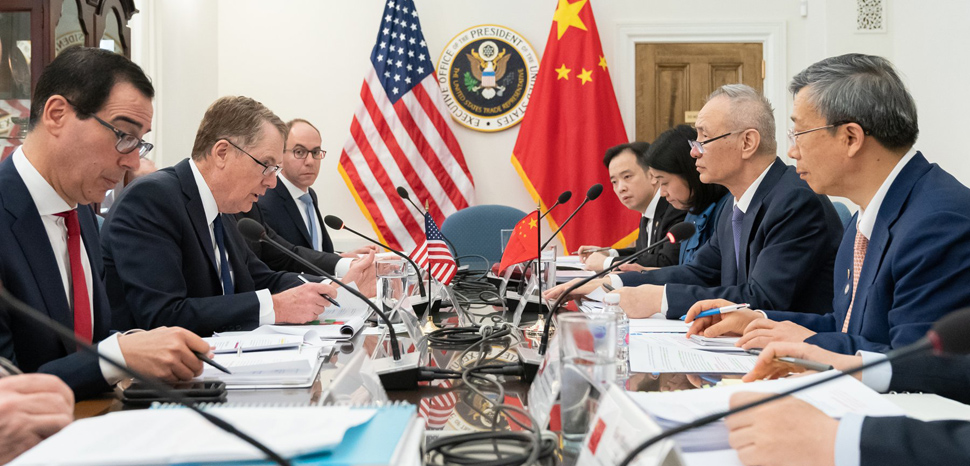
Several policymakers, economists, and trade associations contend that Trump-era tariffs on Chinese goods are causing rising inflation and should be repealed. There are many reasons to oppose the trade war, but blaming it for inflation serves only to distract attention from the primary culprits.
Background
President Trump started the trade war in early 2018 by imposing tariffs on solar panels, washing machines, aluminum, and steel. Though the tariffs did not apply solely to Chinese products, they were largely the result of Trump’s belief that the U.S. economy was being harmed by unfair Chinese business practices including currency manipulation, intellectual property theft, forced technology transfer, and dumping subsidized low-priced goods on the U.S. market. Many hoped the trade war would strengthen the U.S. economy by encouraging firms to bring manufacturing jobs back to the U.S. and reducing our ever-growing trade deficit with China.
The Chinese retaliated by imposing tariffs on American goods and this tit-for-tat pattern repeated through five rounds of additional tariffs on various products. The nations agreed to stop the escalation in January 2020, with China pledging to buy more U.S. goods and services in exchange for lower tariffs on some products.
When Trump left office in January 2021, tariffs averaged 20.7% each and covered 66.4% of Chinese imports. President Biden has shown no signs that he intends to end the trade war anytime soon.
The Trade War Has Not Gone Well
The trade war has failed in many ways. It initially fueled a small uptick in jobs in the U.S. steel and aluminum industries. However, consumers paidan estimated $900,000 annually for every steel industry job that was created or saved — over 13 times the average steelworker’s salary. Then, those job gains vanished during the pandemic. The rest of the world’s excess capacity for steel production is nearly six times the U.S. steel industry’s productive capacity, so trying to revitalize the industry through tariffs was always going to be an uphill battle.
The tariffs also have failed to improve the U.S. trade deficit, which hit a record high of $859.1 billion in 2021. Our trade deficit with China grew 14.5% to $355 billion, reflecting both our continued reliance on Chinese goods and China’s failure to keep its 2020 promise to buy an additional $200 billion worth of U.S. goods and services compared to 2017 levels. China needed to purchase $502.4 billion worth of U.S. goods and services in 2020 and 2021 to meet its commitment. It spent $288.8 billion, falling short of even the 2017 baseline that guided the agreement.
The trade war also has harmed U.S. consumers. Economists typically find that tariffs imposed by large nations lead to an “incomplete pass-through” of prices — firms who wish to continue exporting goods to the tariff-imposing countries drop their prices and share the burden with consumers. However, no such pass-through has occurred during the trade war. The tariffs have been passed along to consumers and real aggregate income has fallen slightly in both the U.S. and China.
For All Its Faults, The Trade War Plays Little Role in Inflation
Inflation surged 7.5% over the last year; the biggest increase in forty years. The trade war’s shortcomings make it an easy scapegoat for inflation. But the tariffs are not a major driver of inflation and repealing them would likely do little to slow inflation’s growth.
Inflation’s acceleration began in March 2021, more than three years after the trade war began. That gap illustrates why blaming the tariffs for inflation is off target. Prices on tariffed goods such as solar panels and hot-rolled band steel actually fell in 2019, before the pandemic created conditions for rising inflation.
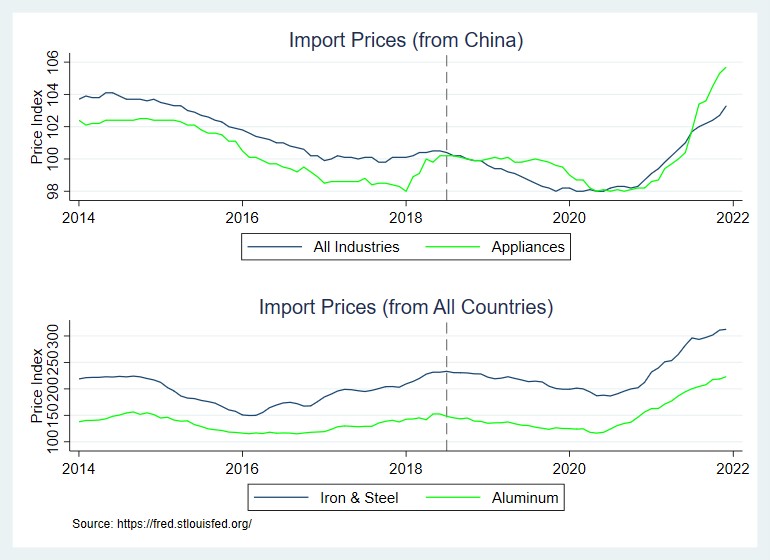
However, those who blame the trade war for higher prices are not completely wrong. U.S. tariff and customs duties rose $49.1 billion between the fourth quarter of 2016 and the third quarter of 2021, reaching $85.7 billion. The increase represents 0.3% of the $16 trillion U.S. consumers spend on personal expenditures. Repealing the tariffs would provide a minimal, one-time reduction in consumer prices. But that proverbial drop in the bucket would do little to stem the rising tide of inflation.
Conclusion
It would be a simple fix if tariffs were the primary driver of inflation. But inflation is raising the price of everything, not just tariffed goods. Repealing the tariffs would offer minor relief, but it would do nothing to slow the rising food, housing, and fuel prices that affect Americans’ daily lives far more than any goods burdened with trade war tariffs.
The views expressed in this article are those of the authors alone and do not necessarily reflect those of Geopoliticalmonitor.com
Sent from my iPad |



