'I feel angry': Why some people regret and reverse their transgender decisions
'I’m angry that every single doctor and therapist we saw told us this was the one and only option'
Author of the article:
Tom Blackwell
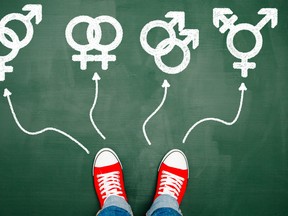
Studies have estimated that 60 to 90 per cent of children who identify as transgender no longer want to transition by the time they’re adults. PHOTO BY GETTY IMAGES
By age 14, Eva became convinced she was a transgender boy. By 16, she had come out to her teachers and classmates.
Her emotionally manipulative family was less accepting of her decision. But a therapist in Toronto and trans activists she knew had a dramatic proposal.
She could move into the Covenant House youth shelter, and then freely go on hormones to push ahead with medical transition.
“They thought it was so important for me to be on testosterone that it was OK if I left home and probably didn’t graduate high school,” recalled Eva, who asked that her last name not be published to preserve her privacy around sensitive issues. “Even at that point in life, when I was 16 and totally believed this was the only thing that was going to save me, I was more rational about it.”
She never did medically transition, a process that involves taking cross-sex hormones — testosterone for girls who transition to a male gender identity — and then undergo various surgical modifications.
And six years later, on her own at university in Manitoba, Eva decided she’d been “misled,” and was not transgender after all. She was attracted to women, and wanted to be attracted to them as a woman herself.
Eva, now 24, is part of a controversial cohort known as detransitioners and desisters, transgender people who come to rethink their decision, often having already undergone drug and surgical treatments.
In October she founded an organization – Detrans Canada – she hopes will support individuals she said can feel ostracized by the LGBTQ community.
She believes transition is essential for some gender dysphoric youth, but questions a treatment approach she said pushes young people too forcefully in that direction.
“I feel a little bit angry, more than a little bit, because other people who’ve been in this position went much further than me,” said Eva. “I have lesbian friends who have no uterus, no ovaries, no breasts and are 21-years old. I’m angry that every single doctor and therapist we saw told us this was the one and only option.”
She is convinced that more and more people are detransitioning or desisting, the latter term covering those who did not medically transition, though their numbers are the subject of debate.
Detrans Canada has yet to launch a concerted recruitment drive and has fewer than a dozen Canadian members. But Eva noted that a Reddit forum for detransitioners – r/detrans – grew from 3,000 to over 16,000 members in just a few months this year.
And s everal studies have estimated that 60 to 90 per cent of children who identify as transgender no longer want to transition by the time they’re adults, often becoming gay or lesbian.
Other research, however, has estimated that actual detransitioners represent as little as one per cent of the trans population.
Greta Bauer, the CIHR chair in gender and sex science at Western University, said she’s aware of no research indicating destransitioners’ ranks are expanding. She said many don’t regret their choice, they have simply stopped taking hormones for various other reasons.
“What concerns me is that some people seem to think that the existence of any regret justifies denying or delaying care for everyone who needs a treatment,” said Bauer. “This is not the standard by which we evaluate any other medical treatment.”
Eva said she suffered from some physical abuse, an eating disorder and attention-deficit hyperactivity disorder as a child and by 14 was on anti-depressants. She also knew she was not heterosexual, but “didn’t know what was going on.”
Then she saw videos posted online by trans men, people who had transformed from “dumpy women into buffed men,” and the answer seemed at hand.
Years later she met friends in Manitoba who were dealing with their identity issues in other ways, and her own dysphoria eventually faded away.
But such alternative perspectives seem of little interest to the health-care system, Eva said, or a clientele convinced by the transition-focused approach.
“You have teenage girls who have issues with their bodies, issues socially with growing up, they have issues about their sexuality,” she said. “It’s no surprise that they have been given this fix, and that they want the fix.” |



