| | | The world-improving complainers fret that Hong Kong has changed
whilst ignoring that which ails Ukraine was tried on HK, until HK, the real HK, fought back and the perps have been defeated, in jail, or ran away, so I am told
is in any case one view
even as I remain agnostic
but, like, just for example bloomberg.com
Will 2047 Be the End of Hong Kong as We Know It?
30 December 2019, 13:00
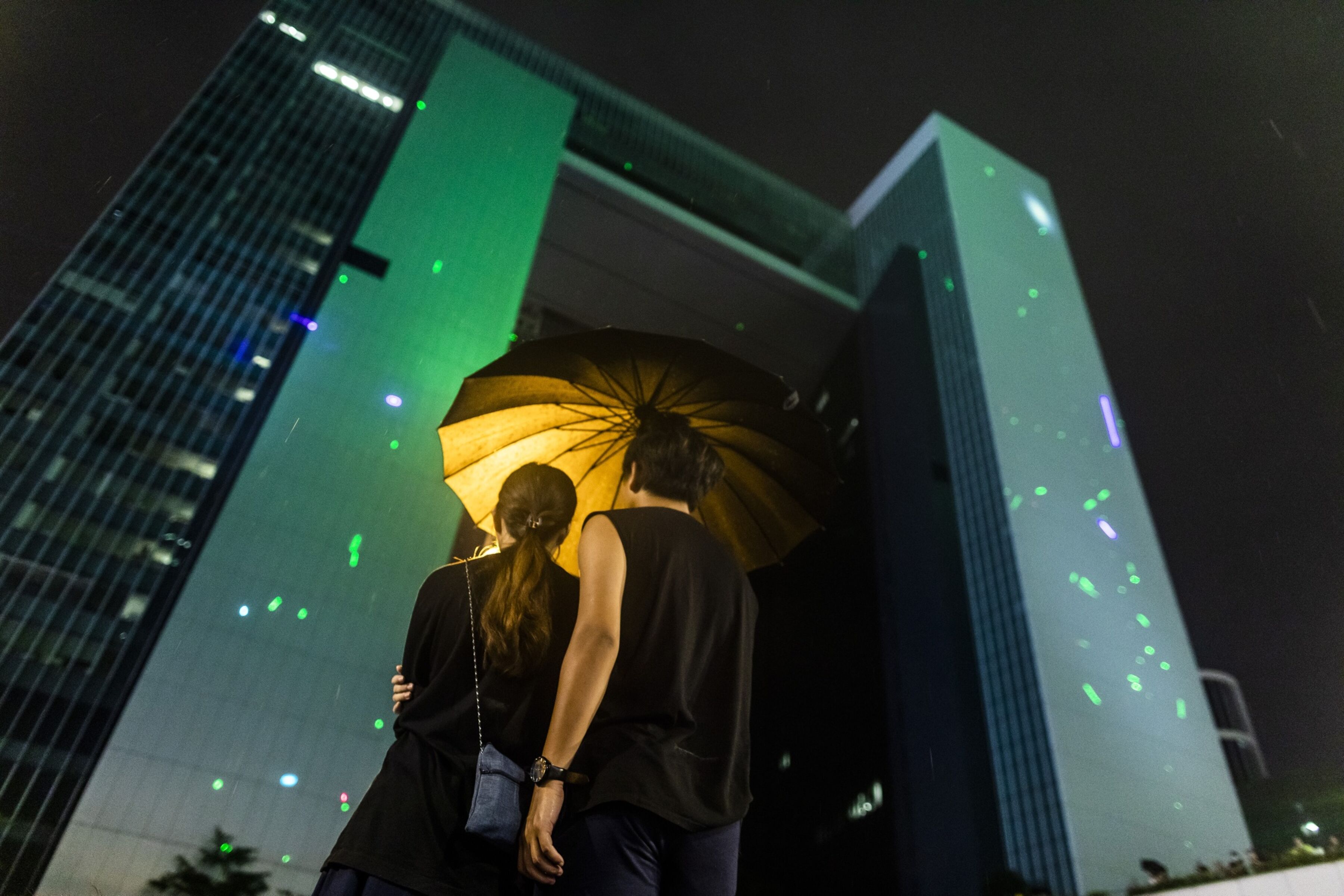 ? Demonstrators stand under an umbrella on Harcourt Road as laser lights are projected on the Central Government Offices during a protest in the Admiralty district of Hong Kong, China, on Sunday, Aug. 18, 2019. ? Demonstrators stand under an umbrella on Harcourt Road as laser lights are projected on the Central Government Offices during a protest in the Admiralty district of Hong Kong, China, on Sunday, Aug. 18, 2019.
Photographer: Justin Chin/Bloomberg
Officials say the city’s fate hinges on serving China rather than rejecting it.
As Hong Kong’s protests took a decidedly violent turn earlier this year, one of the city’s top officials was preoccupied with something potentially more explosive: What happens on July 1, 2047.
The date marking 50 years since Britain handed over Hong Kong to China will also see the legal expiration of the “one country, two systems” experiment that guarantees the former colony’s autonomy. Negotiated by Deng Xiaoping and Margaret Thatcher in the 1980s, it commits Beijing to ensuring political and economic freedoms in the city that aren’t afforded to the 1.4 billion people in mainland China.
“Maybe we should talk about it,” Bernard Chan, who helms the Executive Council that advises Hong Kong’s leader, said unprompted during a mid-September interview on the 16th floor of an office boardroom overlooking the city. “Is 2047 the end date of the ‘two systems,’ or what?”
That question has fueled the dramatic protests that have raged for more than six months, turning one of Asia’s premier financial hubs into a battleground featuring tear gas volleys, petrol bombs, vandalism, road blocks and subway shutdowns. The demonstrations were sparked by a bill allowing extraditions to China and expanded to include demands for universal suffrage—a promise that has yet to be fulfilled after the 1997 handover.
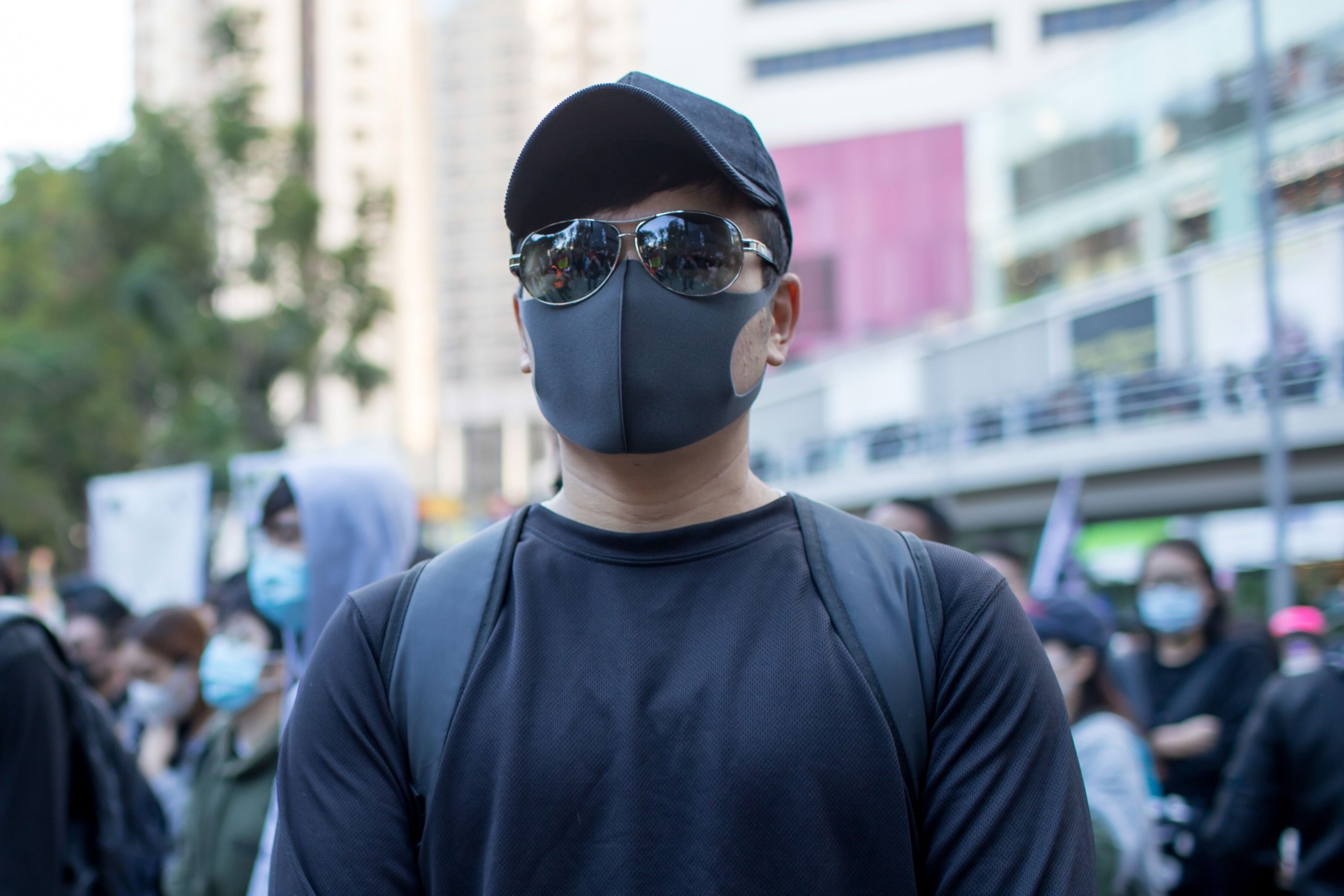
“In 2047, many Hong Kong people are afraid they can’t have elections, they cannot go to Facebook or Instagram, like in China nowadays. In 2047, our freedom will become nothing in Hong Kong. That’s why we need to go out to the street and tell the government what we’re thinking.” —?Alex Lo, 22, Student
Photographer: Paul Yeung/Bloomberg
“I feel like as long as everyone stands unified, we will eventually get what China promised us in the first place.” —Jojo Chan (left), 18, student
“Also, it’s for our next generation. A Hong Kong that has democracy and freedom, human rights, and where we won’t be silenced.” —?Helen Chan, 18, student
Photographer: Paul Yeung/Bloomberg
“I will be 80 or 90 years old at that time (2047). I am thinking for my children. A lot of things in Hong Kong will be suppressed like they are now in China, through controlling the economy, monopolies, speech and behaviour, everything, unable to receive information from the outside [world]. We can see all the things the Communist Party are doing. We feel fear. I am not worried about myself. I worry about my next generation, my children and grandchildren.” —?Anna Chan, 40s, service industry
Photographer: Paul Yeung/Bloomberg
“I came out today to send an important message to them (China): If you don’t give us proper freedom and abide by the Basic Law, then it will be harder for you to rule Hong Kong.” —?Thomas Tai, 26, admin worker
Photographer: Paul Yeung/Bloomberg
All of the unrest is really about Hong Kong’s future: Can the city retain its freedom of the press and assembly, its English common law legal system, its low tax rate and open markets? Up to now, this is what’s kept Hong Kong, one of the most business-friendly economies on the planet, distinct from China. Whether it can stay that way is a bellwether for China’s rise—and how it will co-exist with the West.
Despite the crucial nature of the transition, conversations with current and former officials in Hong Kong suggest there have been no official discussions about what happens in 2047: Chan said simply it was “way beyond for us to consider today.” But he and others, including government-linked figures in Beijing, say all signs indicate that China is happy to leave Hong Kong’s economy alone as long as the city toes the line politically.
“If by 2047 the so-called ‘two systems,’ the privileges, are still and remain only to be good for Hong Kong people, then I think it’s the end,” Chan said.
The past decade showed exactly how China wants things to go. Beijing has blocked a path to meaningful Hong Kong elections, banned pro-independence politicians, and undermined the independence of the judiciary—seen worryingly in the rendition of booksellers peddling works critical of Communist Party leaders. At the same time, it installed an immigration checkpoint downtown at a high-speed rail connection to nearby Guangzhou, built a bridge linking the city with Macau and the mainland, and created a sweeping plan known as the Greater Bay Area to integrate Hong Kong’s economy with southern China.
“We think all this connectivity to the mainland—whether it’s the high speed rail, the Zhuhai bridge, the Greater Bay Area—to us, it’s all good because it helps the economy, it helps Hong Kong,” Chan said. Protesters he’s spoken to, however, told him otherwise. “They don’t want any of these things. They say this connectivity will further marginalize Hong Kong. They want Hong Kong identity. We’ve obviously done a very poor job in letting them understand what’s at stake.”
In recent years, it’s become harder to separate Hong Kong’s political autonomy from its economic strengths.
Many of the young people driving the protests—who will be middle-aged in 2047—see the freedoms they now enjoy as incompatible with China’s political system. That includes widespread controls on the internet, the use of technology like facial recognition to clamp down on dissent and re-education camps for hundreds of thousands of minority Uighur Muslims in the western region of Xinjiang.
“When protesters are being locked up and detained in mainland China already, no one should expect people to travel to mainland China to enjoy the idea of the Greater Bay Area,” said Joshua Wong, 23, the city’s most famous pro-democracy campaigner, who was barred from running for office.
Massive Turnouts Hong Kong’s biggest protests have drawn millions
Sources: Civil Human Rights Front, Hong Kong Police
At one recent rally, Alex Lo, 22, dressed in black with a grey mask and sunglasses to hide his face, worried that Hong Kongers would soon no longer have access to information on Facebook and Instagram—much less elections.
“In 2047, our freedom will become nothing in Hong Kong,” he said. “That’s why we need to go out to the street and tell the government what we’re thinking.”
They are not alone. The city overwhelmingly sympathizes with the goals of the protesters, as seen by the hundreds of thousands of black-clad demonstrators who have flooded the streets month after month. Pro-democracy candidates won 85% of seats last month in an election for local district councils, a huge embarrassment for officials in Beijing.
Right now, China’s leadership has the final say over Hong Kong’s elections for chief executive, and it has ruled out any demands that would allow the city to vote in a leader that stands up to Beijing. That raises the prospect of years of unrest in Hong Kong if the students driving the movement continue to fight.
The unresolved political conflict has deeply shaken the business community. Officials in Beijing have pressured Hong Kong-based companies including Cathay Pacific Airways Ltd. to keep employees in line and off the streets. Capital has started flowing out as tourist arrivals and retail sales plummet, pushing Hong Kong into its first recession since the global financial crisis. That could accelerate Hong Kong’s dwindling economic importance to Beijing when compared with other mainland cities.
Dwindling ImportanceHong Kong’s worth to China has fallen
Note: Data shows Hong Kong's financial sector GDP as a percentage of Mainland China's financial sector GDP
Sources: Bloomberg Economics, Hong Kong Monetary Authority, China Ministry of Commerce
Prior to the unrest, many business groups also opposed the extradition bill over fears that executives in Hong Kong could be snatched away and forced to stand trial in courts beholden to the Communist Party. In March, the American Chamber of Commerce in Hong Kong warned that “the proposed arrangements will reduce the appeal of Hong Kong to international companies.”
Internationally, China’s encroachment on Hong Kong has prompted powerful lawmakers to question the city’s unique economic privileges. The U.S. Congress, deeply divided over the impeachment of President Donald Trump, managed to unite long enough in November to pass the Hong Kong Human Rights and Democracy Act, which strengthened provisions that tie the city’s preferential tariffs to its political autonomy.
“In the minds of a lot of mainlanders, and maybe in the mind of Deng Xiaoping—I don’t think he actually thought it through—was the view that somehow you could achieve economic sustainability and reforms without political liberalization,” said Anson Chan, one of Hong Kong’s top bureaucrats up to and after the city’s return to Chinese rule. “We know in the long run that’s not feasible.”
At the time of the handover, the 50-year interregnum was designed to give China a chance to catch up to Hong Kong, whose economy is ranked the freest in the world by the Heritage Foundation. It’s still a long way off. China’s per capita GDP puts the country roughly in line with Mexico and Lebanon, while Hong Kong is more on par with Germany or Canada.
So for now, Beijing has good reason to maintain “two systems.” Nearly 60% of China’s outbound investment is channeled through Hong Kong, putting it ahead of Shenzhen and Shanghai. It continues to be an important source of IPO fund raising for mainland firms, and bond issuance is a significant source of funds for Chinese corporations.
And international companies also like Hong Kong, even with the unrest. Incredibly low tax rates—a cap of 17% on individuals in Hong Kong, compared with as much as 45% on the mainland—have also made it an irresistible place for global businesses to profit from China’s rise, all with the protection of an independent judiciary.
Yet as 2047 gets closer, businesses will want certainty about what happens next. David Webb, a former investment banker and corporate governance advocate who’s lived in Hong Kong since the early 1990s, recalled the financial turmoil that began almost 20 years ahead of the official handover. Between 1982 and 1983, Hong Kong’s currency lost 25% of its value, culminating on Black Saturday with an all-time low of HK$9.80 to the dollar.
“That’s sort of demonstrative of the uncertainty that pervades the potential change of constitution,” Webb said. The government pegged Hong Kong’s currency at $7.80 in 1983, where it’s remained. In a future more closely linked to China, the fate of the dollar peg is unclear—along with whether China will loosen state control over finance and make the renminbi fully convertible.
“My greatest fear is that we won’t be able to say what we want, to voice our opinion, to actually fight for what we think is right. Slowly we are losing more rights and freedoms. And I might not be able to stand here, to be interviewed by you guys, when 2047 approaches.” —?Zoe Fung, 24, nurse
“We are still within the time frame of the ‘remain unchanged for 50 years’ promise. If we don’t do anything now, we can’t expect them (China) to do anything when this 50-year promise expires. We need to think about future Hongkongers, our next generation. We have to fight for the rights of that we are entitled (promised during the handover).” —?Daniel Tai, 25, healthcare professional
Photographer: Paul Yeung/Bloomberg
“They might be building ‘re-education camps’ near San Uk Ling. They could adopt the model of Xinjiang to rule Hong Kong. There may be more political suppression, such as using the courts to apply harsher sentencing on the youth or those who have participated in protests. So this young generation, a lot of them would lose their future and freedom.” —?Kelvin Lam, 21, student
Photographer: Paul Yeung/Bloomberg
“We never thought this day would come so quickly because they said things would ‘remain unchanged for 50 years.’ But now, 28 years before [2047], it already feels like that there’s no such thing (that they have broken their promise). It’s completely different. Everyone has to come out and resist. At least, first, we have to fight for the remaining 28 years.” —?Winnie Wong, 25, engineer
Photographer: Paul Yeung/Bloomberg
“ can’t even see what tomorrow will be like, not to mention 2047.” —?Emi Lo, 38, service industry
Photographer: Paul Yeung/Bloomberg
Absent any clear signals from Beijing, Webb went on, many could jump to the most drastic conclusion. “People will have to work on the assumption that the reason there’s no commitment is because you plan to apply mainland law to Hong Kong,” he said. “Fully integrate it.”
The costs of doing that could be tremendous, not least due to the fears businesses would have of coming under China’s legal jurisdiction. It would also entail a host of practical changes that would take years of transition to avoid catastrophe, from monetary policy, taxes and capital movement to passports, visa rules and customs procedures.
Others see a more incremental way forward. Regina Ip, one of the city’s most well-known pro-establishment politicians, said Beijing wants to preserve the best of Hong Kong: “And if I ask myself. ‘What is the most unique advantage of Hong Kong, which has served Hong Kong best?’ That’s the rule of law. The common law system. Not democratic elections.”
Either way, Beijing has little incentive to make radical changes, said Martin Lee, a barrister who was on the drafting committee of Hong Kong’s mini-constitution, the Basic Law. They already have plenty of power, he said: “There’s no need to change. Why? Because they can change the Hong Kong system at will.”
In early December, some 800,000 protesters marched through the streets of Hong Kong for one of the first officially sanctioned demonstrations in months. Thunderous chants echoed among Hong Kong’s skyscrapers as huge crowds of people, most dressed in black and some waving revolutionary flags, shut the city down once again.
“They said ‘no change for 50 years,’ but it feels like a lot has changed, so we have to come out to resist,” said Winnie Wong, a 25-year-old engineer. “We never thought this day would come this quickly.”
Hong Kong’s demographic character has already changed drastically since the 1997 handover, with more than a million mainland Chinese settling in the city of 7.4 million. But one of the biggest unknowns about Hong Kong’s future revolves around the fate of China itself, particularly after President Xi Jinping leaves office.
Just Another Chinese CityTens of thousands of Mainland Chinese move to Hong Kong each year
Note: Statistics show annual arrivals on so-called One Way Permits for Mainland Chinese citizens who settle in Hong kong
Source: Hong Kong Government
“Xi won’t be around forever,” Anson Chan said. “His successor, whoever he may be, will he continue in this authoritarian vein? Or will he be someone more open, as was the case with Xi’s predecessors?”
Xi has centralized power and pulled the country in a more authoritarian direction than when the 50-year grace period was struck. Back in 1984, Deng Xiaoping said Hong Kong could have another 50 years if that period wasn’t enough.
“Deng’s comments are very wise, but they have a precondition,” said Gao Zhikai, who worked as Deng’s translator and is also a former Chinese diplomat.
“If Hong Kong is very rational—pursuing democracy but not in violent ways—and has very stable development, the central government may decide that ‘one country, two systems’ stays after 2047,” he continued. “If the current turmoil and violence continues in Hong Kong, and the city becomes a center of anti-China hostility, then 2047 will be the end of ‘one country, two systems,’ as far as Hong Kong is concerned.”
That puts Hong Kong and Beijing in a delicate dance. How much can Beijing flex its political muscle without threatening the city’s economy? Will ongoing political protests forestall a crackdown or provoke one? What people know now is uncertainty—and that uncertainty is continuing to propel the city’s pro-democracy movement forward.
China would like Hong Kong to replicate Macau, the former Portuguese colony that also adheres to the “one country, two systems” framework. Xi praised the gambling hub earlier this month for having “correctly exercised its high degree of autonomy,” including its implementation of a law that makes disrespecting China’s national anthem a crime.
For Chan, the top adviser to Hong Kong leader Carrie Lam, it all comes down to whether the next generation can show that China clearly benefits from the city’s autonomy, “to serve the Chinese in order to extend it.” Without that, he said, “you’re gone.” “I think we still have a good chance to ask for an extension, but it’s only up to us—or up to the next generation—to prove that,” Chan said. “It’s not going to be me proving it.”
—With assistance from Josie Wong, Miao Han, Dandan Li, Hannah Dormido and Adrian Leung
|
|



