SI
SI
discoversearch

We've detected that you're using an ad content blocking browser plug-in or feature. Ads provide a critical source of revenue to the continued operation of Silicon Investor.  We ask that you disable ad blocking while on Silicon Investor in the best interests of our community.  If you are not using an ad blocker but are still receiving this message, make sure your browser's tracking protection is set to the 'standard' level.
Strategies & Market Trends : Dino's Bar & Grill

 Public ReplyPrvt ReplyMark as Last ReadFilePrevious 10Next 10PreviousNext  
To: Goose94 who wrote (127578)6/27/2022 3:53:26 PM
From: Goose94Read Replies (4) of 202784
 
Inflation Shock to Growth Shock – This May Not Get Easier

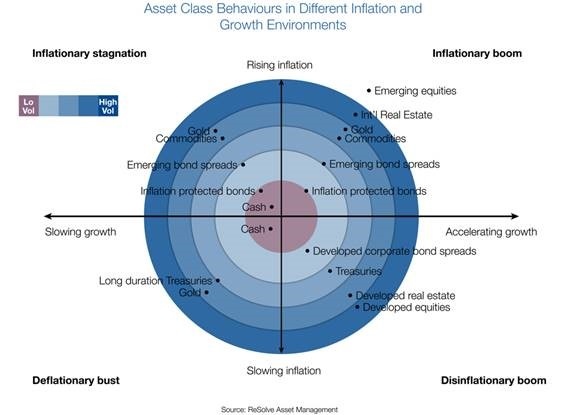
There are four economic regimes created by two dynamics: growth and inflation. These regimes greatly inform whether specific asset classes will thrive or wilt depending on the current economic regime we find ourselves in.

Figure 1 below illustrates the framework showing which asset classes might be expected to thrive under differing economic conditions. Assets toward the middle are least sensitive, while assets toward the edge of the diagram are most sensitive to each regime.

Recently markets have been experiencing and adjusting to an inflationary shock and many traditional portfolios have lacked exposure to the asset classes that thrive under these conditions, leaving investors with disappointing results. Further, the response of central banks and governments to raise interest rates in an attempt to deal with the inflationary impulse has had the consequence of slowed economic growth. This could tip the economy into a recession leading to a subsequent growth shock.


The past decade has been characterized by benign inflation, abundant liquidity and sustained economic growth globally. These qualities favoured traditional portfolios of developed market stocks and bonds, such as the ubiquitous 60/40 ‘balanced’ portfolio but these portfolios are showing their vulnerabilities in 2022. The economic regime has shifted to one where stocks and bonds have declined in unison.

If investors are to succeed in the current economic regime, today’s portfolios must be prepared to weather periods of poor global growth, that are accompanied by large swings in inflation, and tightening financial conditions.

The 1970s offer a meaningful case study, as stagnating economic growth coupled with high and accelerating inflation produced negative real returns for stocks and bonds for over a decade. Investors wanting to avoid these outcomes are going to have to look beyond tradition to thrive.

Mike Philbrick on BNN.ca Market Call Monday June 27th @ 1200ET

Gold:
Report TOU ViolationShare This Post
 Public ReplyPrvt ReplyMark as Last ReadFilePrevious 10Next 10PreviousNext