THIS isn't going away any time soon: Crime without consequences...
Brought to you by George Soros, Michael Bloomberg and the Democrat Party:
Crime Without Consequences...

Things have changed.
There's no longer any such thing as a safe neighborhood or area.
And because that's now true...
There can no longer be any such thing as Condition White.
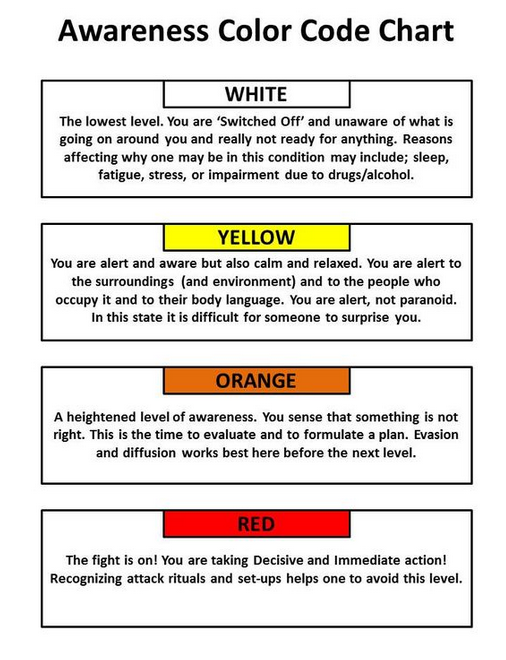
Awareness... Awareness... Awareness...
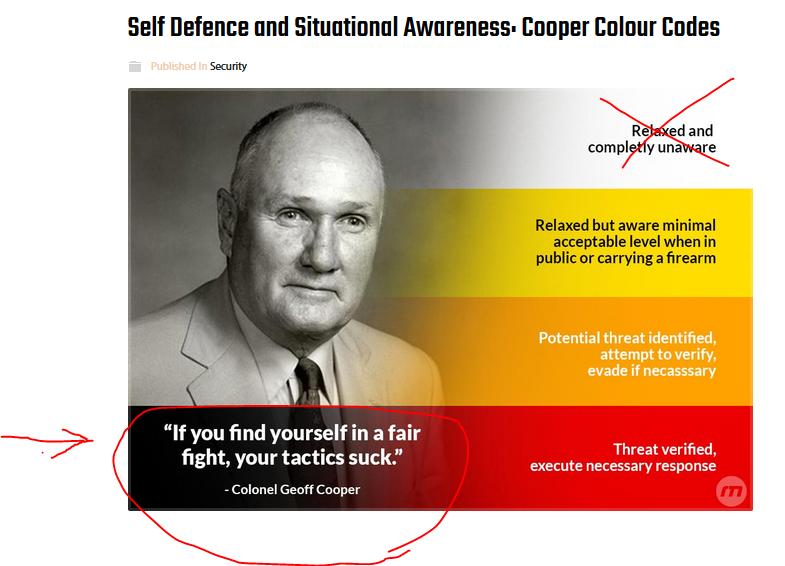
raymancini.com.au
The Four States as explained by Colonel Jeff Cooper
Colonel Jeff Cooper, a famous firearms instructor and writer, discussed four levels of situational awareness.
Called “Cooper Colour Codes,” people go from one, mental state to the next-highest one, as the situation
demands it.
By recognising these conditions, and knowing what each of them mean, you can better assess your overall,
situational awareness abilities. This knowledge can help you stay at a higher level, giving you more time to
react to potentially bad situations. Note that not all of the troublesome situations involve other people. There
are times when being alert to your surroundings can prevent serious accidents. For example, if you’re
conscientious while working in the kitchen, you can avoid potential dangers involving kitchen knives, fires,
and other hazards.
The four levels are:
Condition White This is the lowest level—the one at which you’re the most vulnerable. In white, you’re
playing with your cell phone, listening to music, or digging through your purse. People in condition white
aren’t paying attention even when they’re in motion; they might bump into other people or run into stationary
objects like closed doors.
Condition Yellow This is a generally aware, default state that you can maintain with some practice. In
yellow, you’re more aware of your surroundings; you notice potential dangers like pedestrians in the
crosswalk as you approach the intersection. You’re also aware of people around you while you’re on foot.
However, there’s no specific reason to be on the lookout. This is merely a “casual but observant” state that
helps you quickly recognise potential problems.
This awareness isn’t only for avoiding trouble. There are good situations that condition yellow can make
even better. For example, you might recognise someone you know, but can’t quite place in your mind,
before he approaches you to say hello. This gives you a little more time to figure out how you know him/her,
helping you avoid a potentially embarrassing situation.
Condition Orange This is a response to something specific—whether it’s good or bad. If you’re craving an
ice-cream treat and hear familiar music playing up the street, you pay more attention; you’re looking for the
truck because you know it’s there and you want to reach it.
For the bad things, condition orange happens in situations like the person approaching you smiling only
with his mouth, not his eyes. His body language is telling you that something’s wrong—that he’s not
genuinely happy. This person is the focal point of your attention, so you’re in condition orange.
In this condition, you’re thinking things through: figuring out how you’ll respond as the situation changes.
This is where you decide things like, “If he lunges for my bag, I’m going to drop it and run,” or, “If he comes
this way, I’m turning around and walking back into the store.”
Condition Red This is you preparing for that action—the stranger going for your bag, for example. You
made the plan in condition orange and, in red, are ready to execute it if needed.
This doesn’t mean, necessarily, that you will have to resort to defensive action or violence. A plan like, “If he
heads my direction, I’m going to go right back into the store and call the police,” can work very well in some situations.
In most cases, conditions yellow and orange can help you avoid having to reach condition red. The point is
to avoid problems and, if that isn’t possible, give yourself as much thinking or reaction time as possible.
Now that you’re familiar with the different levels, you can practice situational awareness whether you’re at
home, work, or out in public. When you arrive someplace, make note of emergency exits; knowing where
they are could save your life in a bad situation.
You should also mentally note peoples’ genders, approximate heights and weights, and clothes. Not only
are you being more conscientious, you’re also absorbing bits of information that can help you describe the
offender to the police if a crime takes place.
Train hard and stay safe.
================
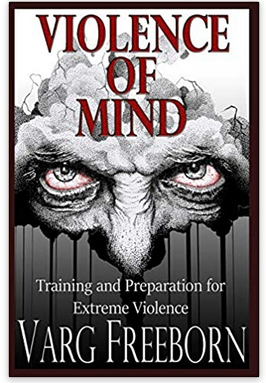
I highly recommend this book which covers criminal mindset and how to become more sophisticated
in your level of preparedness and awareness, how to read behavioral cues of criminal intent, how to avoid
situations where you are most vulnerable etc.
It takes the "old school" basics as defined by Col. Jeff Cooper and modernizes them for the 2022 World
we now live in...
The average person would be shocked by the mindset and value system of hardcore modern criminals,
especially those that have done hard prison time... putting the average law-abiding citizen at a huge
psychological and emotional disadvantage when it comes time to recognize, or confront a street, or
prison-hardened criminal.
This book will help level the playing field.
"Violence of Mind"
- by Varg Freeborn
amazon.com
SOTB |



