Class 1 Nickel and Technologies (NICO-Cse) Identifies new Sulphide Nickel targets in the La Mott Ultramafic Complex, Quebec Canada
July 14, '22 - NR
Class 1 Nickel and Technologies, is pleased to announce positive initial results and recommendations stemming from the 32.85 line-km ground TDEM survey that has been completed over the Somanike Nickel Sulphide Project (the “Project” or “Property”) in La Motte, Quebec.
The company is pleased to announce that 10 new EM anomalies have been successfully identified including a grouping in the vicinity of the historical Marbridge Mine.
The Somanike Nickel Project is located 25 km north of the town of Malartic and is comprised of 172 contiguous mining claims with a combined area of 45.3km. The Somanike Project includes the famous Marbridge Nickel Mine and its associated deposits which were partially mined by Falconbridge Nickel, delivering 702,366 tons grading 2.28% Ni and 0.1% Cu over a five-year period ending in 1968 (see attached Figures 1-3).
President Mr. David Fitch commented, “The presence of these new EM anomalies in the vicinity of the Marbridge Mine is both exciting and significant for the Company and further supports the various expert opinions that have unanimously concluded that Marbridge could extend deeper and along strike. Furthermore, anomalies detected elsewhere in association with ultramafic rocks, bodes well for exploration success.”
Exploration Manager P. Geo Mr. Alex Beloborodov observed, “The new geophysical signatures along with a now-advanced geological database will assist our team in building a targeted diamond drill program. Our aim is to explore these signatures for new nickel-rich sulphide bodies and to investigate the potential continuity and extension of the known mineralized horizons in the vicinity of the historical Marbridge Nickel Mine.”
Figure 1: Somanike Project Location Map is available at globenewswire.com
Figure 2: TDEM anomalies on first derivative magnetic map is available at globenewswire.com
Figure 3: EM anomalies conductivity base map is available at globenewswire.com
The four Marbridge Nickel Mine deposits are equally spaced (300-350 meters apart) over a one-kilometre strike length within a northwest trending ultramafic body interpreted to represent komatiitic flows. The nickel-sulphide mineralization exhibits relatively strong plunge continuity. The deposits plunge either east or southeast and are steep except for the #1 Mine which has a shallow easterly plunge. The ore mined previously was sourced largely from Mine 1 and was milled at the Canadian Malartic located 25 kilometres to the south of the project. Ore mined had an estimated average recovery of 88% producing a concentrate grade reported at 11.9% Ni (source: Falconbridge Limited reports and public domain). The concentrate was shipped to Falconbridge’s Sudbury smelter. The deposits are ultramafic-associated, sub-cropping, plunging “shoots” of high-grade nickel sulphides. These are conductive and comprised of disseminated and massive sulphides with a small surface expression and relatively good continuity down plunge.
Modelling by the Company shows the main lenses are open at depth and has also confirmed the existence of a largely unexplored footwall horizon that correlates well the Marbridge EM-6 trend.
Consulting geophysics group TMC Geophysics reported that the new EM anomalies identified included within the confines of 3 main E/W to ESE/WNW oriented conductive horizons or anomalous trends. The most prospective conductive horizons s being the Marbridge and Ataman trends for which relative interest is already confirmed from past exploration works and drilling.
TMC Geophysics have advised the company to infill the original grid with STDEM reconnaissance profiles at 100 m apart. This would represent a major add-on for the survey data analysis, as one can already observe its relevance by the examination of the historical airborne EM data. Planned drill holes will be surveyed with down-hole geophysical systems. These surveys have proved successful in identifying off-hole mineralization in major nickel camps throughout the world. Downhole EM systems have very likely not been used in the Marbridge area.
The Company’s technical team are now reviewing the results with a view to planning a consequential drilling program.
Qualified Person
All the technical information in this news release has been reviewed and approved by Alexandr Beloborodov, P.Geo., geological consultant to the Company, who is a Qualified Person under the definitions established by National Instrument 43-101.
For more information, please contact:
David Fitch, President
T: +61 400.631.608
E: dfitch@class1nickel.com
About Class 1 Nickel and Technologies Limited:
Class 1 Nickel and Technologies Limited (CSE: NICO) is a Mineral Resource Company focused on the development of its 100% owned Alexo-Dundonald Project, a portfolio of Kambalda-Type komatiite-hosted magmatic nickel-copper-cobalt sulphide Mineral Resources located near Timmins, Ontario, as well as exploring the Somanike komatiite hosted nickel copper project in Quebec, which includes the well-known Marbridge Nickel Mine.
For additional information please visit our new website at www.class1nickel.com
Neither the Canadian Securities Exchange nor its regulation services provider has reviewed or accepted responsibility for the adequacy or accuracy of this press release.
 
Figure 1
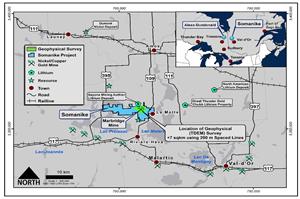
Somanike Project Location Map
Figure 2
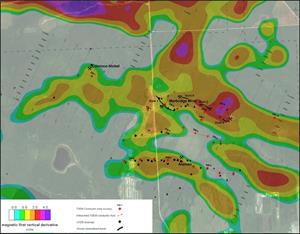
TDEM anomalies on first derivative magnetic map
Figure 3
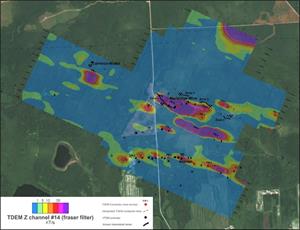
EM anomalies conductivity base map |



