In the meantime, as Team Ukraine is helping other Teams to acquire more gold at cheaper pricing, Team China seems to be negating whatever Team USA is trying to do w/r to its solar industry employment by raising price of the solar poly silicon blocks, enhancing the Shanghai port shutdown, to make doubly sure no Xinjiang products are able to get to anywhere in the world unless wherever really and truly and sincerely want such, in line w/ what Team USA wants by Xinjiang sanctions
I know I know, I know a very confusing situation whenever I see one. Nordstream I for Russian gas and China Xinjiang polysilicon factories all undergoing incidents and maintenance work. Am sure a coincidence, akin to sudden discovery of issues with imported Canada food, Australian wine, and Lithuanian everything.
Team China supplies 80+% of global solar gear, including polysilicon wafers. Xinjiang based plants accounts for 45% of the 80+%.
Team Biden removed tariffs on China solar gear to save American jobs, but Team Blinken sanctioned Xinjiang products. China simply doing what Blinken wants, namely no China products.
Let’s see if any other Team(s) are daring enough to invest in polysilicon plants knowing full well that the pricing can and shall be dialed down once Shanghai port fully opens. Yeah, it is as if Shanghai is the only port China has.
I feel bad for Team Germany. No gas, and no solar, but as a part of Nato, a two front sanctions war, all by coincidences.
The Russia-Russia-Russia rouble-into-rubble war turned into an carbon energy war, and the China-China-China semiconductor war turning, coincidentally, into a solar energy war.
Four producers of the ultra-conductive material in Xinjiang have halted output due to incidents or maintenance work
bloomberg.com
Solar Silicon Cost Rises for Eighth Week in Blow to Clean Energy
Polysilicon prices are at the highest level since 2011, threatening to slow solar panel installations
July 20, 2022, 2:49 PM GMT+8
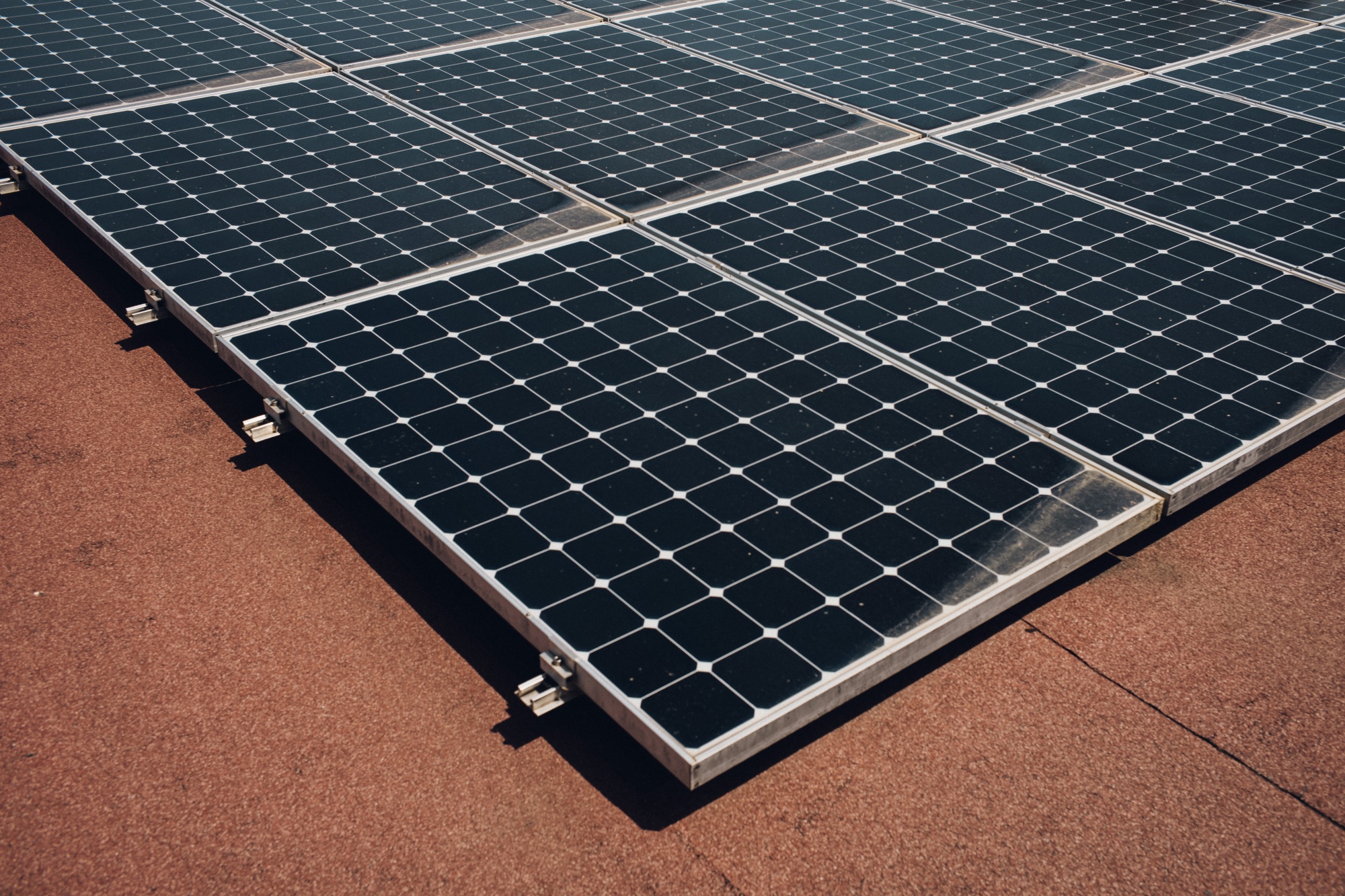
Photographer: Theo Giacometti/BloombergPolysilicon prices extended gains into an eighth week because of factory outages, threatening to slow the pace of solar panel installations just as governments around the world boost clean energy targets.
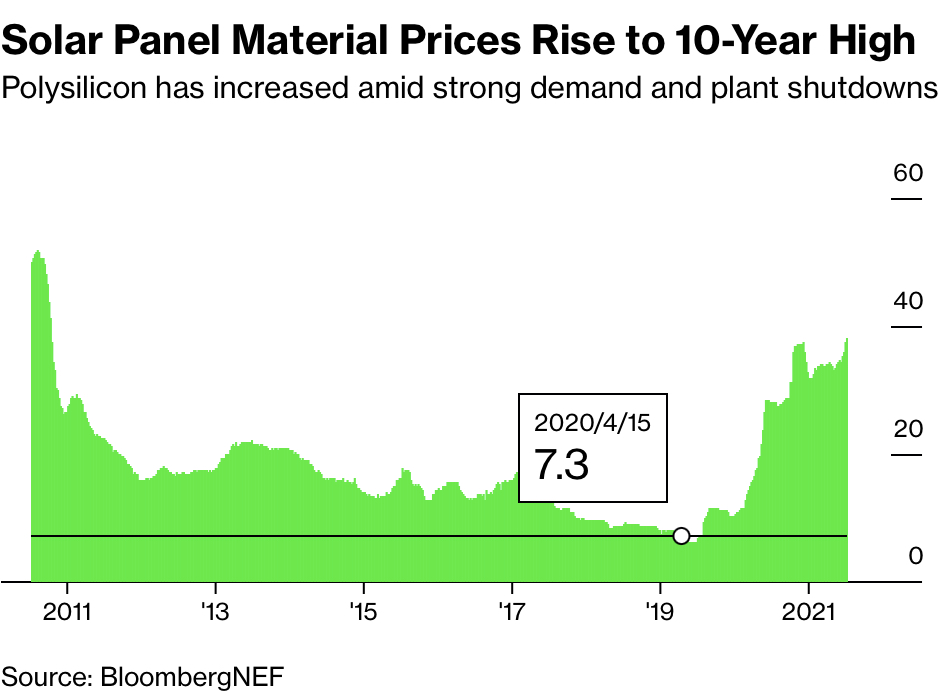
The average cost of the most expensive grade of polysilicon rose 0.9% to 297.6 yuan ($44.08) per kilogram on Wednesday, according to the China Silicon Industry Association. A separate index compiled by BloombergNEFshows prices are at the highest level since 2011.
Solar Panel Material Prices Rise to 10-Year HighPolysilicon has increased amid strong demand and plant shutdowns
Source: BloombergNEF
Four producers of the ultra-conductive material in Xinjiang have halted output due to incidents or maintenance work, and imports from outside China have fallen due to shipping disruptions caused by overseas port strikes, the silicon association said in a statement.
Polysilicon prices could stay at high levels until early 2023, Yishu Yan, an analyst at UBS Investment Research, said on a conference call Tuesday. High prices could hurt demand for solar panels, especially for large utility-scale solar projects that are the most cost-sensitive, she said.
Still, installations in China could pick up speed again as soon as September and October, Yan said, as state-owned power companies face political pressure to meet year-end renewable targets.
“If they don’t have the reported projects connected to the grid, they could face the possibility that the government won’t approve new projects for them next year,” Yan said.
--Luz Ding contributed to this report
Sent from my iPad |



