"He wants to give up the good for the 'perfect'",
I've been thinking about that the last few days, and I thinks it more like he's letting The Myth (FDR) be the enemy of the good.
Thing of it is, FDR had a lot to work with. For starters, we had been in the Depression for almost 3 1/2 years by the time he took office in March, and unemployment was like 25%. There was no safety net, so people were ready for something radical. When Biden took office, the covid downturn was only about 9 months old, we had SS, unemployment insurance, medicare/medicaid, food stamps, a network of food banks, plus a covid relief check and an eviction moratorium, so people were more about changing leaders than changing the system.
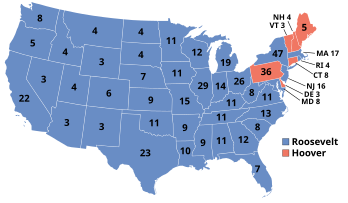
FDR had a real mandate. He won a landslide landslide, not a Trump landslide. His margin of victory in the popular vote was about the same as Biden's; even tho only 1/4 as many people voted; 22,821,277 to 15,761,254.
|
en.wikipedia.org
What did Biden start with? A 7 or 8 vote majority in the House, and a tie in the Senate?
On November 8, 1932, Franklin Roosevelt became the first Democrat in 80 years to win the presidency by a majority vote, rather than a plurality. On Capitol Hill, House Democrats gained 97 seats for a nearly three-to-one margin over the Republicans. In the Senate, Democrats picked up 12 seats, making it the party’s largest two-year gain to that time. (In 1958, Senate Democrats set a new record by adding 15 members.) The Senate’s new 59-vote Democratic majority in 1933 (edit...there were only 96 senators back then) was predominately liberal in political orientation, but it included three conservatives who ended up serving longer than any of their more progressive classmates. They were Nevada’s Patrick McCarran, Virginia’s Harry Byrd, Sr., and Georgia’s Richard Russell.
The results of 1932 echoed through the next two Senate election cycles. In 1934, when the Republican senators who were swept into office with the 1928 election of President Hoover stood for reelection, Democrats picked up 10 more seats for a total of 69. In 1936 that number rose to 76, causing the remaining 16 Republicans to sit quietly as the Democrats’ increasingly polarized factions proved that there can be a majority that is too large.
senate.gov |



