As of 2021, the average battery-powered EV could travel 217 miles (349 km) on a single charge.
Weather: At temperatures below 20? (-6.7?), EVs can lose around 12% of their range, rising to 41% if heating is turned on inside the vehicle.
Towing: Forget about it!!!
Visualizing the Range of Electric Cars vs. Gas-Powered Cars
September 25, 2022
By
Govind Bhutada
Graphics/Design: Clayton Wadsworth Athul Alexander
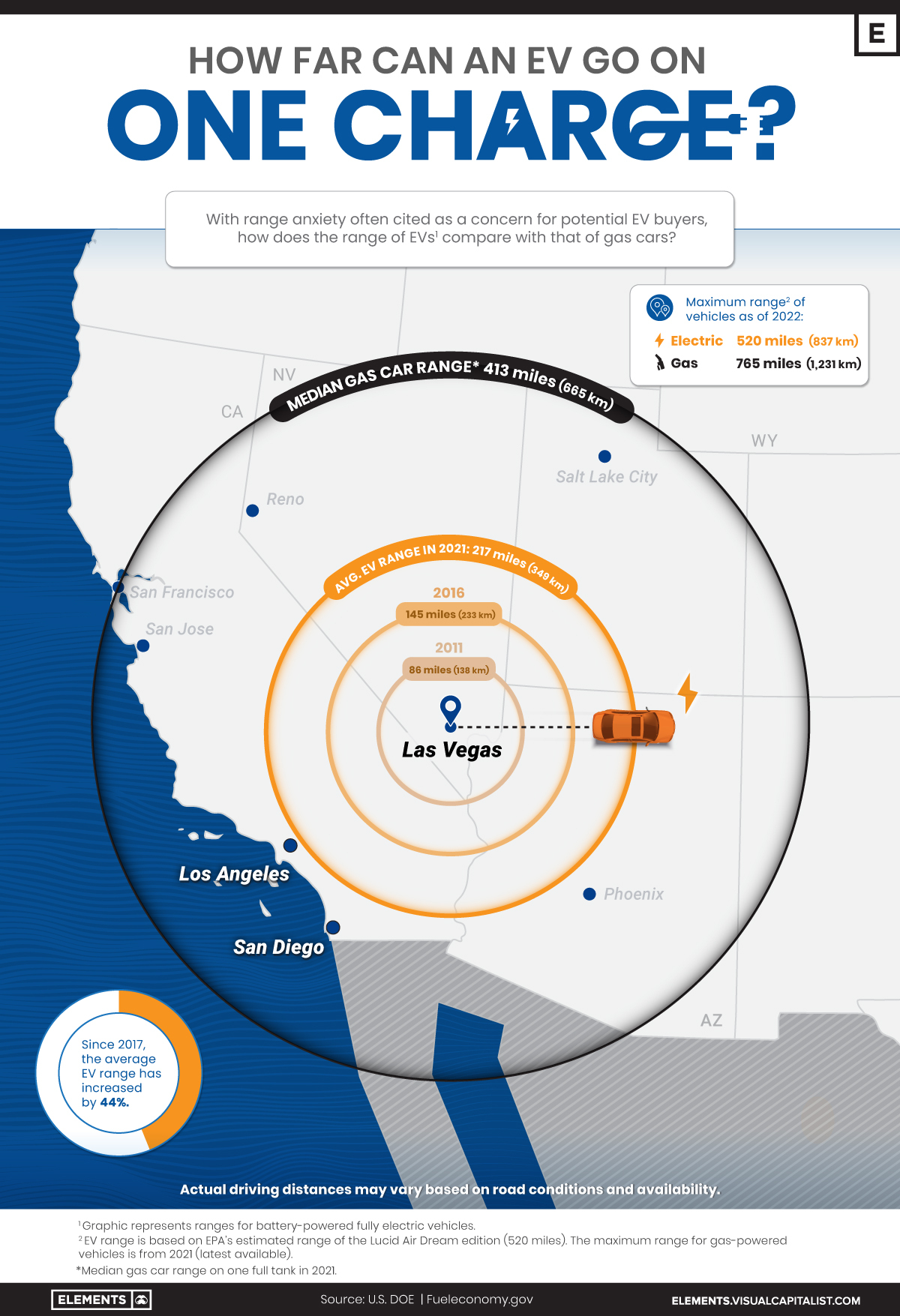
The Range of Electric Cars vs. Gas-Powered CarsEV adoption has grown rapidly in recent years, but many prospective buyers still have doubts about electric car ranges.
In fact, 33% of new car buyers chose range anxiety—the concern about how far an EV can drive on a full charge—as their top inhibitor to purchasing electric cars in a survey conducted by EY.
So, how far can the average electric car go on one charge, and how does that compare with the typical range of gas-powered cars?
The Rise in EV RangesThanks to improvements in battery technology, the average range of electric cars has more than doubled over the last decade, according to data from the International Energy Agency ( IEA).
YearAvg. EV RangeMaximum EV Range
*Max range for EVs offered in the United States.
Source: IEA, U.S. DOE
As of 2021, the average battery-powered EV could travel 217 miles (349 km) on a single charge. It represents a 44% increase from 151 miles (243 km) in 2017 and a 152% increase relative to a decade ago.
Despite the steady growth, EVs still fall short when compared to gas-powered cars. For example, in 2021, the median gas car range (on one full tank) in the U.S. was around 413 miles (664 km)—nearly double what the average EV would cover.
As automakers roll out new models, electric car ranges are likely to continue increasing and could soon match those of their gas-powered counterparts. It’s important to note that EV ranges can change depending on external conditions.
What Affects EV Ranges?In theory, EV ranges depend on battery capacity and motor efficiency, but real-world results can vary based on several factors:
Weather: At temperatures below 20? (-6.7?), EVs can lose around 12% of their range, rising to 41% if heating is turned on inside the vehicle.
Operating Conditions: Thanks to regenerative braking, EVs may extend their maximum range during city driving.
Speed: When driving at high speeds, EV motors spin faster at a less efficient rate. This may result in range loss. On the contrary, when driven at optimal temperatures of about 70? (21.5?), EVs can exceed their rated range, according to an analysis by Geotab.
The 10 Longest-Range Electric Cars in AmericaHere are the 10 longest-range electric cars available in the U.S. as of 2022, based on Environmental Protection Agency (EPA) range estimates:
CarRange On One Full ChargeEstimated Base Price
Source: Car and Driver
The top-spec Lucid Air offers the highest range of any EV with a price tag of $170,500, followed by the Tesla Model S. But the Tesla Model 3 offers the most bang for your buck if range and price are the only two factors in consideration. |



