SI
SI
discoversearch

We've detected that you're using an ad content blocking browser plug-in or feature. Ads provide a critical source of revenue to the continued operation of Silicon Investor.  We ask that you disable ad blocking while on Silicon Investor in the best interests of our community.  If you are not using an ad blocker but are still receiving this message, make sure your browser's tracking protection is set to the 'standard' level.
Strategies & Market Trends : SPY & QQQ intraday chart observations by rimshot

 Public ReplyPrvt ReplyMark as Last ReadFilePrevious 10Next 10PreviousNext  
To: rimshot who wrote (1012)11/21/2022 7:03:32 AM
From: rimshot3 Recommendations

Recommended By
ajtj99
catou1
skier31

  Read Replies (1) of 1309
 
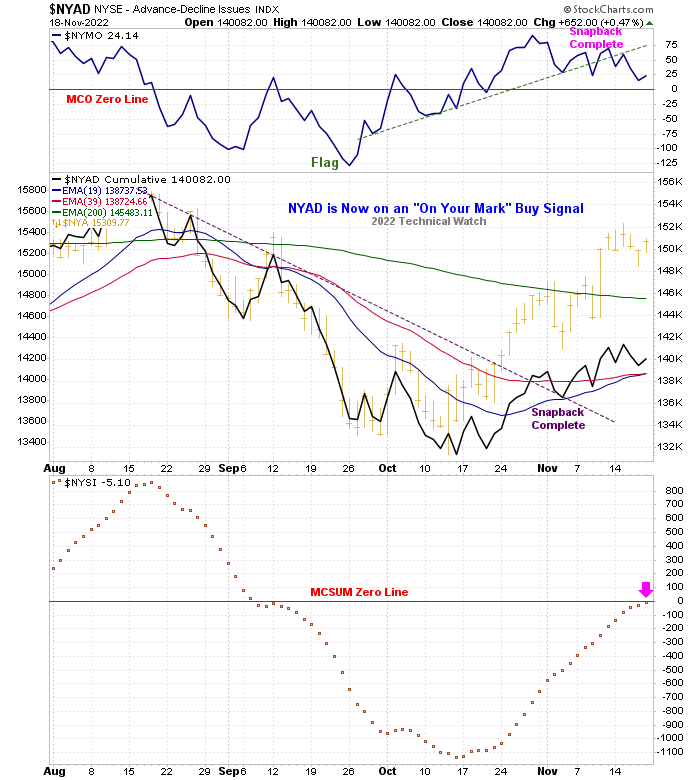
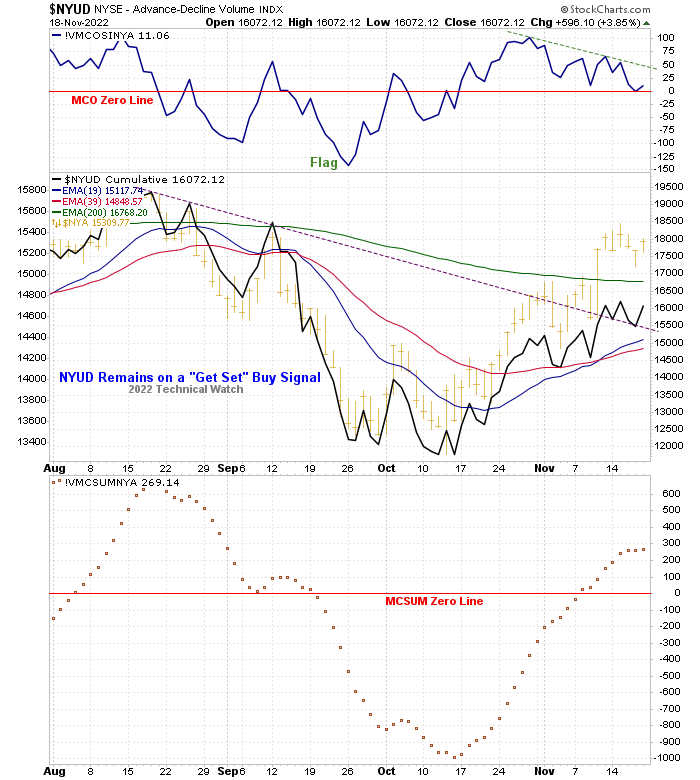
Friday November 18, 2022 chart snapshots showing the technical
context for the current event in which $NYSI approaches its zero line
from below ( author is Dave Breslaw, technicalwatch.com ) -


PermaLink below shows the Friday November 18th closing update for the
selected six major US indices' daily cumulative Advance-Decline
line issues breadth in Histogram format -

* notice the chart location relative to the A-D lines' 200-day EMA
by what Mr. and Mrs. Sherman McClellan determined are
the 5% and 10% trend moving averages for each A-D line

stockcharts.com

here is a repeat of my Friday morning comment about one
of what I consider to be an important technical consideration
for evaluating the actual measure of risk vs. reward #'s
related to the reliability of now predicting the probable Staying Power
for the current rally off the October 12/13, 2022 intraday price lows

* which displayed at their daily closes a set of positive divergences
using the variety of McClellan tools such as the delta between the
5% and 10% trend moving averages which the
McClellan Oscillator measures and further reflected by the accumulation
of this very same daily delta amount which the McClellan Summation Index displays:

* Important big picture technical context FYI -

the confirmation of the possible bull scenario on a lasting basis
for all US indices requires the 5% and 10% trend moving averages
of the cumulative A-D lines to surpass and actually hold above
the A-D lines' 200-day EMA


( see the historic work of Mr. and Mrs. Sherman McClellan ....
I believe many professional advisors do not choose to fully understand
the actual math concepts underlying the accurate & reliable interpretation
of the A-D lines' numerous directional cycles,

and

a large percentage of the McClellans' body of work is devoted to manipulating
the raw daily A-D data to calculate the McClellan Oscillator and
the McCellan Summation Index.

John Bollinger has told me he prefers to avoid applying oscillators to most raw data,
so I have that challenge to my actual use of historic underlying math
developed by the now deceased Gods of technicians )

** see below my summary explanation which I have repeated
for more than 15 years at several free public forums for technicians
who are in their very early development as well as seasoned folks -
=======================================================
my custom charts display cumulative Advance-Decline breadth lines
which are the cumulative total of daily net Advance-Decline values
Common Stock Only indicators for the NYSE are calculated using only the # of stocks
for operating companies within the NYSE Composite Index
(funds & select other symbols are excluded)
CSO indicators often present a more accurate internal picture for the
NYSE Composite Index
The NYSE All Issues indicators are calculated using all issues
traded in the NYSE Composite Index

The McClellan Oscillator is the difference between the 19-EMA & 39-EMA
of daily advances minus declines.
It reflects the short-term strength and direction of market liquidity.
A longer-term view is provided by the McClellan Summation Index,
which is the cumulative total of the daily McClellan Oscillator values.
These indicators move within a trading range and often identify
the overbought/oversold condition of the market

( McSum = McClellan Summation Index )

the dominant rule is: price will eventually follow the direction
of the McSum, except for brief periods of price divergence

The McSum is neutral at the zero line,
bullish while above,
and confirmed bearish while below zero

* the distance down to the McSum zero line currently represents
one objective measure of the minimum downside risk

Confirmed sell signals are a lasting decline below the McSum zero line,
though price action has usually declined by a large amount by the time
zero is reached from the McSum peak above.

Large distances between the McSum daily chart values
represent acceleration events in the A-D breadth decline or advance,
and the follow-on price impact has a high correlation with the
McSum's direction, and usually has at least several days of directional staying power
Report TOU ViolationShare This Post
 Public ReplyPrvt ReplyMark as Last ReadFilePrevious 10Next 10PreviousNext