Re <<BYD Orders $689 Million of Auto Transport Ships>>
... arguably CPC China China China can but does not make as many 3xBus-Sized balloons as does EV cars, but am not sure, even as am certain that the balloon export program does not require expensive transport ships, albeit does compel others to expend air-to-air missiles at $439K a pop Message 34190938
am pondering the mathematical truth, that the DNC USA CPC PRC de facto alliance is actually quite effective, and much has to do with the mathematical truth of the setup, and as such, the natural point of destination of the Globalisation 2.0 can work out even better than 1.0
I do wonder whether wandering EV cars, essentially a 5G handphone on wheels, is better than wondering balloons for certain purposes but assuredly provide more utility to all
(1) China bought lithium Message 33912027 and cobalt Message 32301500 and and and resources for and on behalf of the USA, using USA dollars
(1-i) PRC export cars Message 34167971 firstly to Germany / EU, and non-USA, to help carving out and creating a market for the alliance
(1-ii) Working diligently to keep Germany and Japan on their toes in alignment with the USA Message 34155312
(1-iii) Creating the conditions biased against manufacturing in Germany, Japan, and everywhere requiring cheap energy for manufacturing acts and move such acts from homeland domains to China with plentiful fuel from Russia Russia Russia Message 34040988
(1-iv) USA sending one fellow to teach PRC how to do it right in the form of Elon Message 33144116
(2) Now creating the conditions to open the USA market to alliance input for win-win outcome
(2-i) inviting in PRC battery maker big time nytimes.com
Ford Will Build a U.S. Battery Factory With Technology From ChinaFord’s $3.5 billion plant in Michigan will draw on technology from CATL, a Chinese company that is the world’s No. 1 maker of electric-car batteries.
(2-ii) enforcing a monetary regime that makes inexpensive cars an imperative for the electorates
bloomberg.com
New Cars Are Only for the Rich Now as Automakers Rake In Profits
With pandemic-era chip shortages fading, manufacturers are keeping inventories low — and prices high. The shift to EVs will make things worse.
David Welch
14 February 2023 at 08:00 GMT+8
Illustrator: Emma Roulette
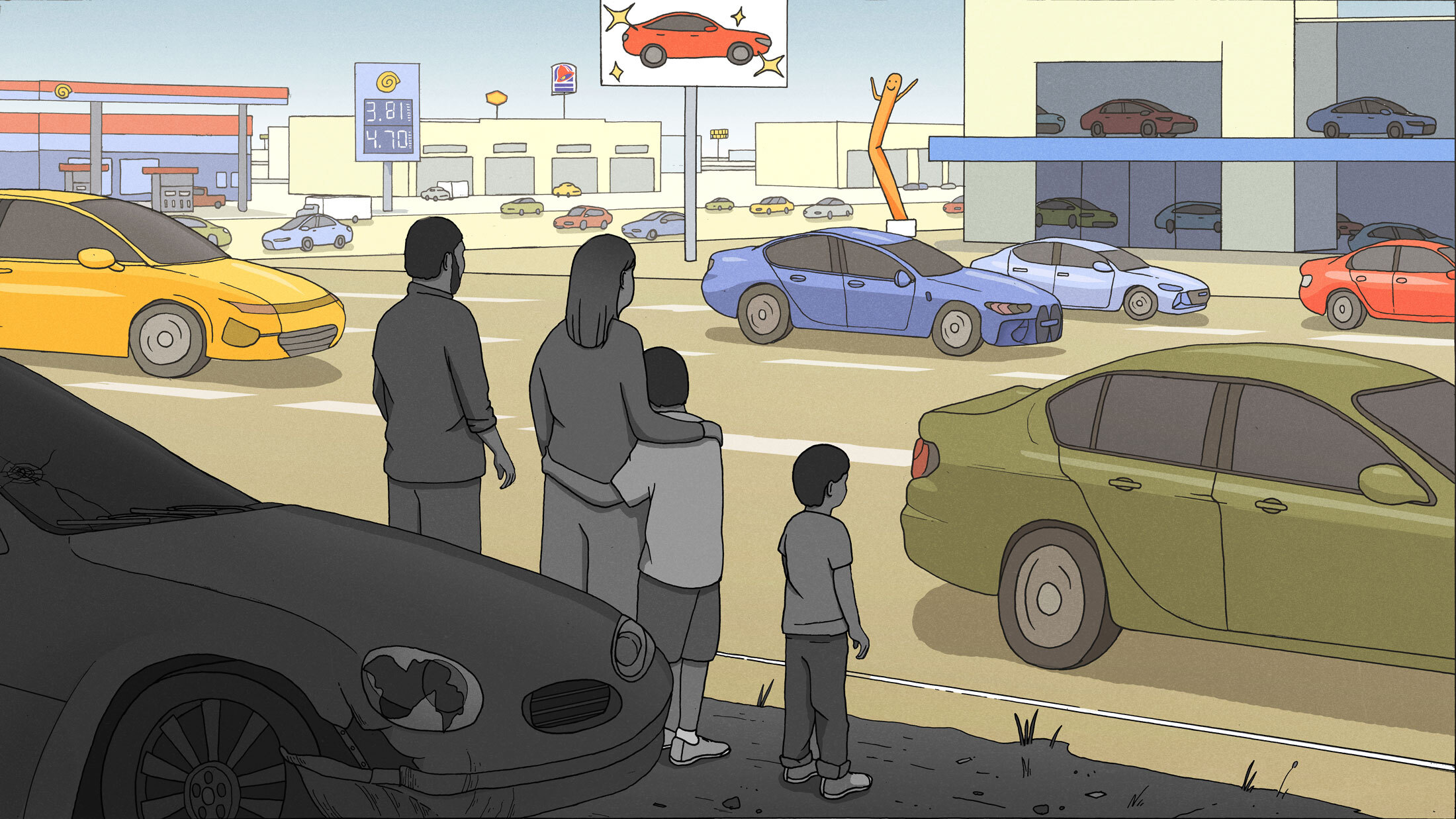
A shiny new car in the driveway has been an emblem of middle-class prosperity for generations. But for the typical American family, it’s now a distant dream.
The average monthly payment for a new car has soared to a record $777, nearly doubling from late 2019, according to Kelley Blue Book owner Cox Automotive. That’s almost a sixth of the median after-tax income for US households. Even used models have climbed to $544 a month on average.
The sticker shock extends well beyond the US, where inflation is a thorny political issue for President Joe Biden as the 2024 election looms. In Europe, prices are flirting with records. Used-car prices soared in Japan last year, and in China, a rapid push to electric vehicles means consumers will have to pay more in some cities.
At the root of the problem is automakers’ new mantra: Keep inventory lean and price tags fat. Three years after the pandemic triggered a global shortage of semiconductor chips and crippled car manufacturing, Ford Motor Co., General Motors Co. and their overseas rivals are notching big profits. Even as the chip crunch shows signs of easing, they’re pledging to keep production in check.
And because electric vehicles cost about 25% more than the average car, the shift to plug-ins is about to make the affordability crisis even worse. Add soaring interest rates to the mix, and new cars — like home ownership and a college education — are fast becoming the domain of the rich.
• Read more: Can You Tell a Car From an SUV? Take Our Quiz
“The idea of a new car in every American’s driveway is not the world we live in,” said Charlie Chesbrough, a senior economist at Cox.
Sky-High Payments
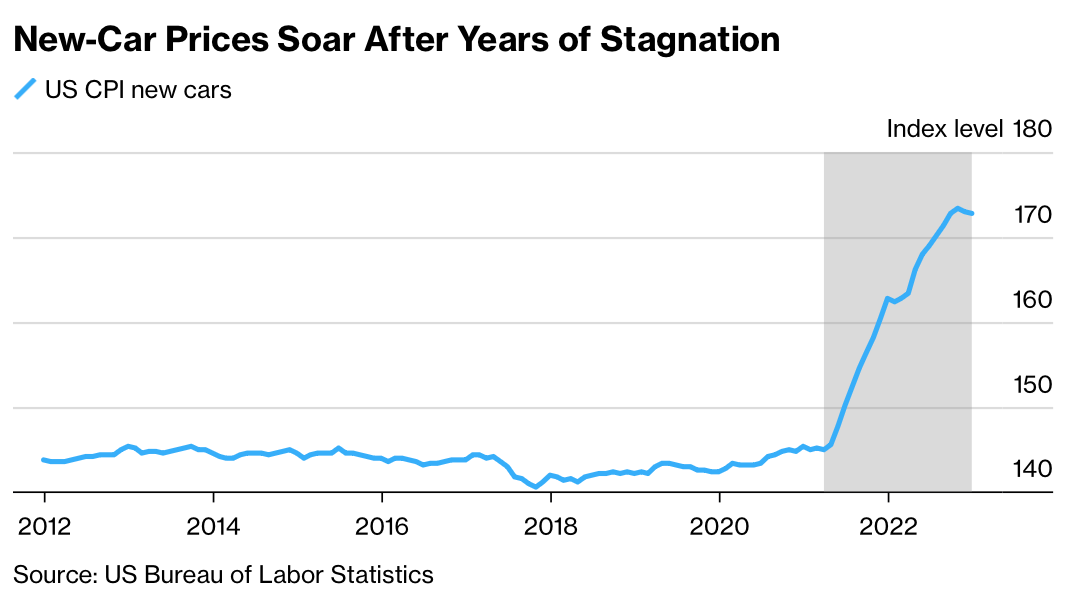
For a decade, the average new-car payment in the US bumped along at roughly $400 a month. That’s about as much as the typical American household can shell out and still meet other major expenses, said Jonathan Smoke, chief economist at Cox. But it crossed that mark in November 2019 and has been soaring ever since.
The average price for a new vehicle in the US has jumped to almost $50,000, up 30% since 2019, according to JPMorgan. Though prices have retreated somewhat in recent weeks as production recovers, the pullback isn’t enough for most consumers to comfortably buy a new car. The average price of a used car, meanwhile, now stands at about $27,000, Cox data show.
• Read more: Americans fall behind on car payments at a higher rate than 2009
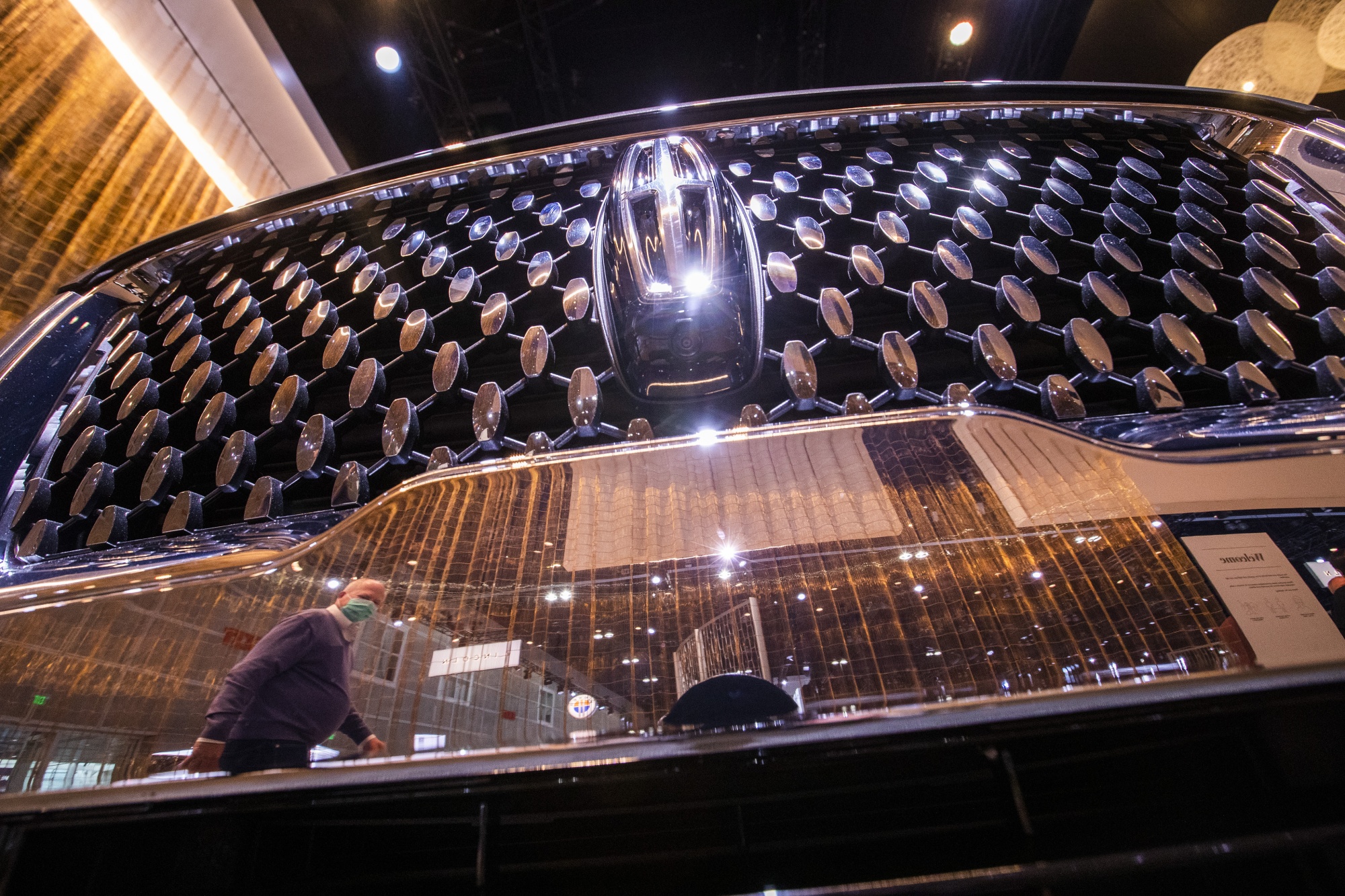
Manufacturers are reaping the benefits of selling fewer but more expensive cars. Last year, automakers sold about 13 million vehicles in the US, down 8% from 2021 and the lowest in a decade. But Ford’s gross profit rose 4.4% in 2022 from a year earlier, while GM’s adjusted earnings grew by about $200 million to reach $14.5 billion. Margins for some manufacturers are expected to narrow this year amid global economic weakness.
In Europe, meanwhile, new-car prices are at all-time highs and still climbing, according to data from ING Research. Vehicle shortages drove used-car prices up in Japan through most of last year. China’s economic slump has kept prices at bay, but major cities are making it difficult to register internal-combustion vehicles amid a push toward EVs, which tend to be more expensive.
Manufacturers are reaping the benefits of selling fewer but more expensive cars.
Photographer: Allen J. Schaben/Los Angeles Times/Getty Images
Keeping Inventories Low
It’s a sea change from the business model that defined car manufacturing for decades: Run plants at full tilt and then use deep discounts to move the metal. In the US, automakers customarily carried 60 to 100 days of inventory. These days, manufacturers are targeting about half that much to lower overheads and keep prices high.
“We’ll never go back to the inventory levels that we were at in the past,” GM Chief Executive Officer Mary Barra told investors last year.
Her rival, Ford CEO Jim Farley, has said he doesn’t want to pay for billions of dollars in inventory or offer discounts and other incentives to offload it. Toyota Motor Corp. and Nissan Motor Co. have vowed to attempt the same strategy.
“You’re not going to see most manufacturers go back to where it was three or four years ago,” Judy Wheeler, vice president of US vehicle sales for Nissan, said in an interview. “We’ll keep that supply and demand in a level state.”
There are some signs, though, that consumer pain will ease slightly as supply-chain snarls abate. Ford Chief Financial Officer John Lawler said this month that he expects new-car prices to fall 5% in 2023 as automakers dial up the discounts, while Nissan’s Wheeler predicted prices will drop toward “a more normal level.” Tesla Inc. and Ford slashed prices on electric vehicles.

Since electric vehicles cost about 35% more than their gasoline-fueled counterparts, the shift to plug-ins is about to make the affordability crisis even worse.
Photographer: Emily Elconin/Bloomberg
Short-Lived Relief
Dealers are skeptical that automakers will keep inventories in check, said Rhett Ricart, whose Columbus, Ohio-based Ricart Automotive Group is a major dealer of Ford, Nissan and Chevrolet models.
“They all talk about 30 to 45 days’ supply of cars. They won’t do it,” Ricart said in an interview. “These chips aren’t a big issue any more. Car wars is back.”
But any recovery in supply is likely to happen in fits and starts. Barra and Jack Hollis, executive vice president of sales for Toyota Motor North America, see the industry getting enough chips to sell 15 million vehicles in the US this year, which is about 12% below where sales were three years ago. Hollis said there could be more than 4 million vehicles’ worth of pent-up demand from the chip shortage, keeping prices from falling fast.
“We will have another year with a supply-constrained sales number,” Hollis said. “Prices keep rising. It’s clear that demand is still outstripping supply.”
For used cars, Cox’s Smoke sees prices falling only 4% this year, in part because automakers have not been leasing as much. That translates to fewer recent-model cars coming back to market.
Sercy Sanders has been riding the bus in Pittsburgh ever since the transmission blew on his 2006 Acura TL in early January. When the cost of repairing it was more than the car was worth, Sanders got pre-approved for a loan from his credit union and set out to find a 2016 Honda Accord for under $17,000. But he found nothing for less than $19,000 and now is looking at models that are over a decade old.
“That’s just the way it may have to be if I want to stay in my price range and not have too high a monthly car bill,” said Sanders, 48, a customer service representative and single dad of two high schoolers. “It’s very frustrating. I wanted a newer vehicle that I felt would be more reliable. With an older used car, you just never know what you’re going to get.”
And for those looking for a new car at a budget price, the options are limited. Domestic automakers stopped building compact cars in the US because they couldn’t make money on them.
The dearth of cheaper models means more new cars are being snapped up by affluent consumers. Nearly 30% of the market is from households with annual income of more than $150,000, up from 22% in 2016, said Mark Wakefield, managing director at consulting firm AlixPartners.
“You’ve seen a move to more wealthy people buying cars,” Wakefield said. “The bottom part of the market sort of fell out.” |



