also.... when i bought the 2 year bond at a discount to 100%, that does not mean that the orig owner sold at a loss. she/he made a profit. i do not know the issue price, but it was under 100%. plus the seller got his interest for the x weeks that he owned it. that covered any small +/- discount gain on sale. I had to pay $x for the note plus the interest accrued. the most recent auction was 4.625% yield with a 4.5% coupon -- so it also sold at a small discount.
Treasury bills (T-bills): T-bills have the shortest maturities at four, eight, 13, 26, and 52 weeks. T-bills are typically issued at a discount to par (or face) value, with interest as well as principal paid at maturity.
Treasury notes (T-notes): T-notes are issued in terms of two, three, five, seven, and 10 years. They pay interest semi-annually and the principal at maturity.
Treasury bonds (T-bonds): T-bonds are issued with a term of 30 years. Like T-notes, they pay interest semi-annually and principal at maturity.
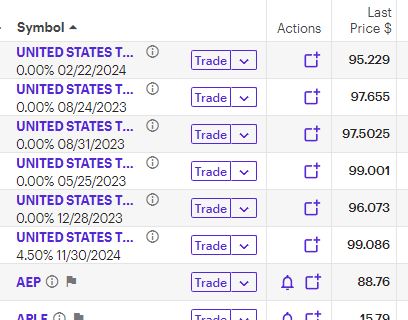
easy to buy in etrade, secondary or new auction. they show up in account just like a stock, can click to buy more or sell, but prices are not up to date like stocks. must get fresh bid/ask quote when trading. i plan on holding to maturity. This is true for buying on secondary after issue date -- I had to pay 3 months interest to the seller but i get the full 6 month coupon in 3 months.
For a Note, Bond, TIPS, or FRN, several days may pass between the auction date and the issue date. The security earns interest during those days. That "accrued interest" becomes part of the purchase price of the security. You get the accrued interest back with the first regular interest payment for the security.
xxxx click xxxx

|



