We've detected that you're using an ad content blocking browser plug-in or feature. Ads provide a critical source of revenue to the continued operation of Silicon Investor. We ask that you disable ad blocking while on Silicon
Investor in the best interests of our community. If you are not using an ad blocker but are still receiving this message, make sure your browser's tracking protection is set to the 'standard' level.
Chinese scientists say new stealth tech for submarines can ‘cancel out’ US Navy sonar
- Sound-emitting tile made of costly rare earth elements can turn powerful US sonar tech against itself, Beijing researchers say
- Low-frequency, high-decibel sound produced can cause enemy sonar operator to mistake the submarine for water, team says in paper
Stephen Chen in Beijing Published: 9:00pm, 24 Mar, 2023
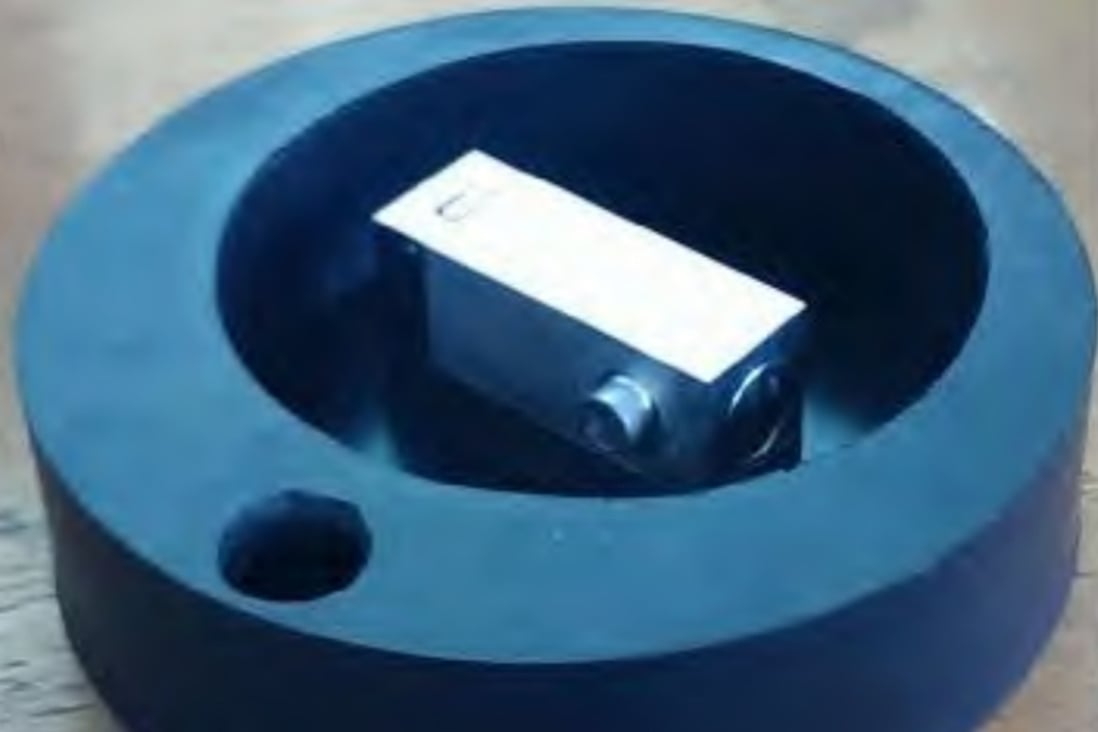
The lightweight, ‘active’ device developed by the Chinese team is based on giant magnetostrictive material technology. Credit: Beijing Institute of Technology
A research team in China says it has created a new coating device that could help submarines evade advanced enemy sonar by mimicking water.
The tile-like device can analyse enemy sonar frequency, and generate opposing sound waves to cause the sonar operator to mistake the submarine for water, the researchers said.
Low-frequency sounds produced by the tiles can reach an intensity of up to 147 decibels, which is louder than a rock concert and sufficient to “cancel out” some of the most powerful active sonars used by the US military or its allies, according to the team from the Beijing Institute of Technology.
A complete unit of the device is less than half the size and thickness of a brick, allowing engineers to stick them all over the hull of a submarine to tackle sonar beams from different directions.
“The submarine surface coating widely used by the world’s naval powers is the anechoic tile,” the researchers said in their paper published in Chinese-language peer-reviewed journal Acta Armamentarii last month.
These “passive” sound-absorbing tiles, made of rubber or synthetic polymer, are usually less than 7 centimetres (2.8 inches) thick, and work best against sonar signals in a higher frequency range with wavelengths shorter than their thickness.
But they may not be as effective against longer wavelengths, and therefore lower frequencies, as the two are inversely proportional.
“The frequency of modern active sonars is getting lower and lower, with wavelengths exceeding one metre,” lead researcher Wang Wenjie and his colleagues said in their paper.
“The passive coating can no longer meet the combat requirements of a quiet submarine, no matter how you change the material composition and structure of the tiles.”
The “active” tile developed by the Beijing Institute team is based on giant magnetostrictive material (GMM) technology, named after a phenomenon discovered by 19th century British physicist James Joule.
In 1842, Joule was the first to observe that some materials expand or shrink when placed near a magnet, in an effect known as “magnetostriction”.
For more than a century, the discovery was viewed as interesting but useless, because the magnet-induced changes were too small for any serious applications.
In the 1970s, scientists with the US Navy invented the alloy Terfenol-D, the first GMM that could convert magnetic force into mechanical energy – leading to visible changes in shape.
Due to its high power output and efficiency, Terfenol-D is used in key driving components for active sonars on many US warships, according to Wang’s team.
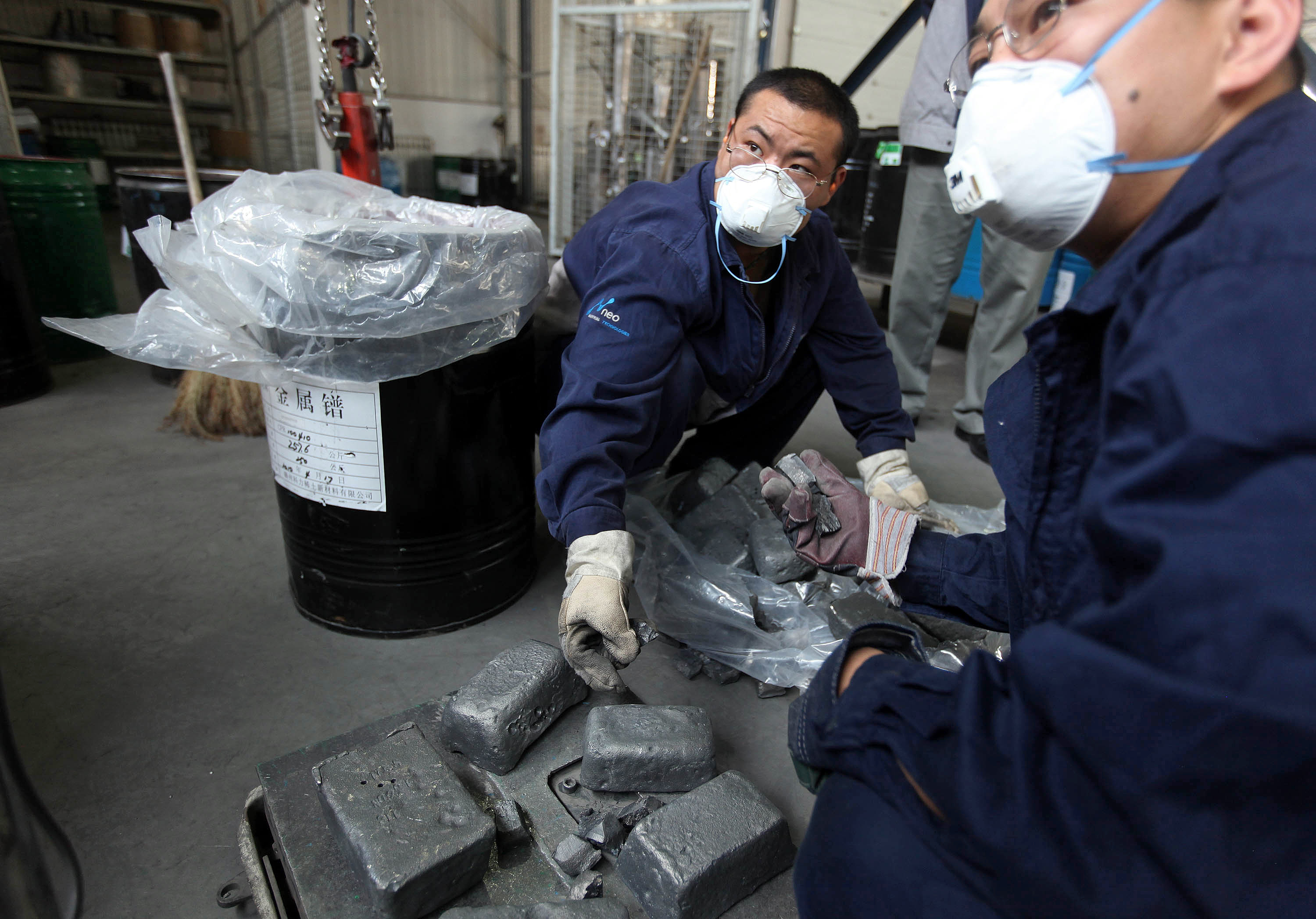
But the application of the technology remains limited, because manufacturing GMM requires a large amount of expensive and heavy rare earth elements – such as terbium and dysprosium – whose reserves are mostly concentrated in China.
Wang’s and his colleagues said their device could turn the US active sonar technology against itself.
The challenge was to pack all the components into a small format while maintaining high power output. Active acoustic stealth prototypes that came before were “tens of times bigger than ours,” the team said.
The researchers also spent a lot of time improving the device’s engineering design to make it suitable for quick installation, long-term operation and maintenance on submarines in deep oceans.
“The emission unit is lightweight, operable in a wide range of frequencies with high efficiency, and resistant to pressure,” the paper said.
While the team did not disclose the cost and rare earth composition of the giant magnetostrictive components of the device, it said the technology would “find broad application in cladding of active acoustic arrays on large-scale submarines”.
Some critical rare earth elements, including dysprosium, are in short supply due to the rapid growth of electric car production in China, according to recent Chinese media reports.
“The Middle East has oil. China has rare earth metals.” So said Deng Xiaoping, the architect of China’s post-Maoist opening and rise, in the 1980s, with remarkable foresight and precision. The rest of the world is only now grasping the implications of his insight for geopolitics in the 21st century.
The natural resource that shaped world politics in the long 20th century — which, for these purposes, started in the late 19th and hasn’t quite ended yet — has been oil. When the Japanese attacked Pearl Harbor, they were — at least as they saw it — reacting to a Western oil embargo on them. When Adolf Hitler sent the Wehrmacht to Stalingrad, he was eyeing the black gold of the Caucasus. When the Americans started holding hands with the House of Saud, they were after the crude of Arabia and the wider Middle East. Oil shocks, Iraq wars and any number of other events have kept reminding the world that much of its economic, diplomatic and political superstructure has been based on the substructure of this hydrocarbon. World leaders who — in contrast to Deng — look backwards in time have tended to draw the wrong conclusions from this history. Russian President Vladimir Putin has built his own rise during the 21st century on the assumption that he could turn Russia from a petrostate into a superpower that’s simultaneously his personal fief. For decades he laid pipelines for Russian oil and gas with the intention of making countries from Ukraine to Germany dependent on these flows, and thus subject to his geopolitical blackmail. A year into his attack on Ukraine, it appears that he miscalculated.
The Chinese, since the 1980s, have followed a different strategy, mining those rare earths Deng was talking about. They include 17 elements most ordinary people have never heard of, and could barely find on the Periodic Table — in part because 15 of them, the so-called lanthanides, are banished to their own exclave on the chart. They have exotic names — ytterbium, erbium, praseodymium, neodymium, samarium, dysprosium — that sound like the cast of villains in a bad Star Wars sequel.
Despite their label, these “earths” are not actually all that rare. Some, such as cerium, are more abundant than copper or lead, and even one of the scarcest, thulium, is more common than gold. But they’re much harder to mine, because they tend to be spread out in their ores. Building the infrastructure to get them out of the ground and apart from other rock takes decades. Even then, the process is expensive, messy and bad for the environment.
China, starting with Deng, decided to tolerate all of this. It has about a third of the world’s deposits, most of them in one gigantic lode in Inner Mongolia. Patiently investing in all parts of the production process, it displaced the former market leader, the US, in the 1990s. By 2010, China in effect had a global monopoly on supply, with market shares above 90%.
That rang alarm bells in Western capitals. Rare earths are used in everything from fiber optics and lasers to medical scanners and the hard discs in our computers — they’re the building blocks of the modern world. They’re also inside state-of-the-art weapons systems, and thus a prerequisite to military prowess. Each American F-35 fighter plane, for example, contains about 920 pounds of rare earths.
Above all, some of the 17 elements are crucial for success in the coming green revolution. To phase out fossil fuels — that is, to exit the era of oil, gas and coal — we need to harness vastly more energy from wind and use the resulting electricity to power our cars and trucks. But turbines and electric vehicles run on super magnets made in part from praseodymium, neodymium, samarium, and dysprosium.
A rare-earth shock, therefore, could in the 21st century kneecap economies, armies and countries as much as — or more than — the oil shocks of the 1970s did. Beijing knows and likes that prospect. In 2010, after the Japanese detained a Chinese trawler that had sailed through a disputed island group, China halted all rare-earth exports to Japan until Tokyo set the boat free. A decade later, after the US offered Taiwan a defense deal, Beijing threatened to stop supplying Lockheed Martin, the maker of the F-35, and other American companies.
The good news is that the penny has dropped and more countries are now trying hard to unearth their own supplies and diversify away from China. The US is back in the business, as are Australia, Myanmar, Canada and others. Japan has discovered a huge lode, although it’s under the sea bed and hard to get to. Turkey has found its own trove in central Anatolia. But building the infrastructure and know-how takes years.
While China’s market share in rare earths is trending down, it’s still huge — amounting to 60% of world extraction as of 2019, and 87% of processing. From the US to the European Union, governments are working on adding new supply chains. Countries like Germany, still smarting from its naive submission to Putin’s pipeline diplomacy, are reconsidering their reliance on China.
As well they should. Now that Putin, as part of his barbaric assault against Ukraine and decency in general, has declared energy war on the West, it seems prudent not to stumble right into the next dependency on an autocratic regime with irredentist grudges. As Western spooks like to say, “Russia is the storm, China is climate change.” The 21st century is young. It would be a pity if we allowed rare earths to do to it what oil did to the 20th.